EP 36 Stretching The Autorotation Glide
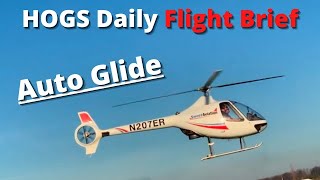
Kenny Keller and Chris demonstrate how to stretch an autorotation glide in a Cabri G2 by increasing airspeed to 80 knots while reducing rotor RPM to 480, extending glide distance and creating substantial float on landing. They explain why this technique isn't standard training and show the trade-offs involved.
Questions this video answers
80 knots airspeed and rotor RPM around 480.
Chapters
Depending on the aircraft you're flying, the numbers could be different and the methods might be different. But Chris is gonna show you how to stretch the glide in the cabri. So I'll let you take off. Take it from there. Chris.
Are we starting the next video ever?
Yeah, I think I started the next video.
I think you kind of just rolled into it.
Did I?
Usually you say, hey, we're back again.
With kidding, but hey, it's Hogg's daily flight brief. And I just now doing the intro halfway through the video.
Right. There you go. Perfect. Okay, so, yeah, stretching the glide. And I'll have to be honest with you, I do not. I kind of talk about it a little bit, but I don't really show it because I always. I think it's in the. It's in my brain or it's in, you know, the thought process. If I have an engine failure and I enter an auto, I'm pretty much going right here in the immediate area. So I have to be honest with you, I don't really talk much about stretching the glide. When you do an auto, if you slow down, you're loading the rotors, so that's going to build them up. If you push the cycling forward and you speed up, that actually slows the rotors down a little bit. In order to stretch the glide, we want to speed up. Okay, I know it sounds weird, but that's just how it is. So if we want to stretch our glide, we want to speed up, and we actually want to slow the rotors down a little bit. In the G2POH, they talk about stretching the glide, and they want you at 80 knots, but they want the RPM down at the 480 range, which is in the middle of the low arc. Now, remember, we're always talking about keep that RPM up, keep it in the middle of green, or keep it on the high.
We train it over and over and over and over and over. Top of the green, top of the green, top of the green.
Now, in the G2, we do have that wide, that arc there from the 12 o' clock to the 6 o' clock position. But most of the time, any type of auto you're doing, the RPMs go high. They're either in the high green or in the yellow. The high yellow. You don't really think about lowering or reducing RPM in order to stretch the glide, but that's what you do. So the PoH for this is RPMs at 480 and 80 knots. That will give you your stretching ability. So we're going to do that today and I have to be honest with you, I don't do it very often. So we're just going to have to see what happens. I'm not used to actually having to reduce rotor RPM unless I'm in that turn, you know, but I only reduce it a little bit but not as much as I think what we're gonna have to today. So we'll just, we'll see what happens.
Goshen Traffic Helicopter 30 tells about a 1 mile final on 5.
Goshen, what do you think? Is it something you saw all the time in instructing or anything? Because like right now. Well, I guess maybe it's just because of the field. I'm just thinking I'm going right there. But I guess in you know like a city or something, if I gotta stretch it to a ball field or something like you better be able to know how to do it.
I mean I think, you know, there's so many times that things come up when we talk about training where it comes up that why is this not in the pts? Why do we not train to this in a normal standard? And I'm sure there's a lot of people gonna go, well we train like that all the time. I'm great if you do. But yeah, it doesn't seem to be something that in the Midwest where we're from, this doesn't seem to be really taught heavy about stretching a glide. Well, I mean you might have to if you lose an engine and there's a spot that's farther, a little farther than you normally would go. But it's your only really good spot. Being able to stretch that glide could be the difference between walking away at the end or flying into a bunch of trees and having an accident and maybe losing your life. So I think understanding how to stretch the glide a little bit if you had to I think is a grand idea that I wonder why in our area why we don't teach it more.
Alright, so I think, I think somewhere right about here we'll get a little closer. I would enter it to hit the spot that we normally do. So let's see what happens if I enter and we stretch it. So here we go in three, two, one. Okay, so I'm going to keep the speed up. RPM is staying. I'm going to raise collective a little bit. There's 70. RPM's a little high for what they want. I'm going to raise collective up a little bit more. Keeping an eye that. There's 80. See now I got to burn all that air speed off. I'm on a float. Look at that float.
Yeah, we went quite a ways past ultimately. You stretched that quite a bit, didn't you?
Yeah, I think so. I mean, it's kind of weird because I was more concerned of. I mean, I'm scanning my gauges, but I'm really watching where my RPM is at on that one and watching my airspeed. I mean, I gotta be honest, that's the first time I've really completely done one on purpose, I guess. I don't know. I mean, we kind of.
Well, it's really. Yeah.
Oh, yeah.
We went. It's kind of.
We're way past where. I mean, we had that big float there at the end.
We're fighting to tell our.
Oh, go ahead.
We're fighting to tell about our. Our side of the story.
Let's do it again.
Okay. What's cool is what, like what you said first. You really done it in a while and really thought through the process. I was a CFI teaching us CFI pull down autos. I'd been teaching quite a while, obviously, when I was doing that. Right. And I think it goes back to. Because we're always taught top of the green, top of the green, top of the green, top of the green. Especially when we flew our 22s. Right. That really beat into your head. So when that pilot showed me I wasn't comfortable pulling the RPM clear down to the low side during an auto because of my training, my training scar that you mentioned. So when he showed it to me, it seemed very awkward. But then I saw the benefit of the low side of the RPM down to the bottom of the limitation, how much it stretched that glide. That's why I brought it up today, because it was just like, hey, let's talk about that. Because it's something that again, maybe we should be teaching a little more. Maybe we should be pushing that. We do S turns. We talked about that first. Sometimes you might need an S turn to get a spot that's close to you. You might need to stretch that glide in the real world to make a parking lot or an open field or whatever it is you're trying to get to. It might be your only choice.
Oh, here's another aircraft out there somewhere.
Goshen traffic helicopter three zero tilt on a right downwind five. Goshen.
Yeah. Look at our. You can see where the Snow's Disturbed on 5 on our both spots. Look how much we floated. See, that's another thing to think about when you stretch the glide like that, you're keeping that air speed up, but you're going to have to burn all that air speed up sometime.
Right.
So either your flare is going to be really aggressive or you're going to have to just do it gradually. I don't know. I'm eager to do it again.
Yeah, that's kind of cool. And it's kind of fun that we're, we're kind of experimenting here while we're, you know, exploring the topic.
Right.
Because like I said, we, I'm really thinking we should probably be doing more of this in regular training.
Yeah, well, I'm personal. Like I said, personally, I don't really think about stretching a glide too much. I just always think about, most of the time I'm thinking about that my best spot is probably right underneath me or just right, right in front of me. But you know, like here, if we had to enter, could we make it before those trees? Probably. But would it be better to try to make it over the trees? Well, how would we do that? You know?
Right. Absolutely. Well, while Chris is making a loop here to head back to the Runway to try one more down below, we have a helicopter maneuver guide based off the helicopter flying Handbook. It's a free PDF, something cool that you can download, you can just look at on your electronic device. Heck, you could print it off on paper if you wanted, make adjustments for the aircraft you're flying. But we made it courtesy of our operations manager, Brian Rutledge. Put it together, just something that's inside ground school for our members. We decided to give it away for free for anybody that just wanted a maneuver guide that they could take and look at and just have, you know, separate from going to the helicopter flying hammock and looking all the maneuvers. So I'll turn it back over to Christopher to do his next one. Go Traffic Helicopter three fairtels right. Big turning, final five.
See what happens here.
This morning we were kind of sitting around complaining about we are mid field the entering left downwind for Runway six Kirsch.
Oh, that's kirsch. I was what? But I know there's an aircraft out here.
So look how much fun we're having now when half an hour ago we.
Were complaining, oh my gosh, we even mentioned that anymore. I think it gave me a headache.
And now we're having fun.
Of course we're having fun.
Go two and a half miles.
Here we go in three, two, one.
Runway 09. Entering downwind.
Coaching.
Definitely felt a little light seat action there.
Trying to keep the speed up, trying to stay in. I'm adding a whole lot of left pedal rpm. I'm still trying to bring down just a little bit.
God, this is weird.
This just feels weird to me. Start my flare. Of course, it's gonna have to be. God, look at that float. Throttle's coming back in. I mean, that's definitely something I can admit that I would have to work on a little bit because I. You know, when am I gonna burn off that airspeed? That's when. I mean, you got a huge flow when you're riding 80 all the way down, and then you start to come in and start that flare. I mean, you saw him twice. It's all floating.
Yep.
That's weird. It's cool. Kind of neat, though. Something different to think about.
Definitely food for thought, man. Another tool in the toolbox.
Yep.
Which leads us to our next video that we're gonna do for you. Come back tomorrow, subscribe, and, like, click the bell and like the video today. Tomorrow, we're gonna talk about aft cyclic entry during your entry rotation. How important this is. There's. There is an actual accident report on a fatal EMS crash where the company was blamed for not giving him proper training for aft input at cruise speed. That's coming up tomorrow. But do us a favor. Subscribe to the channel, click the bell, go down below for a free PDF and give us some comments down below in the comments down below. Give us some comments in the comments below. Give us some love, man. Give us some love. We're working really hard to bring you these videos, and we're having a blast doing it, but we want to spread the word.
Right?
We have been happy that we've had at least two members said that they've been watching the Hogs Daily video and then discussing it. The students is discussing it among themselves and then discussing with their instructors what we've been talking about in the Hogs Daily Breed videos, which is totally what we want. That is, the idea is it's put out the food for thought, and you can like the idea, you can dislike the idea. You can adopt it. You don't have to. But creating the food for thought and the discussions that, like, just look at how much stuff we've just done in the last week or two where we're like, how come we didn't do that more? Or how come we've never done this in our training? Right? We're always learning. Always. Every single day. I swear to God. You taught me a couple things this morning that I'd never heard of before. I'm like, really? You can do that? Never ending, man.
It is. Come on. People like and subscribe.
Hell, yeah.
And if you want to know about our day, check out Chopper Guy 53 Instagram, and you'll find out why I got in the mood today. Yeah.
Go to Chopper Guy 53 and figure out the. What's Chris a bad mood for lunch today?
Yeah. Oh, goodness. All right, what are we doing? We go. Go around. You want to do the cyclic or you want to.
Yeah, let's do it. We're having. It's the fourth one on the list. We've had a good day. These are all, I think, really, really good videos.
Cool.
It's pretty outside, so we'll finish up with that.
All right.
And so where's that airplane?
One second.
Gosher traffic helicopter three share tells on a right downwind five. We'll be looking for that traffic.
I think he's on final. I saw him pass us when we were departing, but I think he's turning.










