EP 37 Autorotation Aft Cyclic Pull To Avoid Nose Drop & RPM Decrease
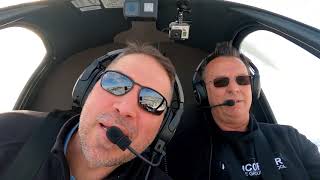
Kenny Keller and Chris compare autorotation entry techniques, focusing on whether to pull aft cyclic to prevent nose drop and RPM loss. They recommend entering a little faster than glide speed (around 72-75 knots to settle at 70 knots) and reference an EMS accident where missing aft cyclic input contributed to the crash.
Questions this video answers
Enter a little faster than glide speed — about 72–75 knots to settle to a 70-kt glide.
They commonly use 60 knots as a training glide speed (gives a safety cushion).
The POH from 'Gimbal' cites 50 knots for autorotations.
Chapters
You taught me a couple things this morning that I'd never heard of before. I'm like, really?
You can do that?
Never ending, man.
It is. Come on, people. Like and subscribe.
Yeah.
And if you want to know about our day, check out Chopper Guy 53 Instagram, and you'll find out why I got in the mood today.
Yeah. Go to Chopper Guy 53 and figure out the what put Chris in a bad mood for lunch today.
Yeah. Oh, goodness. All right, what are we doing? We gonna go.
Go around.
You want to do the cyclic or you want to. I think he's slowing down. All right, perfect.
Gosh. Your traffic copter three star tells come to over top the approach end of two. Seven on the right, downwind five. All right.
Yep.
Perfect.
All right.
Welcome back to HUG Daily fight Brief. And today we're going to talk about something that Chris and I, even though we trained together years ago, now we have a little bit of a different take on how we apply this, and we'll talk about that. So you get two different little bit different views, but we're going to talk about the need for. When you enter an auto rotation, you need an aft cyclic pull. And if you don't, the nose drops, RPM drops, and then you just start chasing the thing all the way down. Once you at the beginning of the auto, if you don't enter it nice and get a nice entry, then you. And one thing's off. Then you chase it all the way down. You're up and down with the collective or you're back and forth with a cyclic. So during the odd rotation entry, a nice small aft pull, I call it set the speed. Because what I do if I'm using 70 for a glide, I like to enter about 72, 73, 75, a little faster than my glide speed. So when I go down collective proper pedal, now that I'm flying two different aircraft, right? Proper pedal and a small aft cyclic pull, that brings me back to 70. It sets the speed, keeps the RPM nice, nose doesn't drop, and it makes for a nice auto rotation. And then I mentioned yesterday that there is an accident, an EMS accident, where the guy's traveling along at 120 knots or whatever, has engine failure at cruise speed, and they determined that he didn't apply aft cyclic, lost rotor rpm and I believe everybody died. And it's been a while since I read that accident, but that's a legitimate accident report that happened in ems. You know, the improper training from the company on what to do during cruise flight at that speed. Not giving him the proper training to make sure that you do the aft cyclic pull. So it's more than just a training aspect. If you have it in the real world, especially going faster than your normal training speed, you need to a small amount of aft cyclic to keep the nose from dropping and keep the RPM where it's at. Now, we try not to discuss this stuff too much before we go out for the day, but this we talked about a little bit today and you have just a little bit different view on the entry. So go ahead and give them your thoughts kind of where you've taken it in your training as an instructor.
If you watch previous videos, you know that I like to do real world stuff. I like to teach real world. So I know once you get your rating, you're going to basically be going from point A to point B and you're going to go from point A to point B at cruise airspeed. So why not practice your auto rotations or your entry into your autos at cruise airspeed?
Sure makes sense.
And the same with the altitude. I know that you're going to go 500ft above AGL or 1000ft AGL, whatever you're going to do. So why, you know why when you enter the auto, are you exactly at 500 AGL and you know, 60 knots? Because that's what we want during our glide. No, I want you at, you know, if you're going to go cross country at 1500 indicated, then I want to be at 1500 indicated and I want you at 80 knots or whatever your aircraft cruise speed is. 80 knots is what we use in here. So that's how I train. That's what I want them to train. And so I'm going to have a little bit more of an aft cyclic input then you would. Because I'm cruising at 80 and I want to back it down to 60 faster.
Absolutely.
So yeah, so it's just a slight little. And that's how I teach. And this. Down, left aft, down collective, left pedal aft cyclic. Down, left aft. Down, left aft. Down, left aft. And if you have to make a turn, down, left aft turn. So that's, that's how I get it. Get it in there. And so today we're just going to set up for a straight in auto and you're just going to see I'm here. I am cruising at 80, I'm at 1600 indicated. Down, left aft. And then just get your scan going.
Goshen Traffic Helicopter 3 Serotel Dive 1 mile, Final 5.
Goshen.
And then maybe after this one, then maybe we could do one where you don't use aft and see what happens. Or let's see, we'll pick up this aft after you get done doing your thing here.
All right, clear on the left. Everything's looking good. Here we go. And 3, 2, 1, 1, down, left aft. Looking for that 60. And in this. This aircraft's going to slow down anyway. So you're just. Actually, you may just be adding just a little bit of input. So you have now gone through a little bit. I'm just going to push forward a little bit. Here comes my treetop level. A little bit of a flare. Little bit more flare coming back on and pedaling.
So what I noticed was because you went from 80 to 60, your nose actually came up.
Yeah.
Which is a good thing. Right? It's better going. It could be almost like it also.
Loads the rotor, so it keeps your RPM up there. But in this aircraft, I don't know. It's kind of strange, I guess, because I don't. Never happened. In the interim, when you enter the auto, this thing automatically slows down. It just. It just does. So, you know, you're just applying a little bit of aft pressure, a little aft cyclic to bring your speed back. But, you know, the tendency of overdoing is great with a student because they're just learning. But. And that's. And that's part of. We've had this discussion before. That's part of the reason why I say 60 instead of 50. And I will tell you, the POH from Gimbal states 50 in their autos, but I like to use 60 because guys get slow. So if you shoot for 60, you may end up at 55, you may end up at 50. Hell, you may end up at 40. But at least 60 gives you little bit of cushion there, and you can always burn that speed off.
Can we go do one with. And not use any aft and see and how different it would be from what we just did?
Yeah.
And to touch on a point that you made either while we were flying or before about the. Yeah. If a student. You said it earlier, if, let's say 60 is the number you're using for your training aircraft, you'll. You'll get students that, like, they want to enter the auto at 60.
Yeah.
And they want to glide at 60.
Right.
It doesn't work if you have an aft pull because you enter it, and then when you get that little bit of half pull that you need to keep the nose from lowering, then you you're pulled back. So let's say you just went from 60 to 55. So then you go, oh, well, I'm a little slow. I need 60. Pull it back forward. And then they hit 65 and then they go, oh no, too fast. Then they pull it back. And that's why I'm saying how they'll see saw with the speed. If you don't have the nice entry, you don't pull the aft. The nose goes down. Then you start monkeying with that cyclic and then you still might start monking with the collective tube.
And it's RPM goes.
So then they pull up, they pull up too much. So what do they do? They go down too much. And as a student, that's normal. Yeah, everything's gonna, everything's gonna be exaggerated.
And it's all about muscle memory, you know, so. And that's again, it goes back to why I like to be at 80 when I do it. Cause you want that muscle memory of aft cyclic. If you enter the auto at 60, then you don't have that muscle memory. Or if you entered the auto at 60 and still pulled aft cyclic, now where are you going to be? You're going to be at 40 or 35 or whatever. This thing slows down by itself. So that's why I like to use that 60 because students get slow and the aircraft automatically slows down.
In the event of that EMS pilot that was killed along with his crew, if he would have done the afic pull accident probably wouldn't happened. How do they know? I don't know. I'm assuming computers on board. How did they exactly determine when they're all dead? I don't know how they determined it, but that's what the accident report said and that's how it came out that they determined that. Well, high forward speed engine failure and, you know, he's busy in the cockpit or whatever. We don't, we don't know.
We weren't there such a thing as, you know, airplane people don't realize this, but, you know, we actually have a vne power off. So maybe if you're already at high speed your cruise flight, you have an engine failure, you don't slow down, you could be pushing your vne power off speed. So that could have been a factor. I don't know. I think I've heard of the accident you're talking about, but I have not read any of it.
I remember distinctly because it came up, I believe, in our EMS training when I was still in EMS and we discussed it at length. So I know it's a legitimate accident that happened.
All right, so this time I'm going to enter the auto, and I'm not. I'm just going to try to maintain our airspeed where we were, not pull aft cycling. But I think you'll see that this aircraft, that nose comes up and even.
Even without an aft.
Yeah. Okay. I'm going to really try because now it's, you know, it's in my brain to pull aft, so I'm going to really try to keep that cyclic right where we were when we entered it.
Goshen traffic copter three zero.
Tiltona. Right.
Base turning final five, Gaussian.
All right. Everything looks good.
Yeah. I'm still new to the Cadbury, but I know other aircraft I've taught in, it's more pronounced. If you don't do an aft pull, you actually legitimately notice the nose drop a little bit. RPM drop.
I think the way it's set up, that nose actually comes up, and that's why. So I'm going to try to hold it there. Bird 80. And I'm going to really have to think about not pulling back. Clear on the left. Make sure nobody's coming down. I don't see anybody.
Clear on the left.
All right, Here we go. In 3, 2, 1.
Aha.
It so does. Look at that. Yeah. So maybe that's what it is, part of it. So it did. That nose dropped and you see the rotor RPM came down.
Yep. Oh, it was immediate.
Yeah.
I mean, it was immediate. That nose went.
I wonder if I was kind of pushing forward, too.
Well, you might.
I don't know. All right. There's a little bit of flare.
I suppose that's possible.
But it did kind of. It did.
I was expecting. I was expecting to be surprised and go, oh, yeah, you're right. The nose didn't really drop.
But it sure it did. I was like, surely did it drop? And maybe that's. Maybe when. When students enter the auto, they're pulling aft cyclic, and with the aft cyclic along with the nose coming up, it just. It's more pronounced with that one. I was really trying to keep cyclic forward so we kept our airspeed, but. Yeah, you're Kenny Keller.
Yeah.
That nose kind of came down, didn't it? We just kind of died. But did you see that rpm? I was surprised by that rpm, too, right away.
We got the low horn right away.
That was kind of learning something new every day, aren't you?
I am. And it's just fun to go out and it's fun to talk about this stuff and then go out and test it and see how it directly affects one particular aircraft. Yeah, you know. Well, you know, I guess we're just gonna have to go in because we're having way too much damn fun. I mean, you gotta quit while the fun. I mean, we're having such a great flight. I think we need to call out a day and go in because you.
Think I can do enough landings out here. I can write my name, probably.
I'm sure you could.
Maybe I can get chopper guy 53 out here ripping on the snow.
That would take ya. That would. I bet you'd take. I bet you'd take damn near an hour to print out with your skids. Chopper guy 53. Because you'd have to do the. Because you got two skids. It'd be like an outline. Oh, yeah.
It'd be like a thick lettering stick. Two lines.
C H. That would take you a while.
We got nothing but time.
Let's just burn a chopper guy 53 in the snow.
Can I use my skid for my skid tail? My stinger. Can I just.
You can just drag the stinger. Or if you were really good, you could just put the aircraft off center and just use one skid to write Chopper guys.
Oh, yeah, yeah.
Goshen Traffic Copter 3 Sierra Delta departing 5 left. Traffic will be on a left downwind niner. Goshen. I'm sure it would work on television. You know what we need to do? We keep talking about we should do something sitting around the office. We need to do what you see on YouTube where vocal coach reacts to the Judas Priest heavy metal singer. Or you see, you know, a lot of airplane guys now. Airplane pilot dissects airplane landing on tv. Oh, yeah, we need to do helicopter pilots dissecting landings. You see on TV and movies where we're sitting on the office, we got some beers and we're going, hey, look at this guy taking off. No hover check, right? Oh, he, you know, did this. Look at that nose down profile on his.
Maybe like a G2 on TV, but it sounds like a Huey.
Yeah, yeah. We could make fun of that because that happens.
Well, they're always Hueys. It's always a Huey that you hear on tv. Now, don't get me wrong, I love the Huey. My dad flew Hueys for 20 years. But there's other sounds than a Huey out there a helicopter makes. You ever heard of 407? That's a completely distinctive sound.
How about the helicopter always goes over the mountain before you see the explosion. Right, because they don't want to toast a quarter of a million dollar helicopter or a million dollar. So why the helicopter over the hill? You can't see it. And then there's an explosion, a huge explosion. Oh, gee, that's. Yeah, we know. The helicopter really crashed on the other side of the mountain.
Way too much fun.
It's good to hear all the frustration out before we went flying because I. Because I thought I was worried that we'd have a bad flight, but because we right for.
Oh, you're not supposed to tell them that. Don't bleep it. They gotta bleep all that out.
Yeah, I'll believe it.
Let's just say we went somewhere that started with the C. They usually are known for ice cream, but they really screwed up my sandwich.
Hell yeah, I heard it. I heard a couple jokes yesterday. I was trying to remember them so I could tell you on camera and I can't remember the joke.
I get the morning corny from how do ghosts listen to music?
I don't know.
By Bluetooth, of course.
Oh, God.
Oh, that's funny.










