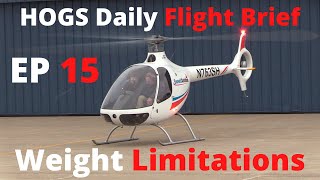
Kenny Keller explains why helicopters and aircraft have weight limits for pilots and passengers. Some EMS jobs require pilots under 220 pounds in full gear. Airlines use 180 pounds per passenger plus 20 pounds for carry-on when calculating weight and balance.
Questions this video answers
January 27, 2021
220 lb (with full gear)
180 lb (per person) — presenter also cites ~20 lb for carry-on luggage
Chapters
Foreign.
Welcome back to Hawk's daily flight Brief. Passenger, pilot and weight limitations is what we're going to cover in this flight today. I'll pick one and I'll let you pick the other and I'll just randomly pick passenger and I'm going to use the, the example of helicopter rides in the summertime. Okay. We have weight limitations on and in a helicop we have a total weight. We can have seat weight, we gotta figure fuel for the day, pilot weight, and then you got the cockpit size. Okay. This is a very, very touchy subject. That's not really touchy because it's. I guess what I'm trying to say is sometimes you feel bad when you're at a fair and whether you're the pilot or you're the person helping loading people, it's, it's, it sucks to tell somebody that they're too heavy to go on the flight. Okay, let's just put it that way for on our end of it, we hate that. Yes, but we are held to limitations on the aircraft and that is law. This isn't just a made up number. Just not what someone says. We have to abide by the limitations of any helicopter. Seat weight, total gross weight, weight and balance for loading the helicopter. Those are all factors in the average person. If you just happen to be watching this video, just know that we, sometimes we have to say no to a person and that sucks. But it is due to a weight.
Limitation and it's all about safety.
And it's about safety.
Right. It does. Not to interrupt, but it does affect the aerodynamics of the aircraft.
Exactly.
So.
Exactly. So, Chris, why don't you take pilot weight limitations because we know we get the questions. Well, how come the pilot weight is.
Like 220 and that is also due to the limitations of the aircraft. C2 does not have a seat weight. Okay. So if I want to put a. And I'm just going to throw it out there, if I want to put a 350 pound person in the seat, I can do that. Now the part of the issue is having a larger person in a smaller cockpit, especially if you're doing instruction, is you've got to have access to all the controls.
Exactly.
So I've got to be able to have the full range of the cyclic, which is the one that controls front, left, right, left and right, along with full range of the collective which controls our up and down. If I can't have full range of those, then technically I can't control the aircraft the way it needs to. Be controlled. So the G2 does not have a seat weight, but there's a point there where you have to kind of say you may want to train in a bigger aircraft. Now, the Robinsons, they have a seat weight and that's because of their design, and that's the Robinson's thing. Now you also see where, like, you know, looking for a commercial job where you might see some EMS positions, they state right in their qualifications, pilot cannot weigh more than £220 with full gear. Right. And again, that comes all back to. Because let's say ems, they want to have as much weight as possible for their passenger being. Well, they're, they're victim, let's say, or their person that they're transporting. Yes, you would know more about that.
They take a lot of equipment.
Yes, there's a lot of equipment on board. Plus you got a, you know, your fuel that you got to get from, you know, the, the scene to the hospital, et cetera, whatever. And that's all because of that. And you know, you've, you've told me before you've worked ems, that you've actually seen where the crew has left equipment at the seat because the, the victim is bigger than what they said. Yes. And because of the weight, they got to leave equipment there and they got, you know, they'll come back, the EMS or the ambulance crew will get it for them and you'll get it later or whatever. But it's all about, it's all dynamics of the aircraft and number one, safety. And don't think that we're the ones, we're the only ones that do this. You know who else does this? Commercial airlines. You may not know this, but commercial airlines. So you go and you decide to fly to Florida today on Delta, they actually do a weight and balance. They actually, they don't get out there and weigh you with a scale, but they have a formula. They say the Average person weighs 180 pounds. I've got 100 people on this flight plus, you know, each one's got a carry on luggage that's probably weighing 20 pounds. Whatever it is, is, they do a weight and balance. You don't see it, but they do it. And sometimes you actually hear the crew say, hey, why don't you sit up front? Because of our weight and balance. And that's what they're doing. It's all about aerodynamics of the aircraft.
Absolutely. Great question. And again, it's physics and it's limitations set by people other than us.
Correct.
Sometimes they don't seem fair. There's nothing we can do about it.
It's all about safety.
It is. Hey, we got a free helicopter maneuver guide down below. It's free. Subscribe to the channel, click the bell. Let us know what you want to see in upcoming videos. We've got another one on the list, and then we're ready for some more. Put your comments down below. We'll see you tomorrow after you like and subscribe. Peace out.