Ground Resonance- Ejected and Survived, I Never Gave Up
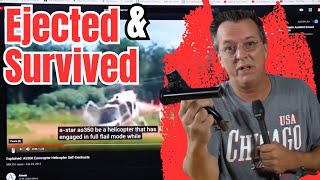
Kenny Keller survived a 2004 helicopter crash caused by ground resonance that ejected him and destroyed the aircraft. The tailboom separated 50 feet in the air, the skids collapsed, and the fuselage scattered across the ground. He shows the bent pedal and cyclic that survived and urges pilots of fully articulated helicopters to study corrective actions in the Helicopter Flying Handbook and their POH.
Chapters
I was still doing everything I could to try to stop it. I was trying to stop the aircraft from spinning.
Hey, we're gonna go back and revisit some Coffee with Kenny videos. And the first thing we're gonna do is ground resonance. If you're flying a fully articulated helicopter. Have you thought about ground resonance lately? Have you ever seen ground residents? Any videos of what happens? We're gonna cover that here in just a minute. Just for fun, to revisit a Coffee with Kenny video on ground residents. But first, we want to tell you about memorial weekend sale that ends Monday night at midnight. Normally, our monthlies are $97 a month. That's on sale now. Half price, 50% off.
4850.
And then our yearly is normally 697. That is 50% off until Monday night at midnight, 348.
50.
50% off. Then we have a private pilot lifetime membership where you keep it. It'll be there for as long as you need it. That's normally 997. That is on sale for 498.50. And then the pro pilot, where you get everything. Private pilot, commercial pilot, instrument pilot, certified flight instructor. You keep that as a lifetime access. That is normally 2,800. Marked off to 1400 with the code memorial50. You can go to helicopterground.com, type that code in the coupon box for any membership and then it will show you the discounted price. And that monthly, that 4850, that's as.
Long as you keep it.
Whether you keep it a month, two months, six months, a year, you will.
Stay at that 50% off.
So let's get to the ground resonance video.
In 2004, I was ejected from a helicopter suffering ground resonance. I don't have a video of it, and it's probably a good thing, but I want to talk about it real quick today. Ground resonance. And I just want to make sure if you're flying a fully articulated helicopter that you've reviewed this recently and this is on your mind because this could happen to you. And I do have a couple of visual aids today. Here's the pedal that came out of the aircraft that I was in when it was destroyed from ground resonance. And this pedal is bent. And I even spoke with the engineer from the manufacturer and they think I bent it. When we were trying, when I was trying to save it, even though I knew in my mind it was going to destroy itself, but I was still doing everything I could to try to stop it. I was trying to stop the Aircraft from spinning. So moral there is. You know, you do fly that thing all the way to the crash. You fly it all to the very end. And I will tell you, my law enforcement training came back probably more than whenever I was a cop where they taught us in the law enforcement academy, you never give up. No matter how bad you're hurt, shot, stabbed, whatever, beat up, you never give up. And that was ingrained in me as a young police officer. And I remember that day, as the helicopter was destroying itself, I can remember thinking that. Here's cyclic two, by the way. All right, let's take a look at the video. I'll make sure about the link for this video down below in the description box so you can see the video yourself in full on YouTube if you like. I will tell you, this is probably the most similar I can think of to what happened to us that day, except ours was even more violent than this. So let's just watch the video. Cool thing is, everybody appears to get out and walk away. The difference in ours that day, it went on longer than that. The tailbone completely separated from the aircraft and was thrown, saying probably 50ft. It was amazing how far that tail boom ended up out away from the aircraft. Our skids were completely squatted out. I can't think of a good term for it, but, I mean, the belly of the aircraft was on the ground. All of this was completely gone, scattered all over the ramp. And I was ejected this direction. Owner of the aircraft, who I was training was, was ejected this way. And then in the backseat, a young man that was one of my students was in the back, and he was strapped with what was left of the fuselage. And again, I. In a way, I don't know if I'd want to see a video of ours from that day, but everybody was on the ramp, all my friends and coworkers. So after the fact, you know, we. I did, of course, talk to everybody about it. The pilot, the owner aircraft was ejected out to this side. I was ejected out that side. And I remember the aircraft starting to destroy itself. I remember trying to stop it. I remember thinking about my family and thinking that I was, you know, going to lose my life in this crash unless I could either stop it or be thrown clear. I was concerned about being thrown through the Up. Through the rotor system because of that violent bouncing up and down. I was worried that that's what was going to happen to us. Again, I want you to refresh your memory on ground resonance. If you're already flying and you're flying A fully articulated. And you haven't reviewed it for a while. Go to the helicopter flying handbook and review this. And of course, if your manufacturer's PoH Pilot's Operating Handbook or flight manual has anything, make sure you know it and make sure you understand what to do in the event of ground resonance. And I want to roll it again. We know that when we got ejected, it went flying again after it threw us out. So we get ejected, the aircraft goes back up into the air and at some point comes back down, luckily doesn't crush either one of us because we're laying on both sides. And I remember opening up my eyeballs and I couldn't see my buddy in the back because of the fuselage was turned away from me, but I could see the legs of the owner on the other side. And it's pretty technical, you know, reasonings on what happened. I'm not going to go into all that because it's, it's even beyond what I understand. So the point I want to make is if you're flying a fully articulated aircraft, make sure you understand the corrective actions. And of course, on pre flights, you're really looking at things like your dampers in the rotor system, your oleo struts. Of course, you know, a good pre flight is something we need to do anytime on any aircraft. But when it gets into the ground resonance, you know, it can involve the struts, it can involve parts in the rotor system. Again with different makes and models. Of course, there's a lot of reasons why something could go wrong. And again, I'm not going to go into that now. I have to say, sure, it's part of my history, right? So I've worked through it, I've lived through it. It's part of who I am today. And maybe it's saved my life at some point since. Who knows from me being conservative and cautious. And I'd been flying many years. And a few years ago somebody said, well, you know what they call you? And this is for the people that I fly with in the area. They're like, well, they call you Cautious Keller.
And I'm like, really?
I didn't know that. And this pilot says, yeah, you're Cautious Keller. And I'm like, well, I'll take that versus, you know, yeah, that guy will go fly anything and he's crazy and will do anything crazy. So I'm okay with being called Cautious Keller. So again, you know, we know we learn through our experiences, right? So again, I just want to relay ground resonance. If you're flying a fully articulated system. Make sure you know what items you're looking at on pre flight. Make sure you talk to your instructors about this. Make sure you understand what it says in the Helicopter flying Handbook. Make sure you know anything that might be in the Poh Pod separating handbook from your aircraft. Just knowledge, right? And make sure that if you're flying an aircraft susceptible to this, that you know in your mind what to do.
When you feel the pressure to fly, but know the right decision is to stay on the ground. Hit the hogs no go and live to fly another day. Helicopterground Com.










