Helicopter Check Ride Part 12 Aircraft Icing
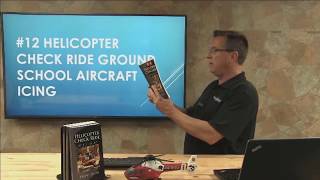
A Kenny Keller YouTube video (Helicopter Check Ride Part 12 — Aircraft Icing) in which he answers pilot questions, promotes his membership, then presents a ~7–8 minute segment of personal anecdotes about encountering airframe/windshield icing. He emphasizes avoiding flight in marginal temperatures (examples given: ~39°F and a case at ~36°F), discusses employer/peer pressure to fly, and advises conservatism. He also touches on aircraft-type relevance for hiring/training (Enstrom, Schweitzer, Robinson, JetRanger, R22/R44) and mentions a colleague Lorenzo (about 800 hours) and tuna-boat turbine-time opportunities.
Questions this video answers
August 17, 2017.
About seven or eight minutes.
About 36°F.
Around 39°F (close to freezing; can ice at temperatures above 32°F due to altitude/cooling).
Around 800 hours.
Chapters
Icing. So I'll go back over here, answer a couple more questions real quick. A couple of pretty good ones. I was just reading, took a little break, got something to drink. And does it seem to make a difference in applications for jobs about which school you go to? I don't think so. I really don't. I mean, I don't think that that's where you need to worry about. I mean, study hard, be good, strive to be the best. I don't think the school, I mean, unless you went to some school that just has a really horrible, horrible reputation. But in general, I don't think going to get your job, they're going to look at your qualifications. They're going to probably fly with you. They're going to look at the totality of the circumstance, look at the big picture. I don't. I wouldn't feel like you'd be held back over one college versus another. I don't think that's that big of a deal. This is my opinion. Or do hours and type of aircraft make more of a difference? Absolutely. If you're going to fly all, you know, you get all your ratings in the Enstrom and you go get a job in a Robinson that's not going to work, or vice versa. You know, you need kind of an idea of what aircraft you're going to fly, because insurance companies always want you to have a certain amount of time in any given aircraft or any specific aircraft. So that's where you kind of need to look. I jumped around in my original training between Schweitzer, Instrom and Robinson. Now it took me a little longer to get my private because I was jumping around, but in the end it was good because it opened up some other doors. I did my ratings in the Robinson, but I was also flying the Schweitzer and flying the Instrum. So then once I was a cfi, you know, the one company said, well, we want you to have at least like five hours of instrument time. And I did. I had like seven or eight. And then the Schweitzer, same thing, same school. They went from Enstrom to Schweitzer. They're like, what do you got any Schweitzer time? And I said, yeah, I had like 30 or 40 hours or whatever I had training in the Schweitzer. Oh, okay. Well, good. No problem. So you do kind of, kind of need to look forward. And that's not an answer or a question. I can give you an exact answer to where you want to look at. Am I going to be Flying in an area that has a lot of R22s and R44s, you're probably going to want to go that direction. If you think you're going to want to go to work for your first job, somebody with an Enstrom or Schweitzer, you might want go that route. I recommend getting, you know, as much time as you can in different aircraft. So, yes, it can play a role. I have a question. Would you recommend a pilot interested in EMS to avoid gaining your turbine hours flying for the tuna boats? I can't really make a good, honest evaluation on that because I have never flown tuna boats. I don't know that much about it. I know that one of our members, Lorenzo, that some of you may know or heard of, Lorenzo, is one of my longtime members who started out, came over here, was learning the language, using helicopter, all in ground school to learn the information plus help learn the English language. Got the privilege to meet Lorenzo at heli expo this year. Went out, had a few beers, had a great time. Him and a couple of his CFI buddies were there. Lorenzo just went to fly the tuna boats and he was all excited because he's around 800 hours and he's like, what do you think, man? I'm like, hey, it's turbine time. You know, if you think you can, you can go for it, do it. And he'd already researched and he knew the type of lifestyle and he'd be leading as far as how many days on the boat and so on so forth. So in this business, getting that almighty time in general and getting that almighty turbine time is so precious, I can't give a good. I don't know what else to say about the tuna boats other than that. I don't know why flying a tuna boat would make a difference later with ems, I don't see that as being a problem, but that's really kind of answering that one to the best of my ability. Thanks for the coupon code and the answers information. Absolutely. Put that code to use. Sign up and get started with us. Interact with us inside the online membership site. We've got a Facebook page we're going to be releasing for just members only, where members can get in and communicate with each other. A lot of great things going on, lots of great new content coming out, all kinds of cool stuff happening. So we're getting near the end here. Everybody's got things they want to do. I know I'm getting tired icing. This is about seven or eight minutes on some dumb icing mistakes. I made. I'm gonna go ahead and roll that because icing is something that you do not want to mess with. You want to avoid icing at all cost. So I'm gonna roll that now. Keep the comments and feedback coming and we'll see you in just a bit. The first one was when I was a younger pilot, a new pilot, and we were going out on a news call and they were calling for possible icing conditions later in the day. Going back. Now, I know what I did was stupid and it was a stupid move. We got a call to go south of the city where I was flying and I'm looking at the weather going, well, the icing isn't for several hours yet. I'm thinking, you know, this is an accident. We're going to go out, do some quick filming of the accident, and we're gonna come back in plenty of time before these icing conditions start. So we're pulling the helicopter out and the line guy who was fueling us was also a camera operator that had been flying with us for a long time. So he'd been in and around helicopters and aircraft and, you know, he knows what goes on around the airport. When we're pulling the helicopter out, he kind of looks at the sky and looks back at me and, you know, I felt a sprinkler too. And he kind of looked at me and I go, yeah, I know. You know, icing isn't supposed to happen till later. You know, it's forecasted for later in the day. So hindsight being 20 20, I should have never left, you know, but being a young pilot and being kind of cocky, you know, I guess I decided I could get out there and if we got into some kind of trouble, I'd just try to come back. You know, that was my attitude. So we take off and we get flying to the south and the cloud layer starts coming down and the visibility starts coming down and I noticed some rain on the window. Well, it doesn't take long before I figure out these raindrops that were moving, they stopped moving, they're not moving anymore. So pretty quickly I realized, I think this is turning to ice. So needless to say, I turned around, start heading back home. And before we get back, I can barely see out the front windshield. So we're over a big field and I make some right hand circles. I'm looking out the side window so I can get on the ground safely. And we tried to decide what to do. So we cleaned the window off and there was a little airport, like a mile or two away, and we decided to go ahead and hop on over to that airport. We probably shouldn't have even done that, but didn't want to be stuck in a field, so I should have just stayed in the field. But we made it over this little airport, and the aircraft ended up sitting outside for three days. So that's pretty embarrassing. Everybody was fine. We didn't get hurt. Nothing bad happened. But then there's the embarrassment of, why did you go out anyway? You knew there was icing forecast later in the day. I didn't get in trouble. The boss was cool, and he said, well, at least you landed and nobody got hurt and everything was fine, but use your brain next time. That was my first experience that really made me think about how you really cannot mess around with this icing. And it's pretty scary when your windshield starts icing up, and all of a sudden you're going, hmm, I cannot see so well. So, you know, it happens so fast. It's just how guys get themselves into bad situations. So there's icing number one. The next story, or the next thing I want to tell is us flying a jet Ranger and flying in Northern Ohio, and we go down to West Virginia to pick up the aircraft after some maintenance, and we waited a day or two for it to get ready, and the helicopter's done, and we're getting ready to head back, and it's snowing outside, and it wasn't heavy snow, but it was snowing, and I'm not thinking that much about it. Visibility is pretty good. And of course, I'm getting pressured from the guy I was working for, you know, calling you every 10 minutes. Are you heading back yet? Are you heading back yet? And, you know, there was a lot of pressure there. So he's paying for the motel, you know, and he's paying us to be there. And, you know, he wants his aircraft back home, which I understand that I owned an aircraft, and I know what it's like. So you want to get the aircraft back home. So the aircraft's all done. We're getting ready to go. And there's this gentleman there who had an office at this maintenance facility who used to work for Bell Helicopter. And we get talking, and, you know, I'm a new pilot and new. The jet Ranger. So he's looking outside and looking at me, and he's like, you sure you want to do this? And I'm like, well, why not? It's just a little bit of snow. And he's going, well, do you have the Snow kit. Do you have the baffle kit? And I'm saying no. So he proceeds to tell me about the snow baffle kit for the Jet Ranger and the company I worked for. They didn't have a the snow kit at the time and nobody used it. And people just went out and flew in the snow and didn't think anything about it. So this gentleman proceeds to tell me how many years he worked for Bell Helicopter and he had a really impressive resume. And he goes, you know what? He goes, I know you're feeling the pressure because I know the guy that you're working for. And you know what? He goes, I'm just going to call him myself because I don't think you should fly. And once we talked about it, I said, hey, you know what, I'm going to take the advice of a pilot's been around a long time. You know, he calls him up and tells my boss that he encourages us to stay there for the night. And everything ended up okay. We went home when it was clear the next day. So then my third story. Having a couple of first hand scares, then learning a little more about the dangers of icing and exactly what this bulletin was talking about. I move into the helicopter EMS world and by this point I'm pretty respectful of the whole icing thing. And anytime the temperature is really close to freezing, I was concerned about turning down the flights because the temperature could be a little below freezing or could be a little above freezing. I think particularly it gets guys in trouble when it's say around 39 degrees. Well, yeah, it's 39 degrees on the ground, but as we go up in altitude, the weather gets colder normally. And the speed of the blades moving through the air makes the air colder too. So you can get icing prior to 32 degrees. So I can think of two instances specifically where I turn down a flight due to possible icing. We had light rain, it was close to freezing, and I said, nah, I'm not going to take it. And I took some flak from the companies I was working for. And the interesting note is on both of those flights, later in the day, another helicopter EMS company who accepted the flight had to land in a field. One was by a landfill and one was out in the boonie somewhere. But it doesn't really matter. Both of these flights I turn down another helicopter, EMS takes them, they go out and get an icing and they got a land. So that gave me the confidence to just be able to say, you know what, it's close to freezing. I'M not taking it, you know, I'm not comfortable with this. So you just have to know when to say no. And sometimes you're going to be pressured, you know, and there might be a time where it cost you your job, you know, you just never really know. So this is something you really got to spend some time thinking about, and you got to be conservative. So the last one I want to give you is in the EMS world, the last place I was working, the lead pilot, he was about my age and, you know, he'd been flying for a long time, flew in the military, and he was really sharp pilot, and he was a good pilot. But there was one night where the temperature was like 36 degrees and we had light rain and I turned down the flight. The next day, he's like, and he's a base manager, by the way. He says, oh, why'd you turn that flight down last night? And I said, well, it's like 36 degrees and the weather was. And the temperature was going to drop. And he's like, oh, there's no problem at 36 degrees. I'm like, okay, well, you know, go up three and a half degrees per thousand feet, and it gets colder and we're flying at night, you know, at least 1,000ft. AGL wasn't really sure why he was questioning me about that. So then a fellow pilot I was working with was an ex Coast Guard pilot, and I asked him about it and he said, are you crazy? 36 degrees and raining? No way. He goes, I wouldn't take it either, not with the temperature, especially coming down. So just to kind of give you an idea that some people are brave and bold, some are conservative. You know, the same individual I'm speaking about, you know, him and another pilot that both been there forever, they kept repeatedly going out and getting themselves into icing conditions. So, you know, I'm the guy turning on the flights, and then I'm Mr. Conservative and, you know, kind of upsetting everybody because I'm so conservative. But then these guys are going out, taking flights and getting icing and having to land. So, you know, what I'm getting at is icing is nothing to mess around with. In any job that you go out to, whether it's ems, flying, law enforcement, whatever, all across the board, there's always pressures put on us by the places we work and the people we work for, and then there's the pressures that we put on ourselves. So it's always to be better on the ground wishing you were in the air than being in the air, wishing you were on the ground. And I can tell you that firsthand. You know, I've had some other scares along the way, so that's my spill on that. So, you know, be careful, make good choices, be conservative. And please leave comments in the box below. So we'll see you in the next video. Make sure you like subscribe comment. Thanks. See you later.










