Helicopter Check Ride Secrets: Top Ten Tips from a Pro Examiner
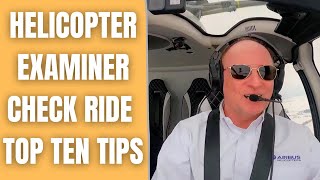
Randy Sharkey, a helicopter examiner, shares ten tips for passing your checkride. Show up on time and dressed professionally, know your emergency procedures cold, and have your iPad backed up. Study the PTS and any knowledge test topics you missed.
Questions this video answers
November 23, 2022.
Advisory Circular 61-65H (dated August 2018).
FAA Form 8710 (applicant and examiner logins in iACARA).
About 45 minutes to an hour (temporary password process).
Chapters
Look great, guys. Ready to go?
Yep.
Scotian Traffic Helicopter 502 will be part of the east hangars with departure off to the southwest.
Goshen, what everybody's been asking for right here.
Everybody always wants tips for a checkride.
Here you go.
Hey, Kenny. Welcome aboard, Chris.
Good to have you.
Chris, why don't you take the controls.
And top 10 pet peeves.
Pet peeves for DPEs. Just a disclaimer that I want to make, Kenny, is that today's recommendations and suggestions are based on my observations and just mine only. So I hope they're helpful. You know, that's the idea. That's why I'm here. And please understand that these suggestions and recommendations are by no means mandated by the FAA. So one of the 10 pet peeves that I have is this comment right here. Get. Man, I wasn't prepared for the winds. That is one of the most common statements that I hear during a check ride. Man, I just wasn't prepared for the winds. So having said that, Kenny, I just want to let your your fans know, your followers know to make sure that their instructor flies with them even on the windy days, even on the gusty days. Because depending upon the instructor that day, he may not give a lot of grace. Helicopters are not like airplanes where airplanes do have a crosswind component limitation. We don't have that crosswind component because we are always into the wind.
And that is timeliness. If your appointment is at 10 o' clock in the morning, that doesn't mean you should be walking through the front door at 10am that does not mean you should be landing at 10am what that means is you should be in the room. You should be in the conference room, the classroom, wherever. You have set up this appointment at least 30 minutes in advance, maybe even an hour in advance. And Kenny, that is where you want to have your books, your maintenance logbooks, your far aim, everything properly organized in the room so when that instructor walks in the door at 10 o', clock, you are ready to go. Number two, timeliness. Number three, Kenny, is dress for success. Sure, you've heard it time and time again. I've had have had applicants show up and everything from shorts to suits, shirts and ties. I've had a few guys show up in shirts and ties. That may be just slightly overdressed, but my thinking is that you probably don't need to wear that three piece suit at the same time. I would not show up either in the beach attire. I'm not talking about flip flops, or I am talking about Flip flops. I'm talking about shorts and your favorite T shirt that you got from Oshkosh. So maybe, maybe a casual dress would be appropriate. Khakis, a pullover, golf shirt. But I guess the one thing that I just want to try to get through on this one, Kenny, is you can't buy a second first impression. You can't buy a second first impression. So it's pretty easy. Just dress accordingly. And part of the battle is already over with. It is one of the most difficult ones, and that is to relax. Probably one of the biggest obstacles that everyone has on checkride day is overcoming anxiety. And I get it. You know what? I take checkrides. I have to take checkrides with the FAA probably once or twice a year as part of being a Czech airman on a 135 certificate. So I get it. I get nervous too. I've done it over. And so what we have to do as examiners, Kenny and Chris, is to help the applicant relax. We have to help them calm their nerves. Because we know as examiners, if they are relaxed, they will do a lot better during the questioning. So a good examiner will help the applicant relax. A couple of tips that I would give you to help you relax is don't tell the world that you're taking a checkride on particular day.
I like that.
Probably the less people you tell, then that is the least amount of people that you'd have to go back to and say, oh, man, it just didn't work out like I hoped it would. So just don't tell the world. Secondly, take the position that the examiner is there for the same reason that you were there, and that is to get that certificate that day, to get that rating that day. My position has always been that we're both here for the same outcome, and that is for you to pass today. So you have to prove to me a reason why I shouldn't pass you. Otherwise, somebody's already recommended you. A guy like Chris, a guy like Kenny has already signed your log book and said, hey, this guy is competent and he is ready to pass today's checkride. So again, tip number four, Relax. We are on number five. And I really feel that this is an important one as well. And it is. Knowing your equipment is essential. Basically, just know your helicopter. I've had a lot of cases where guys and gals have shown up and they've had to change helicopters at the last moment. Maybe it is as simple as changing from the same make and the model just a different year. All the way from an experimental to where they have had to go from their own aircraft, because I can't do experimental aircraft to where they've had to learn the instrument real quick or they've to learn the gimbal real quick. You know what? I get it. And what's really important to me is that you know what each emergency light means. Unlike the guys and the gals in the jets, when they see a light, they have time to look it up in the checklist and they follow the checklist. We as helicopter pilots down here at 500ft above the ground, if we get a light, we are not going to have time to respond and go to that checklist, go to that depth book to tell us what to do. So know what to memorize, know what not to memorize. I don't care if you've got the oil pressure memorized. The red line is right there. Look at it. I don't care about that. What I do care about is if you experience smoke or fire in the cabin, I want you to know what the checklist says. Memorized. I want you to know exactly what to do and explain to me what's going to happen. Back to that tip number five. Know your aircraft is essential. We are down to the one that is probably one of my biggest pet peeves. And the beauty of this one is you don't need to study for it, okay? All you have to do is write it down or have it memorized. And that is the iAcura password and login information. Nowadays, as examiners, we do everything electronically through the government website called iacara. And you have to go in and sign that FAA form 8710. Okay? Back in the old days, you would, you would be, you would hand, you would bring that in to the examiner and you would hand sign it. Nowadays we do it electronically. So I go in, I log in, I get through the checklist and it comes down to that, reads exactly this Applefont sign 8710. That's where I have to log out as the examiner and then the applicant has to log in as the applicant that day. So when you do that, you have to have your login information and your password. So what happens a lot of the times, Kenny and Chris, is that the applicant is so nervous that they forgot the password. They try it three times. What happens? It locks them out. So then we start that process. Well, they have to call the 1-800-number for iAcura. They have to issue them a temporary passw that can take 45 minutes to an hour. So again, it's not what you have to study for, but it really helps the process. Move along, guys. If they show up with that information written down, memorized, whatever.
All right, we're doing good.
We're down to number number seven.
Yeah, moving right along. All right, here we go with the next examiner pet peeve. I'm Kenny Keller, creator helicopter online ground school. Chris Hauser, Sweet, currently with Sweet Aviation. Randy Sharkey, Sweet helicop. Designate pilot examiner Randy. Go ahead and give us your next top 10 pet peeve as a DPE.
G', day, Chris. Welcome aboard the H130. As we continue to knock down this list today we are on one that starts out this way. My least favorite statement from the recommending instructors is what should I have my student study hardest for? It's no secret. It is the pts. Rotorcraft Telecom are still testing from the pts. Now, there's going to be a day, Kenny, when we're going to transition to acs like our airplane folks are, but for right now, it's still the pts. And if it's in there, then it's. It's fair game. So do that. What else can they study besides the pts? That would be the questions that they would have missed on their knowledge test. So let's say they missed three questions regarding airspace. There is a very high probability that you will be tested that day on airspace. As examiners, we have to incorporate those questions into our plan of action. So we're going to ask you those questions on topics that you missed in the knowledge test. So you're going to study for the oral look at the pts, and when you're there, make sure that your instructor covers the questions that you missed on the knowledge test. Doing good.
We got three more.
We got three more. Eight, nine, and ten.
What time we got?
We're at 38 minutes. Oh, man.
Awesome.
We're not target.
We're gonna get it.
Yeah, we are.
All right, I gotta start with us out with special thanks to Randy Sharkey today for putting these together and going out with us in the H130. And thanks to Sweet Helicopters as well. We really appreciate it.
And this we are down to the next one, and that is know your maintenance logbooks. Now, I'm not saying that you need to be an aircraft mechanic and be to log and understand all the ads and the service bulletins that come out with the aircraft, but so many flight schools will send the maintenance logs with them. That is required, by the way, to know that we, in fact have an acceptable aircraft for you to use for your checkride. Part of the checkride is that I get to ask you some questions out of those maintenance logs. And nine out of ten times the flight school will send the logbooks where they have the 100 hour and or annual inspection tapped. They'll have the fetal static system checks tabbed. That's kind of easy, you know, if I ask, show me that. So what I do is just so they have a better understanding, I might say, okay, yep, you showed me where we now have a current aircraft and that's good to go. Let's show me or why don't you show me now where this aircraft was annualed last year. And that's when they become totally confused and I've lost them. So again, I'm not looking for our applicants to be really, really, really sharp with the maintenance logbooks. But at the same time, I guess what I'm asking is that maybe they have a better understanding why we have aircraft maintenance logbooks. And they would know as a renter, hey, I got to make sure that I have a helicopter here that it's okay to use. It's an airworthy condition. So again, part of the deal when you come to see me is that you have an acceptable aircraft that is in airworthy condition. Know the maintenance log.
We're giving you food for thought in these videos. We want you to think about these things, discuss these things with your instructors and do what's right for you. Go for it.
Randy, Danny, Chris. Welcome aboard the H131 of five helicopters here in the fleet with sweet helicopters. So we are down to the next pet peeve. And this one is stated by another examiner out of the east coast. And he says this, iPads can be a pilot's worst enemy. And I do, I agree with that assessment. He had a private pilot that was on a student ride, and go figure, his little mini iPad froze up on him during the cross country, cross country portion of the flight. And the examiner, being patient as he was, he said, well, just use the vor because the examiner had asked him, give me your position. The iPad's frozen. And when the examiner said it's okay to use the vor, the applicant had no idea what the VOR frequency was because that was his only source of navigation. So, yes, we are allowed to use iPads or any personal electronic device that you want to bring with you for the checkride. My recommendation might be have a backup plan. It could be paper, it could be a sectional, but probably have a backup plan. And as we talk about sectionals, Kenny, which is a nice segue, it's all part of this particular pet peeve is know the sectional on the iPad as well. One thing that I like to ask the applicants when we're flying is hey, if you want to make an in flight advisory with the flight service station, tell me how you're going to call them. And so many times they have not been taught that. But what I'm looking for is for them to go to the sectional, look on nearest VOR to know what that flight service station frequency is so they can call and give a PIRE up. Make sure the applicants know what a PIREP is as well. So again it's okay to use the electronic devices, maybe have a backup plan and when you're there know the information on the sectional.
All right Randy, give us your number 10.
Alright guys, welcome aboard again the H130 today as we cruise around Northern Indiana we are down to the the last one that I tried to come up with pet peeves for DP. Again these are just my ideas. Other DPEs might have other suggestions as well. But incorrect or lack of endorsements has become a hot topic lately with the faa. And this is normally documented in the back of your pilot's personal logbook. And we've also noticed where some instructors are not logging the ground instruction that is required for certain ratings. So it really just all down to the right documentations. We've seen many incorrect endorsements particularly for add on ratings. So make sure your instructor knows that those endorsements are important and if you want to check it yourself, here's a source for you. A great source is the advisory circular 61 through 65H dated August of 2018. And if you don't remember that just search FAA pilot endorsem and I can assure you that that link will come up again. It's the advisory circular 61 through 65H. It shows you every endorsement that you'll have to have in your logbook when you go see the pilot examiner.
Kenny, it's so easy to screw up that part of the checkride and then nobody's happy when the instructor's not there. Student shows up, instructor didn't give the right endorsements, examiner can't give the test, everybody's time's wasted. So I always for that reason just because I wanted the checkride to go the first time and the 61, 65 you mentioned the first examiner I ever worked with when my career was brand new, when I went to do my first CFI he said, hey, whenever you bring me a CFI, download that 6165 for them or make them download it and bring it. Have, have them bring that with them during the check. Right. So every CFI I've done for 25 years, 20, I don't know, 22 years, whatever, 20, whatever years it is. CFI student I've sent has had a paper printed document of 6165. And Randy's right, everything's in there. The endorsements are in there. So you know, if you have it on the table and you're nervous during the checkride and you got it sitting there, the examiner may go, well, you got your endorsements right there. Show me. And you know, so 61 65. Absolutely. So many people will ask questions. And every, and usually when I say, have you looked at 61 65? They almost always say no. They almost always tell me no, go download that and then take a look at that and then ask me that question.
Let me give you a good example, Kenny, why I brought this one up. It was over in Porter County. It was one of those flights that I had to be observed on as a dpe. Once a year we have to be observed by an FAA inspector. So I had the head, the student there, I had the applicant there as well as the cfi. He came along with the applicant that day. And part of the briefing is before we start the test is to make sure that all the endors have been done in the back of the logbook. And sure enough, this was an add on rating and the CFI had improperly endorsed the student for that checkride that day. So what happened is the FAA inspector said, hey, Sharkey, let's just stop right here. I want you to excuse the applicant, bring the CFI into the room with me. And that's not good. I mean, you know, the Poor guy, for 20 minutes got a lecture on why it is important to have the proper endorsements. So that's why I mentioned that one today, Kenny.
Well, it is so big for. This is so big for us, not only just the cfi, but the people working towards the CFI to get that thing early, be looking through it and anybody can access it for free. You can just leave it on your electronic document or print it off if you like. But it's, it's, that's a tool that every single cfi, you should have that thing on hand when you're looking up endorsements.
Yep, I agree. Absolute. I have mine printed off and in my instructor notebook so do you remember.
Back in the day? Did I make you download it? Yep, I'm sure I did.
Yep. That is the 6165H and the most recent one I believe is dated August 2018.
Awesome. Well, that's our 10 from Randy. So I'm going to thank Randy again for taking the time to come up with these 10 sweet. And thanks sweet helicopters for letting me borrow Chris for the last month and a half and fly the cabaret and shoot in and around their hangar. It's been and we've had a blast. Comment below and subscribe.
Or not, I don't care.
Click the bell or not, it doesn't matter.
Click the bell.
Click dislike.
If.
Hey, if you want to. If you want to dislike the video, make sure you click that dislike button twice. Click it once and then click it again because you want to give us.
A double dislike on that video, we're.
Coming in for a landing. Look at how's they're flying like a pro.
We.
We know you're out there, you disliker. Yeah, you click the button before the video even airs. We know you're out there. Go ahead and double cl why don't you?
Yeah, double click before the video airs. Mr. Hater could be female too. Who knows, it might be some woman. You made madalum.
Well, I don't know. Maybe they don't like my dancing. I don't know. Minimums. Minimums.
Did you come up with a joke?
No, I don't have a joke.
You can retell your.
Your.
Your ghost.
No, that's all right. I'll have one for next time. I got so wrapped up in trying to.
To make an approach here.
Romeo.
Two miles outside of Bawa on the ILS 27 Goshen.










