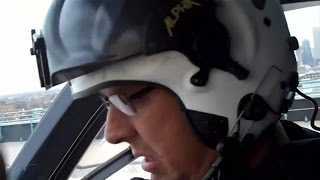
Kenny Keller, a helicopter EMS pilot, walks through what the job actually looks like: preflight checks, standby shifts, emergency calls. He covers hiring requirements, training costs, starting pay, and how many turbine hours you need. He also explains what he loves about flying well-maintained aircraft and what he hates about long inactive periods.
Questions this video answers
Seven days on / seven days off, alternating week of day shifts and week of night shifts.
About 2000 hours total, typically at least ~1500 helicopter hours (company requirements vary).
Commercial certificate with instrument rating; he also recommends CFI for building time.
Approximately $50,000 to $100,000 (to get the required training/time).
$46,000 (he started at $46,000 in 2008).
Chapters
Having been an EMS pilot, I get asked many questions about the job. So I decided to add some of these questions to my book. Helicopter Checkride. This is chapter 14. First question. Can you tell me a typical day on the job as an EMS pilot? A typical day, you show up and talk to the pilot that you are leaving. The first thing you do, go down and pre flight the aircraft, get the aircraft ready to go for the day, check in and look at weather. You have to have everything ready to go so that when that call comes in, you're ready. After that, it's pretty much watch tv, sleep, eat, read, get on the computer, pretty much whatever you want to do. If and when a call comes in, you go out to the helicopter and you fly point A to point B and try to transport the patient in the safest manner that you can. Next question. What was your favorite part of the job? My favorite part of the job flying a $6 million aircraft. That was pretty cool. We had really good maintenance and good equipment. I worked for a really good company that I was actually proud to work for. So the favorite part would be when we got to actually go out and fly. And of course, the next question would be, what was your least favorite part? For me, that would definitely be the hours and hours and hours of doing nothing. No calls, no flying. The next thing that comes to mind is being watched over by hospital personnel that know nothing about helicopters or helicopter operations. Some of them want to dissect every move that you make and play armchair quarterback. We don't get involved what they're doing in the back with the medical situation, but they all seem like they need to get involved in what we were doing up front of the aircraft. Next question. What surprised you the most when you started working in the EMS field? Well, because I had a background in emergency services with the police department and fire department. There were a few things I had to get used to. When I first went to interview for the job, the base manager knew my past history and he said, this is going to be a little bit different. You're used to rushing the fire truck or rushing the police car. In helicopter ems, we don't rush. We walk to the helicopter, we walk to the helicopter, we do a walk around, we climb in, we put our seatbelts on, we come, we go through a step by step checklist to make sure that everything's good to go. Then when we're ready, we're going to fly from point A to point B as if we're hauling cargo. The company I worked at, they Said, guys, basically, it's like you're hauling boxes of nails. Now, the people on the EMS side of things, they kind of have a hard time swallowing that because to them it's a medical emergency. To us as the pilot, it's not. And if you think about it, this makes sense. The guy flying the aircraft needs to stay calm, needs to focus on the job. If he lets emergency get to him and come into play, he takes chances, he takes risk, and he skips certain operations that end up causing real problems. Next question. What are employers typically looking for when hiring people in this line of work? Well, I'm not an EMS employer, but I would say at this point they're looking for qualified people. We know the Vietnam veterans are retiring and those jobs are opening up. So I'd say, in general, can you do the job? Do you have the qualifications? There's another problem in the industry that is people faking time in their log books. And as everybody hears about the pilot shortage, more and more people are tempted to fake their time to get in and get the job. The problem is you need that experience. You need that time under your belt when you get into this line of work and have the experience necessary. So I would say good quality people that actually have the required experience, you need to do the job and do it right. Next question. What was the work schedule like? The work schedule was cool. We did seven days on, seven days off. We would work seven days of day shifts. We'd have a week off, and then we'd have seven night shifts. Shifts. Those seven days did make the work week awful long, but it was sure nice having 7 days off. Biggest problem was switching from days to nights. They would say, well, when you're switching from days to nights during the week, just stay up a little later each night and sleep in a little bit more the next day to help you get your sleep pattern moved around and that will help you get through your week. Me personally working nights off and on for years in all kinds of different emergency services. I don't think you ever get used to working nights. Our bodies are meant to be weak in the daytime and asleep at night. I think that's just the way it is for me. The night part, as much as I like nights, it can be very hard on the body. Next up, what training and education experience is necessary and what can a person expect to spend to gain it? That's a pretty big one, pretty much across the board. In general, you need about 2000 hours of flight time. It's normally at least 1500 hours in helicopters, that is, in general, any one specific company could be looking for something different, but I believe a majority of the time, 2000 hours is the key. You have to be a commercially rated pilot with an instrument rating to get that level of experience. It's probably going to cost you somewhere between $50,000 to $100,000 just to get the training. Then you're going to be a road dog for probably about five years, not making much money until you get to that EMS job. Which then brings us to the next question. What is the typical starting salary for someone in this line of work? Back when I started, it was 2008 and I started at $46,000. I would assume that the average salary probably went up, but I would say it's still pretty close to that range. Could be more, could be less. Just depends on where you're going to work and depends on the company. Next question. I'm not sure if you're up on the trends in this field since you're on to other things, but is the EMS piloting field changing? If so, then how? One of my good friends is a Czech airman for the largest air medical provider in the world. The big thing that he's telling me is the average pilot he's now training is in their late 20s to early 30s. That's a change he's seen over about the past five years. The pilots in general being much younger, coming into the field, coming into the industry. There are other changes that are happening due to national attention on EMS accidents and the National Transportation Safety Board having to step in and make certain recommendations in certain areas. I would also imagine that a lot of changing as far as use of electronic devices in the cockpit. We know at this point in the game that technology is changing very fast and aviation is adapting to a lot of new changes. Next question. What advice would you give someone who wants to pursue this as a career? If this is going to be your career path, I would say get your commercial, get your CFI and your instrument rating, get out in the field and start working, do a good job, fly by the rules and just know that your career path might change as you're going through this process. You may decide to go into the oil and gas with platform operations, or maybe you want to go into forestry. For a lot of us, our goals change once we get out into the real world and start working in the industry, but there's nothing wrong with that at all. Bottom line is, get your ratings, start billing your time, and make good decisions to be a Safe and prudent pilot. And the last question for chapter 14 from Helicopter Checkride, do you have to have a certain amount of turbine hours to get any job? When I got hired, I had around 350. The company I went to work for said, well, we usually hire guys with around a thousand hours of turbine time. And I said, well, you know, that's great, but I really want the job. And 350 is all I got. And that was darn hard to get that 350 hours. And the guy chuckled and said, well, we like to see a thousand, but doesn't mean you won't get the job. And I did get the job, and it all worked out. I know currently, my friend, that the Czech airman told me they look at 1000 hours of turbine time and 2000 hours total. I asked him, I said, don't you think 1000 hours is a little bit ridiculous when there's so many good quality guys out there that might only have a few hundred? And my Czech airman's reply was, well, it depends on the situation, what their background is, and can they waive some of those hours, depending on the circumstance. So getting those almighty turbine hours is always a key. Pretty much in any industry as far as airplanes or helicopters, moving up the ladder always requires turbine time. On an ending note, for me in the helicopter EMS field, I got to do it for five years. It was a great experience. There were a lot of things I liked about it, and there was other things, not so much. I'm glad I got to do it. I learned a lot of things that still help me to this day.