Helicopter Forced Landing, Radio Comms, Remote Pilot
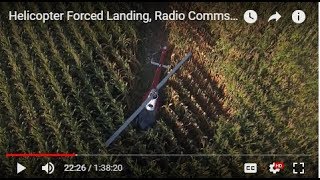
Live training session (YouTube) led by Kenny Keller with guest Gary covering small unmanned aircraft systems (remote pilot/Part 107), a recent personal helicopter forced landing (Rotorway cog-belt failure and autorotation into a cornfield), and practical helicopter radio-communications tips for Class G and towered airports. The video mixes regulatory guidance (registration, Part 107 limits and waivers), a real accident case study illustrated with drone photos, Q&A with viewers, and instructor advice on radio phraseology and cockpit procedures.
Questions this video answers
September 20, 2017
Kenny Keller (host) with guest Gary (presenter) — video uploaded by Kenny Keller.
A small unmanned aircraft is defined as an unmanned aircraft that does not exceed 55 pounds.
FAA site registration: $5; third‑party services may charge around $24.99.
70% (pass required for the initial knowledge test for non‑pilots).
Chapters
Sam. Alright, welcome to live training Tuesday. Today's gonna be kind of a fun day, exciting day. We're gonna talk about some cool stuff and you're gonna probably get a kick out of some of the things Gary is gonna show you and tell you about. And I'm not gonna go into it because I don't want to spoil what he's gonna talk about, but it's gonna be pretty interesting, probably the most interesting live training Tuesday we've had. Gary is gonna talk about remote pilot small unmanned aircraft systems. I got him standing by over there. Here, let's give a wave to the camera, Gary. So he's over there getting ready to go and I'm going to turn things back over to him in a minute. But we wanted to let you know, you know there's things that you need to know as a pilot, especially as a cfi, about the remote pilot. This year when I did my to date or did my teaching during the flight instructor clinic at the heli Expo, we were there for two days, Flight instructor refresher clinic. And one of the topics that I had to speak about was the remote pilot. Because as instructors we're going to have people come to us who are already pilots and they want to add the remote pilot on. And as a flight school you'll also have students come to you off the street that want assistance in getting their remote pilot. So instructors, we need to be able to inform our students how they can get this rating, whether it's an add on for you or whether you're brand new off the street. You need to know some of the do's and don'ts with small unmanned aircraft because we know they are a part of our world now, they are a part of the airspace and we have found we're now all drone pilots here. We've all taken the test. Me, Chris and Gary, we are remote pilots. We have a new course coming out in just a couple weeks for the remote pilot course. So we want a video today for you as a pilot. Kind of some of the things that you need to know. Regardless of whether you're going to be a drone pilot or not, you still need to know some of the basic facts. So we're going to do that first until Gary ready to go and then I'm going to come back. We'll come back, we'll do some questions. So let us know where you're at if you're on watching. We have people logging in every week that we know are here every week. Let us know you're Here. But if you haven't, let us know if you've been here. I can't speak. If this is your first time here, let us know who you are and where are you. At least where you're coming from, whether it's in the U.S. heck, we got people logging in from all over the country, all over the world. I don't remember all the countries already. So let us know who you are, where you're from. If you have any questions, leave them in the box. And we're going to get to questions after Gary gets done. And then I'm going to go over basic radio communications, class G, and some tips for towered airports. The things that I learned as a new pilot that helped me get over that. Oh, in the beginning, we're all intimidated to talk on the radio. And I was, even though I was a cop. I'd also owned the towing service for 10 years where I was also on the radio. I was on the fire department. We worked radios. Why was I intimidated on the radio in the helicopter? I don't know. I just was. So we're gonna go over that stuff after Gary gets done, and then we'll answer questions on that, too. So I think. Are you ready over there, Gary?
I'm ready.
Let me pull up the camera. I'm operating cameras today, so we'll see how I do. So here we go to Gary, who's going to present an interesting presentation on remote pilot. So over to Gary.
Okay, how's my audio?
Looks good. I see my little green thing going up and down. We're good to go.
Okay, thank you everybody for tuning in to helicopter ground and watching our live Tuesday event. I have a couple stories to tell, and we are going to talk about our new small unmanned aircraft systems video course. Like Kenny precluded. First off, my first thought of this whole thing was a local law enforcement officer that's on the county police department approached me and he says, hey, you're a helicopter CFI now, and would you be interested in putting on a class for some of the officers that want to fly the drone that the prosecutor's office purchased? Our police and I had never given it much thought, and I said, well, I don't know. I teach helicopter training. The more I got to thinking about it, I thought, I'm going to look into this a little bit. Kenny and I discussed it and we realized, or came to the realization that it is important even for general aviation pilots to know some information about the restrictions that are held to the drone operators or the small unmanned Aircraft systems, pilots in command, I guess would be the appropriate term being remote pilots, which is the rating definition or category that the FAA has given it. I found that the FAA actually made part 107 in the FAR aim, which lays out all the rules, whether it's operating registration restrictions. Part 107 I had never open. And so I went through part 107 and I became familiar with the laws and restrictions that are imposed upon the remote pilots and the small unmanned aircraft. Then I found the remote pilot Unmanned Aircraft systems study guide that the FAA has out and the advisory circular on small unmanned aircraft systems that the FAA has out. I just really dug into this and I came up with a video course. So it's going to be similar to the course that we have for the actual general aviation helicopter pilots in that everything you need to know can be found with self study. But we know that we learn mostly through vision and then second it would be our hearing and so forth on our senses. So by making a video course, it just helps you to learn faster and you can tap into the knowledge and everything you need to know to pass your test is going to be covered in our videos at some point through our course. And just like the helicopter general aviation courses that we have, the videos can be watched over and over and repeat and paused and the pilots can use it to move forward. So I did not help this deputy back. When he asked me, I said, you know, tell them just study the ASA test prep and don't bother me. Basically because I thought it was, you know, drones are toys. And I've learned a lot more about drones since then. And I realized that they are not toys. They're flying in our world as helicopters. They can fly up to 400 AGL. So I could easily be operating a general aviation helicopter at 300 AGL over somebody's property and be sharing the same airspace as the small unmanned aircraft. Because we know as helicopter pilots our altitude limit is only to keep enough altitude so as not to pose a hazard to persons or property. So therefore you could have a person operating the small unmanned aircraft for pleasure under the model airplane exception. So it is important to know that A the remote pilot should know that he has to yield to all other air traffic and B, general aviation pilots need to look out for the lack of knowledge and ultimately safety is our goal. So just to know there's one more thing to look out for. In addition to towers and power lines, now we have to look out for drones. What if we get a small unmanned aircraft in our rotor system, it's, it's going to cause some major problems.
So I want to, I want to add to that.
Go ahead, Kenny.
This is what I've been saying for a long time and what I've been thinking is the first time a drone goes into a rotor system on a helicopter and kills somebody, or even different, the first time a drone gets sucked into a jet engine, either just anyone, but what if, especially if it's a celebrity or a government official is on some aircraft where, you know, these, we, we've seen these videos, or I have anyway, of these close encounters with drones and I've seen them coming from helicopters where, you know, helicopters flying along. I just watched one yesterday and this one was taking place in Australia. And this thing, because they're so small and the speed of a helicopter, you don't see this thing until it is within a couple seconds and this drone went zoom right underneath the helicopter. And I was like, wow. It makes the case that these things are so small that if you're flying along, even let's say you're flying along in a Robinson at 90 knots, that's one thing. What if you're in a larger, like a Eurocopter and you're flying 120 knots and even if that drone's coming at you at 30 or 40, I mean, you don't have any time, that thing being so small, we as pilots are going to have very little time to react. Hopefully we will be able to. But, you know, informing the public is kind of a big job for us as pilots, I think to help inform people and let them know what they can and can't do. And the danger, especially to us as being helicopter guys and helicopter girls, we fly lower to the ground than fixed wing. Fixed wing are going to have this problem takeoff and landing. But what about us low flyers that can legally fly around at 500ft? Well, the drone, we know that the drones aren't supposed to fly over 400 or hopefully you know that and hopefully most of them know that. But what if they miss it by 100? Or what if we're flying a little lower legally because we're doing some aerial filming or whatever the case is or whatever else it could be because we do lots of things. But anyway, I wanted to jump in and point that out because I think that's when regulations are going to change and we know that things are going to keep changing as more and more drones come into play. They're here, they're not going away. We know Amazon UPS a base manager that I worked with when I flew EMS just five years ago, just went to work for Uber and his job is to help Uber develop. And I forget the name of it.
Kenny, that might be classified.
Okay, well, I think I saw it on Facebook, but anyway, yeah, maybe I'm not supposed to talk about that, but anyway, our world's changing, we all know it. And drones are going to keep changing everything that we do. The regs are going to change often. And that's why we. Another reason we thought, well, let's build a course that like ours, where it's interactive, where members can get in. You know, it's a community, you can ask questions. We're committed to staying on top of things as they change. So I see you grinning over that man. I better go back. I'll let Gary. I'll get back to Gary's presentation because I have the habit of just talk going too long. So here, back to you.
Thanks, Kenny. I needed a drink of water anyway, so the next part of my presentation is kind of ironic. I had, I had a little bit of a rough weekend. I fly a rotorway, I own up until Saturday, that is. And I had a cog belt failure and the FAA has already been here Sunday and investigated it. It was clear cut cog belt failure. I was forced to auto rotate it into a corn field. So the corn did a lot of damage. And I'm now calling it the rotorway corn harvester. It's stuck in the corn field until the farmer decides he's going to pick his corn in a couple of weeks and then we can see exactly what needs done if we're going to fix it. Everything except the skids and the tail boom is probably fine. Oh, the main rotor blades. So if there's anybody out there that wants to buy one for parts and save me from putting it together again, get a hold of me. But this came around full circle. It's kind of weird. The same officer that had approached me with his toy drone project wanting to know if I would teach his officers, he shows up at the scene. And of course I called 911 as soon as I landed. I know the drill. I said, I know people have called. I'm fine. And cancel. Everybody shut the sirens off, but we still had a couple of people show up. A couple firemen, a couple police officers. And one of the officers was the same county police officer. And he said, hey, Gary, you want me to take pictures of the accident with my drone? We couldn't see it from where everybody responded. It's in the cornfield, and the corn is about 8ft high right now. I said, yeah. I said, you got your drone with you? And he pulled it out of the trunk and started pre flighting it. And I said, so I said, did you get your remote pilot rating? Because I'm teaching a course on that now or getting a course ready to put out to the public online. And he said, yeah, I did. He said, I had to go to the FAA test testing facility. And that test was a real beep anyway. I said, wait a minute. I said, you're a private pilot for airplane, right, if I recall? And he says, yes. And I said, well, why did you go to the testing facility? Because I've just dug into all this. You only had to do a simple online course and an open book test and then go through IACRA to get the rating and verify that you had a flight review in the last couple of years. And he said, well, they told me I had to go take the test. So here's an example of somebody in an official capacity that's being told by somebody in another official capacity that he had to take a knowledge test, which includes topics such as airspace and in depth weather and things that an initial unmanned remote pilot would have to go through with with the test at the FAA facility. He could have skipped all that. He's already been through a lot of that with his private pilot rating. But I included in my presentation some pictures that he took with this drone. And this thing is not a toy at all. He was able to get up over the accident and take some very awesome pictures of where the rotorway is sitting. You can see where the rotorway has settled into the corn. You can even see by looking at some of these pictures the exact point where the flare occurred prior to the touchdown. And for some of you that don't know what a cog belt is on a rotorway, that is the transmission of a rotorway. So basically, when the cog belt fails, the rotor system is not being driven like it should be from the sprag clutch or what they call the secondary in that aircraft. So we'll move through these pictures here. These are all drone pictures from different angles. And it just took him a matter of minutes to take these pictures. And he could see it from the position that he was standing operating it. So he had line of sight and he was operating it over the sparsely populated area. He knows all the rules about remote piloting.
His pictures are amazing.
And the pictures are just absolutely phenomenal. And, you know, I guess I'll use These pictures forever because as I'm pointing out to a student, you know how you may have to auto rotate? You can see in these pictures where you've got the flare close enough to the ground to chop some corn. And then as I leveled it, didn't chop as much. In fact, on the one side of the aircraft, you can see where the blade didn't even touch the corn during the leveling process. And then during the settling, there's a nice round patch where it chopped the corn. So these pictures as bad of a day as it was for me. I can walk away from it uninjured. I've got some property damage here, but I've got a story to tell and we survived it. And I'm able to show these pictures to you and students forever now.
Well, I want to interrupt just for a second and you know, of course we're glad he's okay. And I, when I first heard something went down, I figure Gary's fine because he's had an incident before. And so it's awesome that he came out okay and that he's already sharing this with you, which is something I keep bringing up in our training, is you just the years have been around this. Not more than one or two people do I know, helicopter pilot wise, that have ever talked about their accidents. I've talked about mine. Gary's talked about some of his. We've promised a couple videos from Gary on explaining how it feels when the engine quits and what to look for. And we haven't done those yet. But here's number one proof where Gary's jumping right up in there and saying, hey, look, I did everything I could. I walked away. It sucks. It was a bad day. But here he is already on film sharing a story with you. So that's one thing we want to do with, you know, moving forward. What I've always tried to do is make our HOGS training realistic. You know, we don't hide behind, you know, big mansion on the hill. And we're not trying to prove that we're something we're not. We like to give you the real deal about what happens. And right. There's proof of Gary getting up there and saying, look, I had a bad day, but now I'm going to take these pictures and I'm going to use these with my students now in the future because there's tons of things he can use those for. Not only just the fact of how cool the drone was, it's a great story how that deputy is involved in this year And a half stories of how we thought about getting involved with drones. And then Gary as a police officer hearing one thing and then somebody, a police officer being told the wrong information, go and take an unneeded test. When the one that he took, we know because we did it. It took us an hour. You know, he could have easily been done in an hour. But he goes through all that and then goes out, takes $100 test and all that for nothing. So leave your comments for Gary. We're glad he's okay. But it's just, that's what we're trying to do, put the realism here, you know, here's what happened. These are the things that you need to know about as new pilots or even somebody refreshing or it doesn't matter if you've been flying 20 years. We all need to stay fresh on the fact that it can happen to any of us on any given day. My ground residence accident was 70 degrees out. It was beautiful, it was a sunny day. Everybody was happy. We're in this million dollar aircraft and we're coming back for a lobster lunch paid for by the guy that owned the aircraft. And they're waiting on the ramp and beautiful day. None of us had any clue that it was going to turn into this monstrous, you know, thing that's going to rip itself apart and throw us all into the ramp. So anyway, kudos to Gary for jumping in, having the guts to jump up there right away and tell the story already about what happened. Because helicopters get wrecked. You know, we even have, even with the insurance company that we have now, we switched to this guy, he's one of the best in the industry, insures more R44s than anybody in the country or the world. And he said, just because somebody's had an accident, we don't automatically raise insurance. We don't even really raise an eyebrow. Yes, of course, if you fill out a form to be on the insurance, they're probably going to glance over it and see what he said. But he goes, helicopters get wrecked all the time. Pilots make mistakes. Just because you had an accident doesn't mean that you're never going to get a job. I thought that too. And six months later I got an EMS job. So because you've had an accident, why run away and hide from it? Doesn't mean you can't still have a career. I've done it. Gary's still going to do it. I just appreciate people that are willing to get in front of the camera and talk about it. So I'm going to Go back to Gary because again, I've talked too long. So here you go, Gary.
Okay, do you have the slide up?
Oh yeah, let me do that now. Here we go. There we go.
Okay, I just had a couple more pictures of the drone shots that we took and I guess I will add that in the near future I'll do a presentation on what it feels like to have a real world emergency. And one interesting fact is we always think of engine failure. Engine failure, engine failure. What's it going to be like? It kind of throws a little different angle in there when the engine is actually running, but it's not hooked to the rotor system. That's something we don't think about until it happens. And it just takes an extra second or two to process that because we're always thinking, well, when the engine dies, this is what I'll do. Here's a neat shot. It kind of shows you how close I was to a parking lot there. And that's where I really wanted to be. But it was meant first to be in the corn. Alright, Kenny mentioned that him and I did add on the remote pilot rating using the online training and there's a test you take at the end of the online training and they use IACRA to get your remote pilot certificate. We are going to include in the course that we sell for remote pilots, we're going to include the support via text, telephone and email to answer questions and help people through this because it is kind of a new thing and the FAA stepped in and made some regulations and it is not common knowledge. And so just like we do for our helicopter general aviation students, we're going to be there for our remote pilots. And I think we'll find that a lot of our helicopter pilots will be adding on the remote pilot rating because it is kind of a neat tool, a neat rating to have in quite frankly, we'll probably have some remote pilots that take our course that end up also doing the helicopter ground and getting their general aviation private pilot helicopter license. I wouldn't be surprised at all. In going through the process of getting our remote pilot license, we did document exactly what kind of questions we incurred and part of the support to our members is to give them some feedback to help them to know what to expect when they log on there. Not to mention that all of it's going to be covered in our videos. Any remote pilot operating for compensation or hire must have this license. If you're not already a rated private pilot or better, then you do have to go to the faa testing facility like a pilot would for their initial private pilot test. And they have to pass this test with 70% or better to get the rating. And if you're already a pilot, we've already discussed it's an online process. The definition of a small unmanned aircraft is a remote aircraft that does not exceed 55 pounds. And these do have to be registered. I do have a story to tell about my pastor who you'll see in some of the pictures and videos that we show of the small unmanned aircraft system. He became interested in it when I told him I was working on this course and he went and purchased one actually and registered it. He wanted to be all legal with it. He does not need to be a remote pilot certificated through the FAA because he does not plan on operating it for hire. Although I do believe he's going to pursue it. He did register it and he got on the phone with me one night and he said I thought you said it was $5 to register these drones. And I said yes it is. And he said well, I'm trying to register and it says it's $24. And I said, well look up in your address bar of your browser and does it say faa.gov? and he said no. So there are companies out there that will gladly do this simple process for you for $24.99 instead of you doing it yourself for $5. On the FAA site, all of them have to be registered regardless if you're flying them for fun or if you're going to use them for hire. The difference is whether you need to be certificated through the faa. We are finishing up the video learning course that will include videos on all the topics that you will be tested on. Should I go down through some of the topics really quick?
Sure, why not? Give them an idea.
Okay, so we've got videos on use of the FAR AIM pilot requirements, registration and pre flight initial and recurrent knowledge test the small unmanned aircraft flight restrictions part one and two. We have in flight emergencies and how to handle them. We have loading for the small unmanned aircraft, flight planning, airport operations, effects of weather, drugs and alcohol, aeronautical decision making, radio communication, communications, waivers and weather sources. So whether you're adding this on by taking the online course and maybe you don't need all of this, or if you are going as a non pilot to a testing facility and you need all of this, it's all going to be in our site. One thing to point out is that unlike the flight reviews for general aviation where you can find a CFI and he just endorses your book. You do have to go online every couple years and do the course again, a recurrent test. And same with non private pilots. They will have to go to the FAA testing facility and once again pass the recurrent test for the remote pilot certificate which will include much of the same information. So they have to hang on to this knowledge and this course is going to be out there and available for them to use as a refresher. Just to kind of go over a few things. There are some limitations on the small unmanned aircraft that can get a person in trouble if not adhered to. You have limits on altitudes, for example speed, operating over people, operating from moving vehicles and etc. And so let's say I'm going to operate for fun and I don't go take the test and I don't study up and do the online course. I could be operating in violation of FAA regulations. Worse yet, I could cause a general aviation accident and maybe do it out of pure ignorance because I didn't take the time to research and know that there are even rules existing. And our course will include all the rules that a remote pilot needs to know and understand. I'll tell a quick story about. I was at my daughter's cross country meet recently and one of the parents pulled out a drone and was flying right over the crowd, right over the kids. And I don't know if he had it registered. I didn't confront him. It wouldn't be my place to confront him. But he was violating the regulations that are listed in Part 107 for operating his drone, whether it was for hire or not. He probably had no idea. So if the FAA was there, could he be in trouble? Sure he could. And if he caused some type of injury because the drone lost battery power or maybe the connection went bad and it went straight to hover and came down onto the kids and cut somebody with one of the little blades, I don't know. But he would be in trouble because he's operating right over people. And that is part of 107. If you want to operate over people, there are some restrictions. You can, but there are some restrictions and then there's waivers. Just like anything. The FAA can give you a waiver to operate, let's say at night. A remote pilot should know that they cannot operate their small unmanned aircraft after the 1/2 hour of twilight. So when it gets to be sunset, you have an additional half hour to operate that small unmanned aircraft and you must have navigation lighting on it. But there Are waivers. So let's say a law enforcement agency wanted to use their small unmanned aircraft to patrol a festival at night to make sure nobody's breaking in and stealing from the vendors, for example, they could simply just apply. And as long as the FAA felt that that operation seemed safe, they could give them a waiver for it. Our course will include courses on all these things that we discussed. And, you know, we've taken the test, so we'll be there to support our members with information that they may need to pass the test. We can quiz them on the phone via text, email to make sure that they're ready. And this is just the same ongoing support that we provide for our general aviation helicopter people. We plan to make this course affordable. We looked at some of the other courses out there and tried to come up with a number, and some of the courses, well, I guess I haven't found anything for less than $100. And so is somebody going to spend $100 to learn how to operate their small unmanned aircraft safely and legally? If they're not doing it for hire, probably not. So we are still kind of up in the air as to what the course will cost. I know we have quite a bit of money in it, the time that it takes to develop and edit the content, but we do want people out there. We do have a genuine concern for safety in aviation. As you know, how Kenny has built his helicopter ground, it wasn't to get rich. It's a true inner desire to make our members safe and to make them good pilots. And we're going to do the same thing with the unmanned aircraft remote pilot section. There is a lot of information out there that needs to be known to stay out of trouble. Regardless of whether a person plans to operate for hire or get their license or not. In fact, there's kind of a little tidbit on how somebody in a position where you think they would know all the rules, and it kind of drives home how this is all new. Our airport manager, kind of in a kidding way, confronted Kenny when he was operating his drone on the class G airport property out here and said, hey, those aren't allowed on airport property. And we had to find a tactful way to kindly not offend him and tell him that, well, as long as we yield the right of way to all other aircraft, we can. So part 107 lays it out. We can operate at a class G airport. There's it's not illegal, we're not violating any rules, and there's somebody in charge of an airport that didn't know. And I don't fault them for it because it's all new. It's all brand new. These things are popping up everywhere. A year ago, I thought they were toys when I was approached by the county officer. And here I am with a realization that there are a lot of rules on them, and we do need to take them very seriously. And I can see a lot of potential for the use of them, especially after my accident a couple days ago. So that concludes my presentation. And I know Kenny's got an exciting presentation on communications that a lot of people have been emailing me about, asking, hey, we want a video on airport communications. Everybody's intimidated by the tower gods, like Kenny referred to him as in one of his older videos I remember watching when I was training. The tower gods are there to make your day.
Horrible almighty tower God.
But he'll talk you through that now, and we'll answer a few questions, I guess, before we switch out.
Before I can jump up there and do that. We're gonna check comments and questions over here in just a second. But I want to before we move on. Gary's dug in, and he's been on this for two months now. And Gary dug into this just like he dug into private commercial CFI for all the training he's been through with me. You give Gary a task and he digs in and does it. So I'm helping. But it's been fun for me to take more of a backseat role, run cameras, do editing. I'm going to help. I think I've helped with some of the presentations. I'm not even sure at this point. Maybe he shot all of them. But Gary gets credit for setting all this up. Dig it in and, you know, the information will be right. And I was going to chime in there, and he pretty much covered all the things that I was going to mention. Just like the airport manager, you know, he did come out there and made me feel like an idiot. And, you know, that's why people need to know. They need to be informed. Because people go around spouting off regulations all the time when they're not even right. It's what somebody heard, you know, it's what somebody said. So this course is for those that if you're going to do it professionally and you want the light, you need to do more than just, you know, oh, figure out the answer so you can go pass the test. We've been talking about this. You're gonna see more and more people getting violated by the faa. This is my prediction. I already predicted earlier. You know, faa, although it's always been good to me, I've never had a problem with faa. They've always treated me well. I've never had a problem with the faa. But we know that everything is always kind of a knee jerk reaction. So as accidents happen, there's going to be some knee jerk reactions. And as more drones are out there and more violations are happening, I'll bet you $5 that they're going to get more serious. They're going to start cracking down on these more. It's going to happen. I think you're just going to see this thing's exploding. We know they're exploding and you got a lot of people out there. They're just buying them and going out and doing things that they shouldn't be without really digging in and learning the information. So let's go check on comments.
Taz and Brian say hello from Las Vegas and Adam says hello from Fort Worth, Texas. Also Jim Hardy from Texas says hello from Ireland. And Richard would like to know, do current regulations require all drone owners to be registered?
Hello everybody. Thanks for tuning in and saying hello. And as far as the question, Richard, the drone operators per se don't have to be registered, but in a sense they do because the drone has to be registered as a small unmanned aircraft and their name will be attached to that unless of course they've got it under an LLC name or a company name. Hope that answers your question. Okay, should Courtney, is there anything else? Someone.
Oh let me go over to her camera.
Someone would also like to know if you would trust an all autonomous UAV which completely makes all decisions itself.
Well, I guess I will withhold my opinion on it because I really don't have one yet. When they become available, I guess at that time I'll decide. Anything else?
Alright, well I guess we'll kind of get ready for me to go here. Maybe we'll switch places and have you take over camera. Probably do it.
Thanks again everybody.
Probably do a better job than me. So that was pretty awesome. And I commend Gary again for this just happening a couple days ago and that he's already up on a camera telling you about it. And I'm going to mention again what I mentioned at the beginning. I don't get why people don't talk about their accidents. And we are going to do some more. I've been talking about this for a while and members have been asking, hey, why don't you add something in the site where you Guys start covering accidents, we're gonna put that into play. And when we do that, it's gonna be a laid back kind of look over at recent accidents, maybe older accidents. We're not gonna go on and blame pilots, we're gonna go on and say, look what happened. What could a person maybe do to be avoided or what a person could have done to avoid these accidents. So Gary, getting up there and doing that is, I think, awesome. So if you'll bear with me while I pull up PowerPoint here, get mine ready to go. So on this I'm gonna put up a disclaimer first. Which one are we number two? Can you put my PowerPoint up there while I talk, just for a second? Disclaimer. Okay. Keep in mind, depending on where you're flying, there could be different expected procedures to what you want to do. Okay. I've been flying since you 97. The majority of my flying has been in Indiana and Ohio. I have worked other places, I have flown other places around the country. But what I'm going to give you today are basic radio tips, things that I've been using since 1997 when I started flying. Acceptable practices where I've been flying. We have a Class Charlie video on YouTube and inside the site that you can check out. We were going to roll it, but it's 25 minutes long. So I didn't want to go into making you watch a video that long when you can watch it on YouTube or inside ground school. But on that video, Gary and I in Class Charlie with his first trip into Class Charlie and I'm explaining how it worked and the videos got a lot of views and most people like it, but some controller come on there and said, oh, you're doing it all wrong. I've been a controller for so many years and you're making the work harder on the guy at the tower and blah, blah, blah, and I thought, well, that may be at his airport. Okay, I don't know where in the country he was coming from. But again, what I'm going to give you today, what I'm going to talk about are things that we've done here in this area and they're acceptable practices for working around here. So the first thing I want to cover is first call of the day. I hate those little white things that pop up. Should get rid of that first call of the day. Alright? For any given situation, always use your full call sign for your first contact. And I do this whether it's uncontrolled airspace here at class G or Whether I do it in controlled airspace, the first call of the day, always use helicopter and use your full call sign and then you can start abbreviating after that. And that just kind of helps you with your radio communications. If first call of the day you say, for example, we'll use Plymouth here, class G, we'd say Plymouth Traffic helicopter November 8625 kilo departing the ramp, transitioning to the Runway. And then after that I'm going to abbreviate helicopter to 5 kilo. It just helps you, just helps you shorten up that radio call. I mentioned at the beginning of the presentation today that I'm an ex cop, ex fireman, business owner that had multiple trucks with business radios. So I talked on radios for years and I still got intimidated when it came to the aviation part. But what I learned back first is from the fire department being a cop. On both fire department and police work, you have those people who don't respect the radio and get on the radio and they're on there going, yeah, hey, yeah, I just stopped that guy last week and you know, he had a bag of something in the back seat. You better take a look at that. Da, da, da, da, da. Well, well, as a police officer, what if you're the guy out there needing help and somebody else is chit chatting on the radio? Same thing goes to aviation, you'll hear it. If you're brand new to this, maybe you haven't heard it yet. If you're an experienced pilot, you've heard this guy. Let's use class G for an example. Let's say we're out flying around and we need help and we're gonna need to make a mayday call because maybe we've had a failure and there's some guy on the radio going, hey, Jim Bob. Yeah. Did you see what happened last weekend with those bears? Blah, blah, blah. Don't do that on the aviation radio, okay? Please think about what you're gonna say before you say it. Keep it short and sweet, get to the point and get off the radio, okay? There's nothing more annoying to another pilot who's trying to make a call, trying to do what he's supposed to be doing, whether he's self announced or he's on talking with a tower. Those people that get on there and run their mouths and go on and on. I'm sorry, they should be smacked, okay? It's very annoying when you're trying to do the right thing. And what if somebody needs help? It just gets bad what would you say about that, Gary? Have you noticed that.
Yes, it is abused a little bit here and there. People talking about non aviation related things on the, the unicom for instance. And it hasn't really been a problem around here but I could see it being a problem at a busier airport.
Right, so as you're learning and you're, and you're starting to do this or if you're an old timer, you've been doing it for a while and you're the one of those guilty people, you know, quit doing it. Alright? This thing is just so touchy. Alright, so I gave an example of. Well we knew same thing at towered airport. Okay, so let's go back to, to the first call today. Here would be an example. Fort Wayne helicopter tower. Helicopter November 8625 kilo. Tower comes back says go ahead helicopter November 8625 kilo. You can then say helicopter 25 kilo on the, on the Atlantic ramp requesting direct departure to the south. That is acceptable at the. I worked in two class Charlie airports for five years flying ems. They were totally cool with it. Those airports were fine with it, wasn't a problem. Your airport might be different. That's the way we did it. We have any questions? I think I covered that one. So back to the thing. Always use helicopter. Okay, let me specifically touch on that one. I had a video I meant to pull in here and I ran out of time getting ready. I forgot we had an example of why we should use helicopter. We have a video where we had helicopter November 8626 papa out here in the hangar for a long time. There was a helicopter right beside it. It's the hill or Gary. And it was like November 2686 papa or something. It was like one digit away. And a lot of times when you're out there flying and it can be in class G, it can be in towered airport or towered environment. Just by coincidence you will be in an airspace near another aircraft that's an airplane or a twin engine that some other style of aircraft and their call sign will be so close to yours it's not even funny. And 20 years I've been flying, I've seen this happen a lot just by coincidence. So when you're on there making your radio calls, if you always use helicopter then people know who you are. If you're the other guy who has a number close to yours and he's just saying 25 kilo. Right base. Okay, well is he an Airplane. Is he a helicopter? Who is he? Because we know fixed wing are going to fly faster. They fly their approaches differently. As helicopter pilots, we have to avoid the flow of fixed wing traffic. So they need to know that we're a helicopter, just like we need to know that they're a fixed wing or whatever type of aircraft they may be. So always use helicopter in every call. That way there's no doubt about who you are. So by you using your own good practices, you know, be better than everybody else or be better than the weekend warriors who sometimes get on there and don't use the proper calls and get all confused with what they're doing. So that goes for that PowerPoint. Let me get rid of that one and bring up another one while I'm doing that. Do we have any other questions, any other comments?
So Valentine says, great video. You guys are awesome. And they also said, glad you're okay, Gary.
Thanks. Yep, we're glad Gary's okay. He mentioned he's going to do some more videos for you on some of the other failures that he's been through. So that's awesome. And I want to say something to Saab. Yesterday, I saw he said on Facebook last night, hey, make sure that you mention about what happens after an accident. And I'm going to reiterate it again. I said it a little bit ago, I'm going to say it again. Because you've had an accident doesn't mean your career is over. Literally. Our insurance man insures again, one of the best in the industry. And he said, hey, sure, we want a pilot to fill it on a form, but we don't go, oh my God, this guy has an accident. We're not going to insure him, kick him off the policy, don't let him on, raise their insurance rates. It's not like that. I went out and got a job after my ground residence accidents when, you know, I'm in the hospital on the way to the, I'm in the ambulance on the way to the hospital and I'm laying there, you know, neck collar on the whole deal. And I'm going, oh my God, my career is over. Well, I guess maybe I can go back to building houses or whatever. You know, I'm thinking in my mind my career is over. Well, it's not over. So I wanted to mention that that aircraft get wrecked. And that's what our insurance man said. He goes, kenny, helicopters get wrecked all the time. That's why we're here as an insurance company. That's why we pay claims good pilots make dumb mistakes and sometimes things happen beyond our control. So because you've had an accident, don't be afraid to talk about it. It really annoys me how they, they all tell you, oh, go home, don't talk about it, don't talk to your friends, don't talk to your family, blah blah, blah, blah. That's ridiculous. How are you going to get over a traumatic event if you have to go home and you can't talk to anybody about it? I think that's the most ridiculous thing that our industry does is tell people to stay quiet. It's just absolutely ridiculous. Alright, so there. Now that you know my feelings on all that, sorry, but that's just the way it is. I want to go through some tips here and I'm going to start with the old timer story and I want to share this picture. This is a picture of me and my dad at Ken Keller Field and the green 213 Bravo Lima. And it's a cool memory. My dad passed away about five years ago and this is in that original PowerPoint that I made actually probably before he passed away. But I wanted to use this picture because it's in honor of my dad at Ken Keller Field. And I'm really proud of that little personal part of that. But also this helicopter is one of the helicopters I flew as a brand new cfi. I had a little bit of Robinson time. Well, I had a majority of Robinson time with a little Enstrom time when I got my second job. My first job was right before 911 and as most of you know, when 911 happened, so many places went out of business, people stopped flying. There was nobody in the country doing anything. This company, you know, because I wanted it. I just started emailing everybody and I just said who I was, told them my background, said I'm ready to go to work, I need a job, I'm willing to do whatever. Well, this company hired me when nobody in the country was doing anything. And this particular company had a full load of students. So I was so lucky to get this job. But I got it because I went after it. I didn't sit around waiting for somebody to call me. I went after this job in one of the toughest times in our country. So anyway, this helicopter right here was a 213 Bravo Lima. This green helicopter, we used to call it the John Deere helicopter. Everybody made fun of it. But this important part of the story is there was an old timer I flew with named Joe at the time. I'm about a 300 hour pilot. So I'm going to mention again, even with my experience on the radio over the years in professional environments, even as a new cfi, I'm still struggling with the radio. So I'm in a new city, four and a half hours away from home. We're flying in Class Delta downtown Cleveland. We got Class Bravo nearby. We have two Deltas nearby, We have a Class Charlie to the south. So I'm pretty intimidated by the radio. You know, new job, new instructor, new aircraft, different environment. So I flew with this guy named Joe and Joe was really cool because he was a Vietnam, you know, pilot, been flying all his life and actually been had been hired to replace Joe. So it was a friendly thing because he was retiring. So it wasn't like, you know, it was no hard feelings there. So they said, go out and fly around with Joe for a couple days and let him show you the ropes and show you around. He caught on pretty quick to the fact that I was struggling on the radio. And I think we went over to Class Bravo for something and he said, hey, let me tell you something. He goes, I'm going to tell you the key for learning how to talk on the radio and not stumbling and sounding like an idiot. And I'm like, okay. And he said, you're not confident. You know, you're not confident. He said, that guy in the tower or that guy with approach, he has no idea. He doesn't know whether you're a hundred hour pilot, you're a 500 hour pilot, or you're an 8,000 hour pilot. He says, this guy has no idea. He said, so think about what you're going to say. Be confident on the radio. And even if you don't really know what you're talking about, and even if you're not confident, if you just pretend and you act confident when you speak and you're transmitting on the radio and you keep it short and sweet, to the point and get to it. He said, you'll be amazed at how far you get. So I used Joe's advice and I can tell you it did not take me long to get comfortable flying in and out of Bravo Delta Charlie, zipping up and down the Lakeshore, flipping frequencies, going to different towers. Once you get the lingo down and you talk about, talk to them with confidence. You can get about anything that you need. And you just tell them, hey, I'm a helicopter. And if they give you something odd, you say, well, hey, can I do this instead? I had no problem and I'm just Telling you if you're nervous on the radio. A key. One of the biggest things I learned was Joe saying, just calm down, take a big deep breath, think about what you're going to say. And when you talk, be confident. And I had no problem after that. And it is amazing, you know. You know, you're new to it, and when you sound confident, bam, the controller comes right back and gives you what you need, talks to you, and it just makes it go so much, so much easier. So if you don't take anything else away from today, if you're struggling with the radio, be calm, take a big deep breath, and think about it. You know, Joe was good at, you know, I'm transitioning to the Syndstrom, and, you know, and I didn't have a lot of time in it, and I'm again in a new place, and I'm all. And I'm all tense on the controls. He's like, breathe. And I'd go. And he'd go, see, that's what you got to do. And another thing that took away from Joe was as a new cfi, he's like, man, just breathe. You know, so many people as new pilots get all hyped up and you've got your deadlock on the controls and you're not breathing. Whether you're a brand new student or you're an experienced pilot that hasn't flown in a while, or you're transitioning to a new aircraft in a new place, you got to remember to breathe. As CFIs, we have to remember, tell ourselves to breathe. You have to remember, tell your students to breathe. It's amazing. Still today I use that quite often. If somebody's struggling, I look over and I'll go, breathe. And they'll just. I see them looking, I go, go on, breathe. And they take a big deep breath, and they'll admit it, and they'll go, yeah, you're right, I'm not breathing. You know, breathe in and out. Big, huge tip for getting on the radio. Almighty Tower God. Okay, another great story I love repeating. One of my first instructors name was Eddie, and Eddie was from Germany. And Eddie was a brand new instructor. And we became good friends. I was in his wedding. We're still good friends to this day. One of my first instructors, and I remember him sending me on my long cross country for my private pilot, you know, fulfilling the requirements. And I remember being scared stiff that day. And I remember Eddie going, dude, he's not, you know, he goes, you're all worried about the almighty Tower God. I'm like, yeah, I know. And he's like, quit. He goes, the guy up there in the tower is just a normal, everyday guy, just like you. And if you go in there and you sound confident and you talk to him and tell him what you want to do, who you are, where you are and what you want to do, you're going to be just fine. I never forgot the term the almighty tower God. And I can tell you again, over the last 20 years, I have almost never had a problem with anybody in the tower. Maybe a couple times, and if I can remember them as I'm going through where they're pertinent, I'll put those stories in there. But I can tell you 98 or 99% of the time, the guys in the tower or girls in the tower are good to work with. They'll help you out. Don't be afraid to say, if you're struggling and you're a new pilot, don't be afraid to say, you know, hey, I didn't understand that. Can you please repeat that for me? They're going to pick up on that and asking for help. They will always slow down and they'll be much easier to work with if you just come out and admit that, hey, I'm a student pilot, or, hey, I haven't been to your airport before, you know, I need a little help here. They're usually really, really good to work with. I have a story about how working with the tower in an environment eased up a lot of problems we were having. And I'll get to that in a little bit because I want to use this when I talk about that one. So when it comes up, the PowerPoint, we'll talk about that. So the almighty tower guide is not the almighty tower God, okay? It's people up there getting paid to do a job. And 99% of the time, you're going to be just fine. They don't snap at you. You might get a cranky one here and there, but in general, they're pretty good. Law enforcement. I don't have a picture there. I was going to try to hunt down a picture real fast and show something of me or Gary or both in uniform. So law enforcement, I already mentioned it. You know, the key things I learned from law enforcement, I stated at the beginning, I'm going to state it again. We learned then short, sweet, to the point on the radio. Think about what you're going to say before you say it. It goes a long way to take an extra 5 seconds, 10 seconds, 15 seconds to key up that mic, say what you got to say in a nice clear, concise.
Flow.
Try not to use unnecessary words. Think about it, get on there, transmit, say what you got to say and get back off of that mic. First call of the day, controlled or uncontrolled. I mentioned earlier, leave this up for a second, Gary. I want to. I used this pic, these presentations I made back in 2013 and I just colored them up a little bit. But in this photo, just for fun, there's 8,625 kilo that I don't like to talk about a lot just because it's kind of a bad memory. It was a great helicopter, but just financially it wasn't a good deal. But this picture is from a day where I was flying at Med flight, flying the EC135. One of my instructors was flying the instrument. We went to a big air show, air show, car show. So it's kind of fun. Picture just that that point in time. Here was my aircraft I was flying. There's the EC35 that I was flying that day, going to this event. So that's kind of cool. So first call of the uncontrolled or controlled. I do the same thing. I make that call the same way. First call I give the whole complete call sign. When I respond after that I use the abbreviated sign. So has always worked for me. And again, disclaimer. Remember, depending where you're flying, something might be different. Alright, when you're ready to move. Okay, this is a, this is one where I just mentioned about the tower helping us out. When we were flying this class Delta environment, the picture that we just showed you was the instrument on the ramp. So if you're uncontrolled and you're getting ready to move out to the ramp, it's a good idea to make your call, let them know where you're at and where you're going. Even if you don't hear anybody on the radio, you should make that call. When you're going to transition from wherever you started for the day to wherever it is you're going to move to make a call that you're going to move. And I want to switch over to this camera real quick, see if this camera work. And I want to show you, I brought up a picture of just in General Airport when I was doing all this heavy duty instructing in a class Delta. The students would be over here on the ramp and they were calling up, particularly when they're doing their solos or even the instructors were doing this, they're making their call over here on the ramp, and then the tower would clear them out to the Runway. Well, being students, doing things slow, people would take so much time going from the ramp all the way out, getting ready to go, that before they would get on the move, the tower was having to call them back and say, okay, I need you to hold now, I have an airplane coming in. So we discussed this with the tower at this particular airport, class Delta, and they said, guys, here's what we'd prefer you do. Go ahead and get your hover checks all done. Lift your helicopter up, do your hover pre takeoff checks. And we don't even mind if you go ahead and hover over to the edge. Don't pull the taxiway. But we see you out there, we know you guys are flight training every day. We know what you're doing, but we know we see how slow you guys are. You make your radio call and then you pick up and you're out there adjusting mixtures and checking things. And they said, by the time you get ready to go, we're having to call you off. So this was, you know, in cooperation with the tower, this Class D, they said, here's what we want you to do. Get all your checks done, lift up to your hover, get your mixtures done, do your radios, get everything done, and when you're ready to go, then call us. So that, that way, you know, when you're ready, if it's clear, we can give you the go ahead out to whichever Runway it is and clear you for takeoff. So there was something that we were doing as a flight school that the tower kind of stepped in and they weren't, you know, they were cool about it. They just said, hey, this is going to work a lot better for all of us. And that's what we did. And I actually got in an argument with my base manager flying EMS because I was using that same technique I did for years. And he started arguing, going, oh, no, but you got a call before you come off the dolly. And I'm like, well, why? And it doesn't matter what the argument was. But I was like, you know what? I've been doing this for at that point, 15 years. I'm not changing right now because you say, I got a call before I come off the dolly. At this airport where I was flying ems, they were cool with it. They had no problem with me being ready to go. So when I call them and say, I'm ready to go, I'm ready to go, you Know I'm not calling them saying, you know, I'm ready to go, but wait, I gotta check mixtures, oh wait, I gotta change frequencies. So that's my advice, get the aircraft ready to go, do your hover pre takeoff checks, get everything ready, have your frequencies ready to go and then make your call. Alright, uncontrolled airport pattern. I don't know what I really had in mind for this. I taught this back in the day, but you know the basics of the, of the class G we already kind of talked about as far as getting ready to go. What we do here at Plymouth, we make a call usually going out to the Runway, actually make a call that we're transitioning out, then we stop at the hold short line, do all of our checks, get ready to go. And when we're ready to actually go out to the Runway, we make a call departing Runway 27, pull out, do your checks. We usually take off. I don't usually call a right crosswind. I go ahead and do my crosswind and then I turn my downwind. And what I try to do is call shortly after I turn that downwind I do my pre landing checks and get my radio call done clear up here so I can come on down this way. And as I'm getting everything ready to go to start my descent, my radio calls already done. Instead of waiting down here in the last minute and you're trying to do everything you're trying to send and make a radio call, I like to get that call done early. And then what we do here is also we turn base and final into one call. A lot of people you hear them call right base and then they make another call turning final which is okay, that's fine if that's the way you do it. But I like to be more in control of the aircraft. I more worried about flying and being, you know, doing what I do to make a nice setup and a nice approach. So I just turn that into one call. When I'm on base and I've cleared left and right, everything's good to go. I have things set up where I want them. I'll make a radio call that I'm right, base turning final and just turn that into one call. That's always worked good for us. You know, there's the standard class G stuff they recommend calling 10 miles out, call 5 miles out. Well if you're unsure, it's better to be talking than not say anything at all. At least if you're talking people are looking for you and that's What I tell new students, if you're not sure what radio call to make, make something. At least say something. We know when you're a student pilot and we know when you're struggling. Once you're a pilot with some more experience and you hear somebody struggling on radio, I mean, we might giggle, but we know what it's like. We were there, we know what it's like. So it's better to make a radio call and at least get their attention. Maybe you misstated right base or left base or you called the wrong leg. Even if the radio call is wrong, at least if you're talking, they're looking for you. Use right base. Use left base. Class G environment. You'll hear a lot of other pilots, they're going, they're saying, you know, 26 on base. Well, 2 6, what, who are you? Are you airplane or you helicopter? And what base are you on? Always call right base, left base, right downwind, left downwind, always add that to there and you'll be amazed at how many pilots don't use right and left. Well, we need to know that. You need to know that as a pilot and you need to let others know. Always make sure you say right and left. Alright, we'll keep rolling. This is part of what I've covered. We've got some more to do. Oh, airplane versus helicopter. This is a good one that I like to talk about. Depending on where you're flying, you always have to take into consideration is how much experience does the person in the tower have with helicopters. You go to some airports like the ones where we flew, where I flew EMS for five years. Okay, you have a system down, they know who you are, they kind of know the calls you're gonna make. There's no problem when you go to fly somewhere else, particularly in airport you're not familiar with. Sometimes you might be in an airport where they just don't get a lot of helicopter traffic. They get a lot of fixed wing but not a lot of helicopter. So always be ready. If the tower gives you an instruction that doesn't make sense, don't be afraid to say, you know tower, I understand what you just told me, but that would be a downwind lane landing. Would it be okay if I do a 360 and you know re enter the pattern to go the other direction so we can land into the wind. 99% of the time it's no problem. They'll say okay, sure. Helicopter execute right360 re enter on da da da da. And it goes a Long way. So just remember that when you're going to different airports, you're not familiar with the person in the tower, may not be be experienced with helicopters, and they will give you something that works for an airplane but doesn't work with us. We know that airplanes will commonly land with a little bit of a tailwind. They don't usually do it if they have a lot a big tailwind, but if it's a. If it's a light tailwind, sometimes airplanes will land with a tailwind. That's okay if that works for fixed wing. As a helicopter pilot, I never land downwind. I never purposely downwind. Land downwind. If I've ever done it was because I misjudged the wind and I accidentally, accidentally did it. There's always a way to land into the wind, land with the crosswind. With a helicopter, there's no need to ever land downwind. So just keep in mind again, when you're going these places you've never been before, remember that they may not be familiar with helicopters, they may not be familiar with your procedures. So don't be afraid to just say something. If they give you an instruction that doesn't make sense for you in a helicopter, make sure that you go ahead and say it. Hover taxi versus air taxi. I like talking about this one. This is one time where there was confusion between myself in the BK117 and the person in the tower. We know there's. Well, sometimes some of you are new. So a hover taxi is simply very slow, very low, low to the ground, three to five, hover. Okay, that's a hover taxi. Speed of a brisk walk. Air taxi we know is more of in flight around, we use like 40 and 40. We use about 40ft. 40 knots or 40 mile per hour. You don't go higher than 100ft, no faster than 50. But there's quite a difference between a nice slow hover taxi and an air taxi. And I'm cleared by the tower one day to cross from some hangars across a taxiway and a Runway over to the ramp area to get fuel. And it's been a while now, and I can't remember which was which, but honestly, I was right. I knew what I was talking about. And when he gave me the instruction, it must have been. He cleared me to hover taxi. So that's what I'm doing. I'm hover taxiing across those runways. I'm about halfway across, and the guy in the tower snaps at me, says, I said hover taxi. You know, you're going too slow. And I'm like, okay. You know, So I went ahead and he goes, I got traffic coming in. So I went ahead and got across. The guy in the tower did not understand between a hover taxi and air taxi. Okay, I know what it is. He didn't know what it was. So in reality, I was right. I was doing what he asked me to do, but he didn't understand the difference between hover taxi and air taxi. So that's one time that I had a little bit of. A little bit of a problem with a controller. Not a big deal, you know, he just got a little snotty. Lack of his knowledge wasn't on my part, it was on his. Not that I've never made mistakes. I make them all the time. And if you watch any of our training, you know, I'm always talking about all the stupid stuff I've done. So just saying, this is one time where I got accused of something or a controller got snotty with me when it was the controller's fault for not understanding the difference. Working with the tower during a pattern, I've done a lot of pattern work over the years. Class Delta, class Charlie, and I can tell you never really had a problem. As long as you understand three of the key things, which is I talked about ready to move. Now this again, ready to move might not work at some airport you're at. You're going to know through your instruction with your instructor, your flight school. And I encourage you, if there's a question, do what we did. You can always talk to the guys in the tower and say, hey, is this okay? Or would you like us to do something different? Or if you have an idea, something that works better, don't be afraid to bring it up and put that out to people. So I want to cover. Cleared for the option, and I want to cover touch and go and clear to land. Cleared for the option. What can you do? Cleared for the option. You can do whatever you want. If you're cleared for the option. He's telling you he doesn't have any other traffic. Probably not much is going on. So if you're cleared for the option, you can come in, you can do a slow approach, you can come to hover, you can practice quick stops, you can do hover autos, you can stay out there all day long or until you're ready to go, or if all of a sudden, let's say you come in, you're cleared for the option, you come in, you're doing Some work doing hover autos, picks up pick ups and set downs. He gets alerted of some traffic coming in. He may say something like helicopter 2, 5 kilo, I need you on the go. And you can just simply say okay, helicopter on the go and do your takeoff. If you're out there for five or 10 or 15 minutes, there's no traffic. Let's say it's late at night near a small class Delta. Once you're ready to go and you're going to take off, I always do a quick tower helicopter such and such on the go so they know to look out for you and that you're on your way. So cleared for the option, you can do whatever pretty much you want. Next, touch and go. Now this one, you have to think about the difference between airplanes and helicopters. Touch and go in an airplane, you know, they come in with a lot of speed, come in touch and go, stay, do their, you know, whatever their normal height is. Sometimes they go ahead and touch their skids, do their little roll, whatever it is and then they take off. So for a touch and a go and airplane, airplane is a lot different than a touch and go in a helicopter because we come in so darn slow majority of the time and we come into a hover and then once we hover, pre takeoff checks get ready to go and then we take off slow. So not a problem most of the time. But you got to go back to how much or how much helicopter activity is there at any given airport. Because if they don't have a lot of helicopter activity, helicopters aren't there practicing sometimes the tower might get a little snarly with you because they're used to airplanes. Touch and go, touch and go, touch and go. So you're coming in really super slow and I've had them go helicopter. Are you going to arrive to the numbers anytime today, you know, or sometimes they'll push you along. So remember if you're flying at a flight or at an airport where they're familiar with what you're doing, what your touch and go is not a big deal. You want to do it a touch and go to unfamiliar airport. When they're not used to helicopters working the pattern, this is one that they might urge you to kind of move along. So pretty important to know again if you understand these things when you're doing your, you understand what you can and can't do. You're, you're ahead of the game already and clear to land. What can you do? If they say cleared to land, you can land that's it. It's not a touch and go. You can't come in and start doing hover work. If they say cleared to land, they're expecting you to go to most likely, probably the numbers. They're not expecting to go clear the other end of the Runway. If you're cleared to land, they're expecting you to come in on your approach, come down to approximately around the numbers and come to a stop and wait for further instruction. Any questions? Anything popping up? Probably because mine's so boring compared to Gary's.
John asked how much should helicopters taxi via taxiways and depart from them versus a more direct approach or departure to from the ramp? My DPE advised me to avoid using the taxiways when practical.
Yeah, come back to me, that's a great question. That can depend on where you're flying again, in a training environment, of course, most of the time in a training environment, we're going to use the taxiways, we're going to use the ramp, we're going to taxi out and take you to the Runway. Same thing, leaving, coming in, come into your numbers, use your taxiways and move off the Runway. That's pretty common. When we get into more the commercial environment, what do we do? We take off from the ramp and we go and we land at the ramp. So, you know, for training we got to kind of keep it, you know, we want to keep you close to the ground, low to the ground, stopping, clearing your tail each time, clearing your tail, clearing your turns, doing all these different things. We like you low and slow, commercial environment a little bit different. So again, great question. So depending on your airport, they may be totally cool with you using taxiways or maybe at some airports, maybe they don't want you doing that. Maybe they would rather you move on. So as far as examiners asking you a question, in our area, what I've been doing teaching wise for 17 years, using the taxiways is fine. There might be an airport, there might be an examiner. That's not acceptable to you, but for us, totally acceptable to use the runways and the taxiways. We even do a lot of, let's say the wind is coming this direction, airplanes are doing left traffic, we'll go over and take off and land from the taxiway, do right hand traffic. Where I did all my original training, that's how we did it for years. That way, airplanes always going left, helicopters always going right, if the wind worked out that direction. So again, that kind of depends. Always check with your local area because again, as my disclaimer, I put in the beginning, these are what I've used, These are the methods I've used and what we do. Always find out what's working for your local area. Lastly, I have a tower departure approach and clearance delivery. We've been talking about tower approach and departure. What we've done and I've done this area, I use the same methods. And for example, I did five years ems, two and a half years at one class Charlie airport, two and a half years the other. They pretty much let us depart with tower. Once we're clear the airport, then we would switch to departure. Same thing coming in, coming in. We would just call approach. At a certain point, they turn you over to tower and take you on in. So in that environment, they're used to us going in and out because we're based there. So we take off all the time. Sometimes you're on a mission, sometimes you're just coming back home where you don't have a patient. So you get priority. If you're loaded, you have a shorter radio call and they'll expedite you out. But what I want to get is we almost never had to call clearance delivery. I can tell you I started flying in 97, okay? So I've been flying 20 years. Two times in my career I have been forced to call clearance delivery. And everything I've ever done has always been tower approach and departure. When I was fairly new, believe I was a cfi, and I went to get an aircraft in Michigan, bring it back to Indiana, and I stopped in the class Charlie that I worked at. Later stopped in to get fuel, called approach, sent me to tower. I went into land, get my fuel, get ready to leave. I come out and I do as normal. I get everything ready to go, pick up to hover, have my frequency set, I'm ready to go. I have tower and I have departure. Two radio, two frequencies available. I'm ready to go. I call up the tower, tell them I'm ready to go. I'd like to depart to the south. And like helicopter such and such, we need you to call clearance delivery. And I'm like, clearance delivery? What's that? You know, I've never done that. So I sat back, I'm like, okay, I'll have to set back down so I can, you know, secure my controls and change frequencies. And they're like, okay, helicopter, go ahead, sit down in place. So I just sit down, find clearance delivery, put the frequency in, call them up. And basically, you call them up, tell them who you are, where you are, and what you want to do. They get you ready to go and they will then switch over to the tower when they're ready and they'll get you going on your way and you'll talk to departure. Only ever time I had to do it at that airport and then fly an ems, I never had to do it flying the EMS ship at this other class Charlie. One day there, I'm training a private individual. We pull his helicopter out of a hangar and we get ready to go, and we pull up to hover as normal, get ready to leave. We call the tower and they said, helicopter such and such, we need you to call clearance delivery. I'm like, okay, so sat down, got the frequency up, called them up, and did the same thing. You basically, once they're clear, you're ready to go, they'll end up switching you back to the tower and you'll talk to departure after you get away from the airport. But that's the only two times I've ever had to do that. So if you're like me and all you're used to doing doing is tower and approach and departure, always kind of be ready for that clearance delivery, have that frequency up on your, on your knee board or whatever, and always be ready to set back down. Because we personally, we don't change frequencies in a hover, especially if you're by yourself. We don't take our hands off the Collective. If I'm going to hover and I'm going to change frequencies, I'm going to set back down, collective all the way down. I want to secure it, and I'm going to do what I got to do, and then I'm going to lift back up again. That's just what we do. We do not take our hand off the Collective during a hover. If it was Gary and I, it'd be different. Hey, Gary, you got the controls? Yep. Okay. I can switch frequencies, do what I got to do, and then we can get back to it. But if I'm by myself or with a non pilot is with me, I'm going to sit back down and change the frequencies. So we've been rolling for a while. I think that's probably about it for the slide. I know that's pretty basic, but that's what I wanted to do was go over some of the basic things because people struggle with the radio all the time. And if you are taking your time, think through it, breathe, sound confident, be familiar with the typical things the tower is going to ask you to do and tell you to do, know how to respond. And that is going to get you a long, long way in working with radios. So I think I'm going to check messages and wrap up it up here because I see Gary's been over there yawning, and it's giving me a. It's giving me a complex because I'm like, oh, my God, my presentation. That boring. He's over there yawning.
I think it's more of a comment rather than a question. But Taz said, why do helicopters always say helicopter instead of Robinson? Like airplanes do.
You know? That's a good question. Never thought about it. I suppose most airplane pilots probably don't really care. Kind of like airplane pilot. Just kind of like, okay, I'm gonna get. I'm gonna get hate mail after this. I'm an airplane pilot, but I only have private privileges. I haven't flown an airplane since 2005. I know what a Cessna is, and I know alir, and that's about the extent of it. I don't know the difference between a bonanza and a this and a that. So that doesn't really mean anything to me. And maybe with helicopters. Robinson Enstrom. Most airplane guys probably don't know what a Robinson is versus a Schweitzer. Some would, but I'm just taking a guess. Just easier to say helicopter because we know what a helicopter is. We may not know what a Hiller, a Robinson, some other goofy gazelle. What if you're coming in a gazelle? Ah, gazelle. 2.5kilo.
Oh.
Most people ain't gotta know what a gazelle is. I know what a gazelle is. It's helicopter. It's Blue Thunder. Anything else?
Someone said, anybody that has reservations about communications, have them watch Smokey and the Bandit a couple of times.
I don't know what to say about that other than, you know, that was one of my favorite movies. Of course, as a kid, I can remember standing on the street lined up for hours to get in, and the first night we went to see it, we couldn't get in. And I've seen that movie a hundred times. I can assume I know what they're talking about kind of, but doesn't really relate to helicopters a whole lot. But anyway, yeah, Good movie.
Jamie asked, can you ask for clearance delivery?
I suppose you could. Well, you can call. You can call clearance delivery on your own. I mean, because of those two times. They made me do it. They made me do it. So, yes, if you wanted to, go ahead and call them. I mean, airplanes do it all the time. But Airplanes have a different procedure because they have to taxi and have to do what they do to get out to the Runway to take off. And since we're a helicopter, that's why a lot of times we just don't have to call clearance delivery. They're allowing us just to depart from the ramp if that's what we need to do. So if you wanted to call clearance delivery. Absolutely, absolutely. There's no reason you couldn't. Airplanes do it all the time. So if you're in your helicopter, you're in a controlled environment, you're getting ready to go, you could call clearance delivery on your own. Absolutely. And you could call them before you pick up and be ready to go because they're not going to dispatch you, usually just immediately. It's going to take just a few minutes for them to put the information in whatever it is they do in the clearance delivery room. And anybody wants to elaborate on this that knows more than me, they can. But you, yes, you can, certainly if you want to. You're in the aircraft, you're in the helicopter, you're getting ready to go. You can call clearance delivery on your own. Absolutely. It's just a step that they've alleviated for us at most airports because of the fact we can safety permitted. We can just get ready on the ramp and we can just pick up and away we go. We don't need a Runway and a taxiway, and we're usually short range. A lot of times we're hopping over here. You know, we're only flying. Maybe we're flying a mile to go land at the restaurant, go eat, just because we think it's cool and that's what we want to do. There's really no reason to get on with clearance delivery if you're going to hop over to the local restaurant and get on and land in the yard. Anything else?
There is one, but there's a word I don't really know how to pronounce. It says most of the helicopters keep the same speed for approaches, which is different for jets versus Cessnas.
Yeah, that makes total sense. Absolutely. We. I can tell you in the R22, the R44, the instrument, the BK117, the EC135, the Jet Ranger. I start every one of those approaches at 60 or maybe 70, but pretty much right at 60 to 70, 65. For every one of those aircraft, I start to approach at the same speed and I fly the approach at the same speed, which is another one I learned from the old timer Joe. It should Always look like you're approaching your spot at the same speed. I don't watch the airspeed indicator. I'm not going. Okay, I'm 50. Okay, I'm 40. Okay, I'm 30. I saw an old sporty's video where they're like, at 50ft you should be 50 and 40ft. 40, 30ft. 30, 20ft. I thought, who in the hell can do 50, 40, 30, 20. No, that's not what we do. If this is the numbers 2.8 and I start at 60 up here, my 300 AGL, I'm approaching that spot. So it always looks like I'm approaching that spot at the same speed. So depending on my wind for the day, my ground speed is going to be different, but I'm just gently slowing that aircraft down the whole time from here to there. So the answer is yes, as far as the way I do it. I fly every single helicopter I fly. I fly the same approach, same speed, nothing different. Airplanes, wide variety between a Cessna and a jet or a jumbo jet, absolutely. The approach speeds are going to be a big wide range. So that's different for fixed wing versus what we do.
Jamie would also like to know, can you ask tower for that frequency or does that make us look like we aren't ready?
I would say look that up on your own. You certainly could ask the tower for it. But they'll probably. I'm gonna just guess they might act a little bit annoyed because they're gonna think in their mind, you know, as a safe and prudent pilot, we're supposed to know everything about the flight that we're getting ready to do. So if you've done your weather briefing, you've done your pre flight, you've checked your route, you've called flight service, if you've done everything that you're supposed to do, which is find out all the information that is required for your intended flight. If you're going to use clearance delivery, clearance delivery would be on that list. Let's say you have a good reason to call the ASTA tower for it. Maybe, you know, you diverted because of weather and maybe you flew outside of, you know, just across the line where you had an AFD for where you were, but you just crossed the line and now you're at an airport that you don't have something handy to look up. There could be a reason. So, I mean, if you needed it, ask for it. But I would try to, I would say in general, try to have that frequency ahead of time because they might act A little bit annoyed because they're just going to think you didn't really. You didn't properly plan your flight if you don't have that frequency up in handy would be my guess. All right, well, Gary, if you want to queue up our little 22nd live training two step thing, we'll roll that at the end. Oh, hey, we could roll the Class D. You want to roll that video?
Okay.
How long we been out of here? I'm getting hot, I'm getting tired.
It's been about an hour and a half.
How many videos we got or watchers we got? Anybody left?
11.
11.
I'll go ahead and roll this class D video and if you, if they want to stick around and watch it, they can. It could be informative.
Okay, we're going to roll a class D video for you. I did with a guy that we were training in a Jet Ranger. So he was a student pilot at this point. Hasn't taken his checkride, doesn't have his rating. So this was our first time going through Class Delta. It's only about four and a half minutes. But just to kind of, if you want to see kind of what it sounds like, making some radio calls in Class D, we'll roll that. We'll come back and sign out for the day and thank everybody for coming and answer any last minute questions. So you want to go ahead and roll that now?
Here we go.
The course goes right through the corner of Elkhart's airspace. To get that to come up, you just got to zoom in a little bit. And now you can see the Class Delta. So your course is going to take you right past the right side or the east edge of Class Delta. So either you talk to them or you just skirt to the right and go around it. So but yeah, you can just like, you know, out you go out right there. It only shows the class Charlie. Doesn't close show the Delta. So we gotta get over to the other side of Elkot. Otherwise we gotta talk to him.
Right?
Or we go through and talk to him for the practice.
Should be good.
We should probably close enough to talk to him, weren't we?
Yep.
Yeah, we're right there.
Right there.
According to helicopter and a map. Okay, so we go back to, you know, I think through it before I do it, who we are, where we are, what we want to do. We are south, transitioning northeast. He's gonna want to know our altitude, so I'm gonna make the first call just to get his attention. I'm gonna say Helcar Tower helicopter November five three Romeo Whiskey. Wait for him to come back. I'm go a guest approximately seven south west transitioning northeast at 1,800. He'll come back and give me whatever response, whatever he wants me to do. Elkhart tower helicopter November 53 Romeo whiskey. Helicopter 53 Romeo whiskey. Helicopter 53 romeo whiskey. Approximately seven to the southwest transitioning north least 1,500. Helicopter 53 romeo Whiskey. Flight three five Steve space is approved. The alcant altimeter 3029 flight through the class D approved helicopter hot three romeo whiskey.
That's it.
So now we just listen for to give us any advisories for anybody that's coming or going. We know from Elkhart is normally pretty quiet, but he may come on and tell us turn left, turn, turn right, descend, climb. You know, we could opt to fly right over the field, but that takes us a little off of our course. No sense doing that. It's, you know, not that busy of airspace. Just staying on our course is probably just fine. So, you know, I have to think about it when I'm going to talk to any of these different airspace classes. Airport's straight ahead now and I'm used to having a compass up here. So when I'm getting ready to make my radio call, I always glance at the compass because I have it right there. So in the event when I go to talk, when I start forgetting, you know, because I'm trying to spit the words out and easily glance at the compass and I know the bottom is where I'm coming from and the top is where I'm going. So it's easy to glance at the compass and report I'm 7 Southwest transitioning Northeast. And I use the compass to correlate. Correlate exactly what I'm. The duty is still for us to see and avoid other traffic. I mean he might give us an advisory, but it's still our job to make sure that we don't get in somebody else's path flying along. That's a truth. I should have glared with him and I still can. He could probably hear. I could have heard him. Okay, and how close do they watch that people leaving their airspace? Do they keep track of you? Usually they'll say. Usually if you don't say something, they'll come on and say, previously, change approved, see you later, blah, blah, blah. So sometimes they'll say it if you don't. Elkhartown Helicopter five three Romeo Whiskey, clear northeast. Thanks for your help. Maybe you can even hear me. Helicopter five three Romania Whiskey Under Freight Street Junior approved. You have a good day. Oh, that easy. Just, you know, it's just. It's what we should do, you know.
Communicate more.
Exactly. You know, I don't get in a big hurry to get off the frequency because, like, right now it'd be nice to call him if we needed to. You know, if we had a problem, we had an emergency. Hey, we still got him up. We know we can talk to him. You know, ultimately, we could call for help.
All right, we're back. Thank you, everybody, for being here. We've got a bunch of people still watching at the end of an hour and a half. It's hot in here. We're ready for a break. Thank you, everybody that's been tuning in. Live training Tuesday. Every week. We're committed. We do it every single week. Gary and I are committed. Even if one of us has to be gone, one of us is going to be here somehow, some way, or we'll have Hauser here or whatever. We're doing this every week only might be thing might be heli expo. I imagine Gary's going to want to go with me this year. So if we miss a Tuesday, which that would probably be the only time that we'll both be gone, or in case somebody's sick, something like that, do us a favor, subscribe. If you haven't subscribed yet this morning, we're at 9,982. We want to hit that 10,000 because it's a big help for us. Opens up some new doors with YouTube. We can get live help, which right now, you can't talk to anybody from YouTube. How stupid is that? So we want to hit that 10,000 to get that ability to be able to get life support from YouTube and then a few other little perks that comes with that. And it's a personal thing of mine just to hit 10,000. We're almost at 3 million on views, so that's awesome. We got so much cool stuff going on this week. In the last week, we've been talking with the faa, we've been talking with the software designer. We're setting up the wings program. It's happening. It's coming. They're doing the nuts and bolts right now. Gary and I have done everything we needed to do to make it happen. It's gonna happen. We're adding quizzes for all of the training because in order to be ready to go with the wings program, we need quizzes for people to take at the end of each lesson. So Brian's been Giving us some questions. Gary's been working on that, preparing quizzes and tests, so we're putting it all together right now. A lot of you have asked for quizzes, so you're going to get quizzes, and it's a part of the wings program. So that is happening. We're doing everything we can. The ball's rolling. We're putting it together now. They're doing the software stuff to integrate our site with the faa. So when you complete the videos, you do the quizzes, you get your FAA Wings credit. That's big. What else we got going on? Help me out here, Gary. There's so many things going on. We don't even always tell you everything because it's just crazy. The drone thing, you know, we're gonna go live with it. I almost want to do, like, a special offer today, but we just need to get a little more stuff in there. We want it. We want it. We want it done. We don't want to be cheesy and go here, buy now. And you can have it all in a week or two weeks. That's coming. Email garyelicopterground.com if you want any, any information on the drone program, because he's got it nailed down. Instrument program. He's handling all that. That's still members only at this time. Not available to the public. And there's a good reason for that. It's nothing against the general public, but we're finishing the instrument course. Taz is doing an incredible job. Taz just sent me a message before he went live and said, hey, wow. I was just inside the instrument program. That's looking nice. And I said, yeah, it is. We've formed the chapters, or models modules, to follow the Instrument Flying Handbook. And that is looking really cool. Courtney's here helping edit and add pictures with presentations in there. Same with the drone program. So that stuff's all going good. This video, this has been one of our best live events as far as I can tell. As far as audio, video, we're struggling to learn, but each week we get better. And I think this is probably our best live event ever, where no real technical issues. I think the audio is good on everything. We're all getting better with each one of these. We get better and we're committed. It's a lot of fun. So much cool stuff going on. So please subscribe the channel, share and like this video. Put your comments. It'll be inside ground school for the next week. I'll leave it live on YouTube for a certain amount of time and then I'll take it down, maybe put out an edited version, but it's good enough. I think I might want to leave it so. And I'm going to start doing a better job. Somebody recently said, hey, why don't you put your social links down below your descriptions. And I haven't been big on that. So in the videos I'm going to start trying to put the links down below. If you want to hit like our Instagram or the Facebook, remember we have a. Oh yeah, two more things. We have the HOGS private Facebook group. Join that. If you haven't yet, send us a request on Facebook for that. We're going to do something new for HOGS Live real soon. We're building a new page where instead of having to go to the site, you can go to HOGS Live. But we're building that right now. Oh God. There was one other thing I'm thinking in my mind I was trying to get out. That's not. That's not coming out. I'm trying to spit it out. Another cool thing going on that's just so important, so important that I can't even remember it.
I think you hit it. FAA certified instrument program is just about ready for the public drone program right around the corner. And we just got to think of a cool topic for next Tuesday if somebody wants to email me and we'll start building it. I've got some ideas from past requests to pick from, but if we have somebody out there that really wants to hear a certain topic, email me and, and we'll do it.
Alright. I'm sure after we close it out there'll be something else, but that covers a lot of it. So thank you. Thank you. Thank you everybody that's been in here. We tried to respond to everybody, we tried to mention everybody's names. Thanks for all the questions. Thanks for being here. Let's wrap it up up and we'll see you next Tuesday, 1pm Eastern Standard Time. Live training Tuesday. Sam.










