Helicopter Instrument Training & The Revolutionary Icarus Device
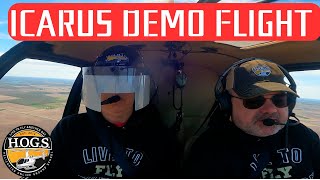
YouTube interview/demo (host: Kenny Keller) of the Icarus Device — a smart, view-limiting helmet/visor system for helicopter instrument/IMC training. The video explains device components (visor, power control unit, app), traces the inventor’s decade-long development story, lists early adopters (law enforcement, EMS providers, flight schools, military), demonstrates app-controlled visibility transitions (gradual fade, selectable transition times, VMC safety mode), shows in-flight training in an R44, and includes strong user endorsements recommending the device over traditional foggles. The creator’s website (icarusdevices.com) and social links are noted for follow-up.
Questions this video answers
Instrument Conditions Awareness Recognition Understanding System.
icarusdevices.com.
About a decade of development.
About three years.
Law enforcement (Austin Police Department), EMS (Metro Aviation), flight schools (UND, Embry-Riddle), the U.S. Army, the U.S. State Department, and a unit to train pilots in Antarctica.
Chapters
I'm sold, man. I mean it's. I totally get it and I will, I'll support you in your device and your endeavors and flight schools, hands down, should be investing in a set of these. No doubt. I mean it's a no, It's a no brainer.
All right, we got something new and fresh for you today. Something that can help you live to fly another day. Super important device here for helicopter training to help keep yourself alive, help you learn what to do in the event you fly into the clouds when you weren't intending to. You got to be prepared and you got to figure out a way that you're going to be able to save your own life. And right here is a wonderful tool to do it. This is Nick with Icarus Devices and we invited him to the Hogs hangar. I want to put in real quick how we met this year at Heli Expo. I'm just walking down the aisle and quite a few people that I wanted to talk to but I didn't always like, well, you know, kind of maybe just hesitated, didn't want to go up and didn't want to, you know, just my own self confidence, right. And Nick just coming out there and grabbed me as me and Gloria, my daughter were walking down an aisle and just coming out there and grabbed me and brought me over to show me his device. And so for those entrepreneurs out there, you know, be like Nick, right? Have the initiative to just jump in there and fricking go for it. Because that's why he's here today. And I'm going to help him promote his product. That I believe in non paid advertisement here. It's not an advertisement, it's this great product. I know you had something you want to say.
Yeah, Kenny, you miss 100% of the shots you don't take. So I recognized Kenny and I was like, you know what, I want to go talk to him. So he was more than gracious to come over and let me show you, show you what we're doing here with the Icarus device, which stands for the instrument Conditions Awareness Recognition Understanding System. It's a smart view limiting device and we're out here to get people better. Inadvertent IMC and IFR training.
Perfect. So you told us what it is who uses this product.
So we've been selling them mostly to law enforcement operations, ems like the Austin Police Department, Metro Aviation, which is a huge EMS company. State department flies with them all over the world. We just sold a device that'll be used to train pilots in Antarctica. And the military, the army is our best customer right now.
If I can encourage anybody that's interested in this product, we'll have his website down below it will be icarusdevices.com yes sir. And we'll mention a couple more times and that will be below the video. So if you want to go find out more than what you see here today. Icarusdevices.com and he said everything's there, contact, everything you need to know is there. And of course he's on social media as well. Facebook, Instagram and LinkedIn, correct?
Yes, sir.
What about flight schools? How many flight schools are using it?
We've done pretty well with helicopter flight schools. So UND is using it. Embry Riddle suu, a lot of the big ones and then quite a few of the higher end type of training in the sense of like turbines and stuff like that. So partners with the Helicopter Institute, there's a ton of flight schools and also independent instructors who use the Icarus device.
Nice. I was impressed. I think for the price, what it can do, I think for flight school, it's a no brainer. I think it's something that should be well within their budget if they have, you know, currents coming and going and they're doing instrument training. Well, not even just instrument training. This can, a student pilot needs a little bit of that what to do if things go really bad. So it's not just for instrument training. It's, it's really good for anybody that's in the cockpit manning a helicopter. It's a, it's going to be something that can help you prepare for the worst that could happen to you if you made the wrong decision, you didn't judge things correctly and you ended up popping into the clouds.
Been about a decade of working on it. And as they say, necessity is the mother of invention. So I had a really bad experience with poor instrument hoods and we almost hit a bird. I was on an IFR training hop and it was not a fun experience. And I was walking away from the helicopter that day. And about 10 years ago the Boeing 787 was coming out and it has electrochromatic windows in the back seats. There's no visor, it's just a dial. And I thought, well, if Boeing can figure out how to put it in there and make it weight and cost effective, why are we still training with pieces of paper, you know? Ended up selling my car to get a patent and starting off by making the first ones in the garage. And then I upgraded to making it in the basement. And you know, played around with this film. The smart glass PDLC technology has been around for about 20 years and you see it in conference rooms and you know, sometimes in fancy hotels in Japan they use it in bathrooms for whatever reason. But anyway, so I got some of that film and just started prototyping it. And if you look at my really old stuff, hopefully if you can't find it, but you know, it didn't always look like this. And we've been on sale for about three years and you know, just, just been bootstrapping it and selling your car.
To move the business forward. Yeah, been there, done that.
Yeah.
I'm gonna walk over and I just got a brand new set of goggles. I'm gonna go grab them.
Okay.
So we're here with this device that we're gonna talk more about. I just ordered a set of these. Okay. Because we have some three commercial guys coming up and in the pts that will soon is now the acs, you need a view view limiting device for the checkride. So for those of you that don't know and you're new to this whole flying thing, so this is what we've been using for decades. You put this thing on. So like me, I wear glasses. So first problem, I have glasses and then I have to have those. So then I'm trying to put these things over top of my glasses. Okay, how does that feel and how does that look? So, and then I've got, you know, a bifocals, right. So or trifocal. So I use different areas of my glasses to look at the instrument panel. So now you're going to make me put these on and I'm going to get in the aircraft, you know, or actually we're out flying, we're doing instrument training here. Put the foggles on. So you're jacking around in the aircraft and you're putting these stupid things on. And then I'm here, I am flying helicopter going, you know, and you're trying to keep your head down. But look here. And you're trying to get the right parts of your glasses. I think that's going to help show the value of what you're going to show us here shortly.
Obviously I can't compete on price with a. You know, these are just 10 cent from China safety glasses and they've got the really thick temple. So when you put your headset on it hurts and you start getting, you know, an hour into it and it's, your head's throbbing and you know, you're not getting Good training. The cutout is just for, you know, standard for an aircraft panel, which is very different than your R44. That's something that Icarus that we do. We tailor the visors cutout to the panel. So this one's for an R44. And you can see this is about the smallest that we'll do. And it's slightly off center because we fly helicopters from the right seat. So the instrument panel is slightly to your left. And we're all after, you know, our big goal is to give you the best training possible. And you're not going to get those visual cues in a cloud. You shouldn't get them in training.
Well, what came to mind as you were talking about that and us bringing these up? I'm not a guy that I don't get a lot of headaches, but I can tell you some of the worst headaches I had in my life were during my instrument training. Getting ready for my instrument checkride, wearing these stupid things and trying to fly and do all the procedures and everything I needed to know to fly proficiently gave me this incredible freaking headache. Yeah, and I hated the instrument rating for that. It was the hardest rating for me. It was difficult, gave me headaches. I can already see, I haven't even attempted to wear that, but I can already tell, hey, at least I can wear my glasses and I don't have this. Oh my God. The benefits obvious already.
And the, the device, the frame is made of carbon fiber and you want to make everything in aviation light. And a big part of that is, I mean, there's a safety aspect to it, there's a comfort aspect to it. But when it comes to training, I can get it so light that I can get you to forget that you're wearing it. So three basic components of the Icarus device. You've got the visor, the power control unit and the app. So with the visor, which will go on your head, you can come here and your instructor can use the app.
Well, let's do it.
For doing a, like an inadvertent IMC scenario, I can give you a drop down and this is a seven second transition.
Oh yeah. Oh yeah, that's, that's beautiful. That, that's authentic.
That's another thing about instrument approach training is you're doing an instrument approach because the weather is bad, so the visibility is probably not 10 miles clear in a million underneath the clouds. A lot of times you're going to break out and it will be like four miles, which if you don't Fly around in four miles a lot. You'll realize four miles isn't that great of visibility. So you're going to have to hunt for the airport a little bit more. So I really want to give people a chance to replicate that. In the EMS industry, people do point in space approaches to, you know, the top of a helicopter pad. So that's one of the reasons why it's so popular, especially with the IFR programs, is that they can simulate that they're breaking out into marginal conditions. And you've got to hunt for that airport. Sure. So the app is very simple. It has two pages. So on the settings page, we've obviously paired already, we can set a transition time so we can go all the way up or down to maybe an instant transition. It'll log the time and then we can adjust our settings, go back to the regular settings. Now over here on the Icarus page, if we go VMC safety. There we go. And boom.
Clear.
Boom.
It's clear. Instantly clear. And then if I go down through the visibility levels, it'll now transition.
It should transition very quickly.
That's what I like that fact of it, man. The fact that you can keep that in the flight scenario and you're able to change and go in and out for the. That's, that's.
And honestly, there's never a reason for me to take this off in flight.
Correct. Yeah. So we can. We can do kind of wall to wall. You're not breaking the scenario for immersion. Take the fog wheels off. You can for instrument training at 400ft, what are you going to get on an instrument plan? You're going to start getting that first turn, probably. So you're in that turn and boom, I put you in. And now we're on instruments. So it's really a tool designed to give that instructor the capability to make the scenario however they want to accomplish their objectives for the day.
You know, you just opened my eyes to the reality of, again, training with Foggles. Thank you for opening my eyes. Thank you for opening my eyes. You know, never once have I been climbing out in a helicopter at 400ft and instantly gone IMC. Because we don't do that with Foggles.
You can't.
You can't. At least. At least not with me on the controls.
Yeah.
You know, so we spent a lot of time yesterday bashing iPads and how they can overheat and fail. And I've talked about my own failures and how tpes have failed my iPad for me. And I think the value of this is you've thought that through a little bit, and let's just say you didn't get it charged last night. The battery dies. It overheated. I don't know if it even can overheat. Can it overheat?
It won't overheat if the battery dies, it'll just. Well, that's what won't go perfectly clear. Yeah, you'll have warnings, and there's a battery indicator on.
Yeah. So I just want to show the power failure. We're just going to disconnect it visibly right there. And there you go. For whatever reason, my battery doesn't work and I'm already in the air and I can still go flying a train today.
Yep.
Old school. Foggle style.
Yeah, well, you know, ground demos are okay, but the best demos are flying, actually.
Well, since I get to be the instructor this week, how about we grab Kenny and we go fly the R44 and put this thing through its paces?
Let's do it.
Let's do it.
All right, boys, I'm flying. You call out what you want me to do.
All right, well, let's give ourselves a little extra altitude today for. Give ourselves at least 1800. And if you're ready, we'll start.
All right, I'm ready.
All right, so we're just gonna start skirting through the clouds in 3, 2, 1. So focus on your scan.
That's kind of cool. I mean, seriously, like, that's how you would start, as it would start happening to you.
Yeah, that's what I like about it. It's not an on off switch.
Because the. You know, the times that's. I've had, I've been there. I've done this. I've been there popping through this crap, and I've done it at night. And you're going, oh, shit, now what do I do? And I'll already tell you. I prefer this 100% over freaking foggles. Yeah, screw that shit.
All right, so I'm going to fade you into 1 mile visibility in 3, 2, 1. Should gradually fade in. How's that looking to you? Think you got a mile, Viz?
I think that's. It's. It's over a mile.
Yeah.
You got that white building up there.
Yeah.
Oh, yeah.
So, yeah, that's. That's probably.
I can Probably. I can see the. I can see the horizon right now.
Okay. So I want to bring it down a little.
Oh, yeah, now you're getting it to come down. You're not.
You don't. You don't have the Horizon now.
No, no horizon.
All right, so what about that white building on the nose?
Nope. Okay, so all I can see now is the instruments.
Keep flying this heading. Watch your VSI and watch your trim and. Maintain this heading best you can. Kind of hard. The only thing you got to maintain your heading is a turn coordinator.
I'm pretty damn happy with what I'm doing at this point.
Honestly. I didn't think about the heading until just now with this helicopter, you know. So this is, this is a good training opportunity.
Yeah.
I have straight up VFR helicopter and you don't have a directional gyro to help right now.
Right.
So remember that. You start giving me headings, I can't see any.
Well, you got a compass, but we all know that sucks.
Well, if I do that, then I'm cheating. I can see outside.
Okay. You got that white building on the nose yet? You are climbing quite a bit too, which would be okay in real. In real iimc, I can see a.
Couple of white buildings now.
See the tall one? It's like a farm thing. I don't know what they're called.
I can't tell you. There's two big white buildings up ahead. I can't tell you. I don't know which one you're talking about.
Okay.
Getting pretty slow, Kenny, which is a real reaction to flying in these conditions.
I'm almost back to my 2000. I'm a 65. I was trying for 70, so, you know, I can't see. At least I'm doing this. Well, that's the way I look at it.
The bad news is the weather's not getting any better this direction. And now I'm reducing your visibility to half mile. Considering the instruments you have available and the conditions I'm presenting you with, you, you're doing a good job. You're a little out of trim. You caught the climb before. Who gives this.
I can't see. I got 2,000. I got 2,000ft. 70 and 0 rate ascent. I give a about trim right now. I got the aircraft under control. I could care less.
I haven't had to take the controls.
That's.
That's a positive.
I'm freaking happy with what I'm doing.
You see that big tall building? 11 o'. Clock? 11:30. Just a little.
The one at my feet, but not. I can't see through the. I can't see through the.
It's not at your feet visor.
So no, I can't see it.
Can't see a thing.
No.
Have you had enough? You Want me to bring you out?
I mean if we want to turn direction since we're, you know, going to end up, we'll end up at Michigan soon.
All right.
I'm just saying go ahead and give me a left standard turn. And starting now we'll go to 16 minutes on the timer. I'll call the timer for you.
So you want me to go now?
Yeah.
All right.
All right. And I'm gonna bring you out, Kenny.
Okay.
One of the, one of the reasons I initially developed it was so that you could quickly clear it specifically to find traffic.
Alright. So my review of the product, I like it. Right. It's standing in the hangar today talking about this. I could already see the benefit. You know, all I've ever used is foggles. Even in professional EMS environment we were still jamming foggles up underneath our helmets. Yeah, this, I get how you said, how you set it up for the R44. This is perfect for this particular R44. It's perfect. I mean the size fits the panel perfectly. I'm able to see what I need to see. You know, for doing it in an aircraft where we don't have a directional gyro, we don't have an indicator training. Yeah, for, for what we have to work with for our VFR aircraft in this little bit of flight that we did. Just kind of messing around. I get it. Because we can do those scenarios where the instructors making the different changes through the screen. And especially when we first started when it was like popping me in and out, in and out, that was realistic. That's something you'll never ever, ever get with a goggle. And I like how it is perfect for this instrument panel. It's set perfectly so I can firsthand tell you first time out, this is what people need to be using. And for the money I can't see any flight school going, ah well, let's just use a twenty dollar piece of, you know, garbage. Garbage. Let's invest in the money and let's get the Icarus device and get out there and give somebody that's a much more real world scenario. I like it. I like it a lot.
Yeah, I love it. Appreciate it.
Kenny, I'm serious man. I'm gonna help you promote this thing because it's, this is a freaking. With the kind of money that you spend on aircraft and everything that we do, the money for your equipment, well, it's, it's totally reasonable.
I get what you're saying, totally reasonable. But let's not forget the money, the value of your life.
Yeah.
This might one day save your life.
If you and if you find yourself in that situation, do you want to be like, oh man, I really love that I saved, you know, I went with the cheap option.
If we end up in your story with our 10 year old son next to us inadvertent imc, we don't want to be wishing we'd spend money on inadvertent IMC training.
Yeah.
No. You know, I don't do much. Everything I've done, this probably part of the video, everything I've done for going on 13 years, I've never been paid to promote anybody's anything. Right. And I don't. If I show a product or a service, it's only because I believe in it and I believed in the idea. As we state the beginning of the video, when you presented it to me at heli Expo and now that you've come and demonstrated it to me and I've got to get in here and actually use it, I'm sold, man. I mean it's, I totally get it and I will, I'll support you in your device and your endeavors and flight schools, hands down, should be investing in a set of these. No doubt. I mean it's a. No, it's a no brainer.
Yeah.
I mean it's a no brainer for me. Live to fly another day. Helicopter crown.
I can get a better angle on it. I'll press it and you can narrate.
It when you feel the pressure to fly. But know the right decision is to stay on the ground, hit the hogs. No go. And live to fly another day. Helicopterground. Com.










