Helicopter Normal Approach, Collective Controls The Angle, Cyclic Controls The Speed
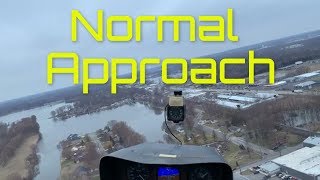
Kenny Keller and Heather demonstrate normal helicopter approaches to Runway 18. The collective controls your descent angle, the cyclic controls your speed. Start at 300 feet above ground at 60 knots, aim for a 10-degree glide slope, and climb out at 500 feet per minute.
Chapters
All right, people, Kenny and Heather with helicopter land ground school. We're gonna go out and shoot a normal couple of normal approaches. But we're gonna give you the shot today of not only outside looking out towards the Runway, but we're also gonna get some panel for you. For years, man, I want to see the panel. Well, what we do, we got two stamina stabilized cameras going. And this way you get to get the view both inside and outside. So I'm gonna make a radio call.
Here on the trap or check that Warsaw traffic helicopter 8626 Papa departing one eight for right traffic Warsaw.
Okay, so we're gonna get going around the pattern. I'm going to kind of talk to you about the setup as we're going around. And then again, I'm going to have Heather kind of alternate between shots of the panel and also looking outside. And the thing I always say it's hard for me to show you in a video what my sight picture is going from my eyesight down to the numbers 1 8. We're going to use 18 as our landing spot. OK. So when we are shooting it in, I'm gonna have Heather hold the camera about the same height as my eyes. So as you can hopefully see when I'm looking from here down through the compass down to my spot 1 8, hopefully you're gonna get that, be able to see what it is I'm talking about. On my angle, a normal approach is 10 degrees, steep approach is 15 degrees, a shell approaches 5 degrees. So I'm gonna shoot what I believe to me is 10 degrees. And when I from my sight and my height looking through the windshield, about the center of the compass lined up from my eyes to the compass to the numbers 18 is pretty darn close to that, what I believe is 10 degrees. That's how I shoot my normal approaches. So again, as I set it up, I'll have Heather alternate between looking at the panel once in a while. Have her hold the camera up to where you can see my sight picture. So we're turning downwind right now. So I'm gonna check left and right, make sure we're good. Don't see anybody coming. I make a radio call.
Warsaw traffic helicopter two six Poplar right downwind for one eight. Warsaw.
Nice quiet day, not manybody out, not many people out. It's overcast, so it's not as pretty, but not as many flyers. So the radio is quiet, airport's quiet. Good time for us to shoot some video. Okay, so on a normal approach, I Tell everybody all the time. The key is a good setup, right? If you set the normal approach up nice, it's going to be nice. Collective controls the angle, cyclic controls the speed. About 1250. Should be at 1300 for my 500, normally where I would be right now. But I'm also basically beam my spot so I can start a small descent. When I start my approach, I want to be at 1100, which is 300 AGL, because we're at 800ft here. I want to start my approach at 300 AGL and just a little over 60 on my airspeed. Now, depending on what helicopter you're flying, you might be shooting approaches at 60, you might be shooting them at 70, you might be shooting them at 50. Depends on what aircraft you're flying. For this helicopter today, I'm going to use 60, so I want to have basically zero rate of descent. I want to be just above 60. So when I go aft cyclic at the beginning of the approach, I can pull back and pull it right to the 60. I want to be in trim and I want to be 300 AGL, 1200 AGL right now. So now I need to clear basin or clear basin final looking right, looking left. Making my pattern plenty big. So I got time to talk to you and tell you what I'm doing. Clear left, clear right.
Warsaw traffic, helicopter two six, pop up right base turning final Runway 18. Warsaw.
Okay, I'm gonna turn, line up with the Runway. I'm about to my 300 AGL. I'm about 65, so I want to try to get everything set where I want it before I start this approach. So good job, Heather. Yeah, pulled it right there so they can see where I'm setting everything up. There's my 1100. So then I'm 300 AGL. I'm a hair slow, just a little bit of power, get a little bit of speed. My VSI is close to zero. This is a nice setup. I like it. I'd like to be a couple mile an hour above 60, but that's okay. Now, Heather, raise the camera up about my eye level. And I'm waiting until my eyesight looks right through that compass down to the numbers 1 8. So here we go. I'm going to go down collective right pedal, aft cyclic. We do that every single time. And it should look like I'm approaching those numbers at the same speed, meaning the whole time I'm going to keep giving a little more aft, a little more aft. And I'm going to keep slowing it down. Go Ahead and keep it up there, Heather. We'll show you this time what it looks like looking outside. Then the next time around we'll stick more on the numbers. But I like this angle and I hope it's showing up good through the camera. Like I said, she's holding it about the height of my eyesight. Okay, so I'm following a line all the way down there to the numbers 18 and I'm trimming into the wind until around 50ft. Now I'm pushing in the left pedal. My angle is still nice. And because I'm just gradually slowing it down, I'm not flaring. I'm keeping the helicopter nice and level. I'm glad I went out and practiced these the other night because that was pretty nice. Normal approach and I don't hit them exactly every time like I like them. Sometimes I do. Most people don't nail them. Just perfect every time. Alright, so I'm going to clear my tail left, I'm gonna do a right 360 turn, check for traffic. We're gonna go around and we're gonna do it again and this time I'll have Heather focus the camera more on the instrument panel. So the first time around you kind of got to see my sight picture, what it is I'm looking at. And I can tell by where she's holding this, it's going to be pretty darn close. And for you, no matter what you're flying, the sight picture is going to change, right, depending on the aircraft, the model, where the compass is located. But you're going to figure that out for your aircraft what your sight picture is. Some people draw, take a marker and you know, put a mark on the windshield for their normal approach. All right, so make a radio call.
Warsaw traffic, helicopter 26 Papa departing 18 for right traffic Warsaw.
All right, so let's just talk you through your normal approach while we're going around to do normal landing. We'll just throw an extra in there. So what I'm going to do is I'm not going to increase any power. I'm just going to leave the collective right where it's at now. It's going to gently start moving forward. Let the aircraft start to build speed. I'm going to keep it low to the ground, stay in ground effect, and right about 30 or so, boom, there's ETL. I'm just going to push a little bit through the forward with the cyclic. I bumped the trim forward and now I'm going to get my 60 for my speed. And 500ft per minute on the climb. That's a textbook climb for most aircraft or most helicopters. 60 and a 500ft per minute climb. I have not changed the power the whole entire time. I trim into the wind now and I got my climb, got my speed looking good. Okay, so as we go around, I'll just keep talking. I've got my, you know, my landmarks laid out to where I know where my pattern is. And you should have the same thing wherever you're flying to do your practice. You probably already doing that. If not, if you're brand new to this, you want to pick out some landmarks so you know about where to turn base, where to turn final, so on and so forth, and what works for you and your aircraft. So I'm going to repeat myself. The key to a good approach is a good setup. If you set it up nice, it's going to be nice. If you set it up sloppy, it's going to be sloppy. That's just how it turns out. I'm going to clear left and right looks good. Don't see anybody. And I'm gonna turn back now on my downwind. So my downwind should be 500 AGL, which is 1200. I'm right there. I want 70. There's about 70. 75. That looks good. I like that. I still got a hair of a climb, so I'm going to lower. Just a hair collective, make sure I'm in trim. I am gonna make my radio call to get it out of the way.
Warsaw traffic, helicopter two six papa right downwind for one eight Warsaw.
Okay, so I'm gonna hold my 500D AGL, hold my 70. Downwind checks warning, caution lights are out, gauges in the green. All my switches are on all the way across the board because I got all my lights on so anybody can see us. And it's looking good. I like it. So I'm thinking ahead of time. I'm looking out. When I'm a beam, the numbers 1 8, which I'm about there. I'm just going to start a very small descent. And I got lots of time again to set up my normal approach. And to set it up, I want to be 300 AGL. I don't want a big climb or a big descent because that could throw off your sight picture. And I want my speed just above 60. When I start the approach, I'm going to go. I'm going to do the same thing I do every single time. It's three things. It's down, down, collective right Pedal aft cyclic. And those are all small, tiny minute changes. Even if we held the camera on them, you wouldn't even be able to see them. They're that slight. So more importantly for this video, again, I'm going to have Heather keep the, keep the camera on the panel so you can see exactly what I'm seeing and hear as I'm talking through it. For all of those of you that have been saying, I want to see the panel, I want to see the panel. All right, here you go. We're showing you the panel. And if you make fun of my old 1983 F28F, I will smack you. Because you know what? This is a great little helicopter. I love flying it. And you know what? It's a freaking nice helicopter. It doesn't matter whether you got glass cockpit, you got old gauges like this, it don't matter. They all work. And the methods are the same regardless whether you're reading from a glass display or using the old gauges, it don't matter. Okay, so I want to start lining up. I showed you the sight picture before, part way through. Maybe I'll ever hold the camera up just for a minute, but you're just going to stay focused on that stuff. So there's my 1100, there's my 60, zero rated ascent. I'm in trim now. I'm just waiting until I have the sight picture. I want to start flying it down. We don't have much wind today. If we had more wind, this would be actually easier. I'm actually a hair below 60. Just a hair. But I'm okay with that because there's not much wind. I have the sight picture I want. So I'm going to go down collective right pedal, aft cyclic. And I'm just going to keep gradually bleeding off that speed. The whole time I'm coming in, it should look like I'm approaching those numbers at the same speed. I'm using the collective control, the angle, the cyclic to control the speed. I'm about halfway through the approach. You can see I'm about 45. You can see my radius sense about 500ft per minute, 600ft per minute. I'm going to start raising collective. I'm going to get rid of that before I get below 30. And you watch me. I'm going to do it. I'm going to keep her moving forward. I'm raising some collective, Keep her moving forward. I want to get rid of that rate of descent. Like I said, it's calm today, but there we go. Now that's 300. That's nine seconds behind. So staying 200ft per minute as I get slower than 30, ain't no way.
I get in vortex ring state selling with power.
No way. I'm still in a nice angle down to my numbers, keeping it level. That's how I fly an approach. You have some people that want to fly the approach fast to put a big flare at the end. You know, if that's the way your guy wants to teach it or your girl wants to teach it, that's okay. It's a method. But normally, what they'll say is, oh, but it's the high velocity diagram you got to worry about. Well, coming from legend in the industry that I was lucky to train with, you know, they write articles about this guy. He's the one that turned me early on. He said, kenny, the high velocity diagram is for takeoff. It's not geared for approaches. You're more likely to have a problem when you're pulling power than when you're descending in nice and slow. That's how I was taught to do them from the beginning, and that's what I've done my whole entire career. I don't argue about it. That's just the way I do it. Let's go around and do one more time. What do you think, Heather? That's kind of fun. You want to do one more? Yep. All right. Let's just keep the cameras rolling. I don't have to edit. It's going good. Here's another normal takeoff again. And you can focus on the panel on this one if you want to. Heather, last time, did you show the panel on takeoff? If you want, go ahead and. Just go ahead and focus on the panel this time. For the takeoff, I'm going to add no power. I'm just going to just keep engine slow forward just little bit by little bit. Trying to stay on top of the pedals, Trying to keep the nose straight. I want that airspeed to come alive before I start climbing. Still added, no power. Here comes etl Forward cyclic. Airspeed's coming alive. Trim forward a little bit. Look at that. Boom. I added no power whatsoever. Boom. I already got 50. If I adjust the cyclic just correctly, I can get 60 and 500, and I've still never changed the power. I'm going to show you exactly how I do it. All right, I'm about 50ft, so I'm trimming into the wind now. There's my 60. Almost to 500. And I am actually pulling less power than I was when I Took off because the road should just become more efficient. So the, the power requirement changed. Not because I changed it because the aircraft is now more effective. Awesome. So there's 70 now. We want to climb to 300 AGL before we start a turn. That's textbook. I learned that as a basic private pilot and when I flew EMS, our EMS company due to the 135 regulations said you will do, you will make your climax until 300 AGL before you turn. I learned it as a private pilot and I was expected to do that as a commercial pilot flying EMS with more than 2000 hours and however many years of experience I had at that point, I was expected to climb to.
300 AGL before starting a turn.
So that's textbook and that's what a lot of companies like to see. Alright, so we're going to do it one more time. Then we're going to go in and see how this come out. I think this should be a pretty good cautionary video. Clearing left and right. Gonna do my downwind checks early. Get them out of the way. Warning, caution lights are out. Gauges in the green. Fuel's good. I got my timer running. My switches are on, my boost pumps on. Everything's looking good, looking nice. Okay, so I'm a little high. So again I'm at 800 at this airport. So I'm going to go. I really want to be about 1200 for the 500 AGL for our normal. I'm a little fast so I'm going a little down. Collective adding a little bit of right pedal. I'm just going to wait till I see my ABEAM spot and then this time, let's see. I'll probably have Heather start out with my I the picture outside first on the bridge and then so again I could try to hold it about eye level so we can talk about that angle. You know what, this time we'll just leave. You know what Heather? This time just keep it right about where my eye level is so they can see and I can talk more about the angle of the approach and how I'm using the collective to control the angle and I'm using the cyclic to control the speed. And I should be looking. You can watch me. I, I should be looking.
Traffic Malibu 6 my campus 6 miles west. Inbound landing Orsa.
I should be looking more outside than inside. I should be knowing what I'm doing by feel and, and backing it up of what the aircraft says. So I believe there's a helicopter in.
The pattern at Warsaw. What's your location.
We're getting ready to turn right base and final to 1 8.
Roger. That's our landlord. Oh cool. I didn't know he was a pilot.
Warsaw traffic on Lou 6 Mike M5 West. We'll make a right base. Runway one eight Warsaw.
Coming in behind us.
Warsaw traffic, helicopter 26 Papa. Right base turning final for the numbers one eight Warsaw.
All right. I figured he'd be using two seven.
Oh well, are you guys going around again after this one?
We might be going in after this one.
It's got to be a slow approach though.
I can move over to the taxiway.
If you need me to.
Let's see, we're three, three and a half mile, right base, right now.
Well, you know what, right now is a good time for a go around.
I'll just do that.
I'm doing some teaching to the video, so I'll do that and you can head on in.
I appreciate it.
All right, so let's do a go around. This is a good time to do this. This is one of the ones that I told Heather this morning. I was showing her how we're going to reshoot a bunch of these maneuvers. So on a go around you're all set up, ready to go. What do you do? Airplanes coming in. I'm going to let them come in because I don't want to feel rushed trying to film that approach. So you just pull the power back in, get your airspeed and you make a simple radio call.
Warsaw. Travis, helicopter 26 Papa going around for Runway 18 following the fixed wing traffic, Warsaw.
Okay, that's all you basically do when you do it.
Warsaw traffic, Malibu 6 Mike, have a two mile right base 18 Warsaw.
When you call a go around, it's pull the power back in, make sure everything's good to go and make a simple radio call. Like if you're in uncontrolled airspace like this or if you're in a towered airspace, you just let the tower know what you're doing. Go arounds are so freaking important. And the thing that I see, in my opinion, not enough people go around and as often as they should, you can go around to avoid a problem. Like you said, traffic.
Melibee6 Mike to have a turning final 18 will be full stop or something.
If you, if you're setting something up. Yeah, I lost my train of thought. Darn it.
Listen to the radio.
God, what was I saying? Going around. Oh, going around. That's right, going around. So you'll save yourself so much headache and heartache and you might even save your life and not kill yourself because you set up a sloppy ass approach. And then you have the macho attitude of, oh, I can do it. Oh, I can do it. You know what? Have them be macho and be brave enough to go, you know what? I'm going around that, that approach setup sucked or I misjudged the wind or whatever the case is. Oh, somebody just pulled into my landing area with a truck. There's a thousand reasons, a million reasons why you might need to go around. And I'm telling you, as an instructor of 20 years, people do not need, do not go around enough. And when the five years in ems, I will tell you, the Czech airmen always praised me when I would be setting something up. And I just go, you know what? I set this up sloppy, especially on confined areas. And I just go around. And they go, God, why doesn't everybody do that? And they would tell me, you know, guys will set up this horrible approach. It'll be all jacked up and they'll fly the thing in and they'll be too steep and their airspeed goes to nothing. And they're like, it doesn't matter what's going on in the backseat traffic.
Malibu 6 Mike have a clear 18 taxi to the ramp. Appreciate that.
Okay, no problem, man. Thank you.
Warsaw traffic, helicopter 26 Papa, right downwind for 1 8.
So the point of that, of this is we threw that in there. That way I don't have to edit and go around. I've been thinking that in my mind. You know what? I haven't pushed go arounds in a while. I'm telling you, if you set it up sloppy, go around, somebody pulls in your landing area, go around. You misjudged the wind. Go around. It's just, you'll save your own ass, man, and it'll make you a better pilot. And I just can't preach enough how important go arounds are and their maneuver on your checkride, right? If you go around your checkride and you weren't doing anything really dumb, the examiner could. Oh, well, hey, we just took care of the go around maneuver. Let's go around and try it again. I'm not saying you can't fix the end of an approach when you completely blew it and you're screwing it at the end. That's not what I'm saying. I'm saying at the very beginning, something ugly kind of happened. You go, you know what? It's going to go around and set that up again. My examiner will Go. Great. Sure. Again.
Well, it's not dangerous and stupid.
All right, so we're going to do radio call.
Warsaw traffic, helicopter 26 Papa. Right, base, turning final to the numbers 180.
All right, so I'm going to tell you one more time. Key to a nice approach is a good setup. Heather's going to keep the camera up at eye level to show you what the sight picture looks like. And we're really going to talk about the collective and the cyclic. So I got zero rate ascent. I'm about 50ft high. I'm in trim. I'll clean that up a little bit. So for my approach, for me in this aircraft, when I have my sight picture, a visible string. Imagine a string going from my eyes through the middle of the compass all the way down there to the numbers. I'm almost there. I'm close, I'm close. I'm a little bit slow, but that's okay because I don't got no wind. Here we go. I'm on my angle, so I'm going to start my approach collective down a little bit, right pedal aft cyclic. And I'm going to slowly bleed that speed up from here to there. I'm controlling my angle with the collective, my psychic with the speed. Right now I'm not doing anything because this instrument flies like a freaking dream. A little bit of right pedal. I'm going to go a hair down collective, and I'm going to go a hair aft cyclic. You could never even see it even if I had the camera on it. My angle is freaking perfect. And again, I'm making tiny changes up and down with that collective to keep that angle cyclic. We're down about 40 on the airspeed of about 500ft per minute. Rate of descent. But I'm going to start raising collective now. I've got to get rid of that rate of ascent. I'm still above 30. No danger of vortex ring state or sling of power as we're at 300 right now. My angle's still good. I'm just raising Collective, and I'm working that cycle to keep us nice and level. I'm telling you, a lot of people fly their approaches this way, and a lot of companies are going to appreciate that. As far as the fast approach and the big flare, it's not what I teach, not what I do. Maybe there's a company that wants you to do that, and maybe you have to for some type of reason, you know, maybe in some kind of whatever the case may be. But for just normal flying, normal practice, that's how I do it. That's how we even did it in ems, the company I worked for. I think that's pretty darn good. We're gonna, we're gonna go in and edit that shit up. Oh, did I just say that? I did, didn't I? Look out the right hand side, Heather, and make sure we're clear. And because we're a helicopter, we're just gonna go right across the grass. So this video that comes out good will be inside helicopter line ground school for our members. But I was planning on putting it on, maybe I might throw it on YouTube today just because I'm kind of proud of it and I haven't even seen it yet. If it sucks, I won't put it up. I like it. In the end, all I care about is whether I like it or not. So we're gonna go in, see how it came out. Subscribe to the channel and when you subscribe, click that little bell because some crazy stuff going on in the world right now. You know what? People are gonna be home watching YouTube. So what are we going to do? Every day that the weather split, we're going flying and I'm going to shoot something new. Number one, for fun and I like to fly. Number two, to work on my skills. Number three, to update these older videos that are inside helicopter only ground school. I just checked them out all this morning. Some of them are as much as nine or 10 years old. So, you know, it's time and I can fit in a lot of things into these videos that people have been asking for for a long time. So I'm kind of excited about that. So we're going to set her down, shut her down, subscribe, click the bell, click the thumbs up button that's right there directly below the video, and we'll.
See you in the next one.
Peace out. Awesome.










