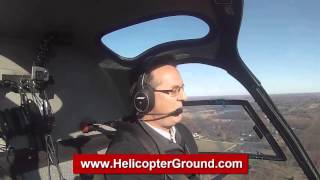
YouTube video by Kenny Keller (Helicopter Online Ground School) answering a member’s question about wind limits for helicopter training and EMS flying. Keller gives conservative guidance for students (typically solo limits around 12 knots), discusses increasing tolerance with experience, describes rough thresholds for operational EMS flying (rough above ~30 knots, with gusting conditions making lower steady winds uncomfortable), and offers practical tips (stay relaxed, slow to ~60 knots, land if it becomes unsafe).
Chapters
Hello, I'm Kenny Keller, the creator of Helicopter Online Ground School, and I'm going to answer another question from one of our members today. This member asked, hey Kenny, I was curious about wind. And he said, how much do you use? As a general rule, that's too much for training. And then he asked another question was how much did you guys use for too much in ems? So what I want to say is, you know, as far as training goes in the beginning, you know, you want a fairly calm, fairly nice day, you don't want a whole lot of wind. As you progress through the and you get better and more experienced, you can handle wind a lot more than what you did in the beginning. And it's even advisable to go out as you're going through your training before you get, say, the private to go out on an extra windy day at least a couple times with your instructor and let it beat you around and get to know that feeling of what it's like when it's kind of uncomfortable in the wind speeding you around. But you know, as far as, like, say, solo, we don't let students usually go much over 12 knots. We usually sign 12 knots or less for a solo. And then as far as EMS flying goes, we didn't have an absolute limit. It was up to the pilot and up to the crew as far as what we really would go out in. And I can tell you that in general, when it gets much over, say, 30 knots, it starts getting pretty, pretty rough. And then again, it depends on, you know, 30 knots can be not bad if the wind is fairly steady and smooth. But let's say it's 15 or 20 gusting 30, that can be pretty darn uncomfortable. So it really depends on the pilot, depends on the crew, what they're comfortable with. The most winds I've been up in, as far as, you know, current winds is 45 knots. And that was in the Jet Ranger. And I really didn't care for that really at all. And then flying the BK117, I did an approach to a rooftop once, pretty tall rooftop and with winds gusting somewhere around 45. And that was pretty darn uncomfortable. So not saying you can't fly in those higher winds, but it really can be, or it really can be very, very uncomfortable. So, you know, it kind of varies depending on what aircraft you're flying, what stage are you at in your career, but as far as training in general, if it's over 30, I'm not even going to take a person up just because it's just hard to make any progress when you're getting really, really beat around. So to recap, I'd say, you know, you kind of set your own personal minimums after you get flying on your own. Be conservative. You know, as you learn through your working with your instructor, you're gonna kind of get an idea of what's. What's beneficial to your training and what's really not. Just like right now, this day didn't seem all that windy, but I'm up right now and this thing's kind of beating me around a little bit. And it's not that super windy. So, you know, like, there's a big bump right there. It's just not that comfortable. You know, you can do it. The trick is, if you get into turbulence or it's kind of windy and beating you around is don't fight it. Just try to relax. Try to stay as this thing's beating me around, try to stay relaxed on the controls. Slow down. A good number is 60. Slow to 60 and, you know, just kind of ride it out. If it's getting too much for you, get it on the ground. You know, get back to your home base or find another place to land. If it's getting to be too much, it's just not a lot of fun getting beat around in a helicopter. So I hope that helps. Leave your comments down below. Please give us a like and a share and we'll see in the next video. Oh, and psycho. You want to learn more about our helicopter airline ground school? There's a link either below this video, beside this video or above this video, depending on which form of social media you're viewing this video. So if you'd like to learn more about our helicopter online ground school, click that link below, beside or above. We're celebrating four years online, 600 members worldwide, and numerous, numerous checkride success stories from our members. Getting through the big pile of paperwork, the big pile of books, and all the things that you have for your checkride can be very overwhelming. No matter what it is private commercial, cfi, no matter what rating you're going for, it can be very overwhelming. And that's what we're here to do, is help get you through that overwhelm. So again, give us a like and a share comment below and we'll see you in the next video. It.