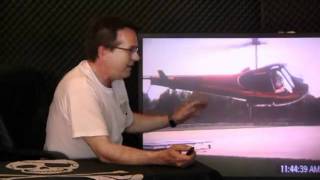
Kenny Keller teaches how to land a helicopter on a dolly safely. Approach, hover steady, then descend while moving forward. Watch for an air-cushion effect starting 6 to 10 inches up, and abort if the landing gets unstable.
Questions this video answers
Around 6–10 inches above the dolly/ground.
Kenny Keller.
June 16, 2011.
Chapters
So here we go. We just shot this the other day. Terry with TJ Productions was helping me. Taj Productions was helping me over at C65. And we're going to point out some of the stuff on the dolly landings. Luckily, we got a dolly that we've been using, a platform we've been using, thanks to one of my past students from Fort Wayne, that is kind enough to let us use it for right now, until we get more established and figure out what we're going to do. And basically, what I want to show you is what somebody taught me back 10 years ago when I started in Cleveland. I was flying with the old timer, and he taught me that when you're making approaches to a dolly, we called it the dolly monster. Everybody gets nervous, and they come in for a landing, and they come up over top of the dolly, and they want to come straight down. The trick that he taught me is you want to get back behind the dolly, get a nice steady hover going, and then smoothly move forward as you descend down to the dolly. Now, if you come in, get a good setup going. You come in to sit down, and you get down, and then you start messing up, and you start getting all over the place. Take a little break, pick up as you're to supposed. See here, Go forward. And then what I teach is do a hovering square pattern. Everything we do in our training is hovering square patterns. So you want to get moving, stop, clear your tail, left or right, depending whether you're making left or right turns. Make your turn, go this direction over here to the next corner. Stop, clear your tail, make another turn, stop, clear your tail again, come around, and then one more time. So the whole point is you're just taking a break. You're relaxing, going, okay, I messed up the first dolly landing. Now I'm going to come around, and I'm going to do it again. So here we come in for our approach to the dolly. We stop. You can see I'm flying in this video, and I'm having a little trouble there. It's a pretty windy day. So here I'm going to attempt to come in from straight down. And this is what I've seen in 10 years. I've seen this happen a lot. Guy comes in, you stop over top of the dolly, you start coming down. The thing you gotta remember is you get that air cushion somewhere around 6 to 8 to 10 inches above, above the dolly, just like above the ground. When you get there, if you're not ready for that, you start to do that typical wobble so if you're nervous you're coming into the dolly, you start screwing it up. You say, okay, going to take a break. So we pick up, we're going to go back around doing clearing turns, and come all the way around and get set up again. Now, some of you may be saying, well, that takes an awful lot of time to go around, come all the way up, back around, and get set up again. Well, you're still doing hover practice. You're giving yourself time to breath in and out, think, okay, it's not really a dolly monster. It's just a dolly. You're trying to get from point a to point b. So I think it's well worth your time to go around, come back in, get set up again, get stabilized, move in nice and slow moving forward, and then come down to the dock. So there you go. Hope that helps. It's not the dolly monster. It's just a platform. If you screw it up, take a break, calm down, relax, and just remember to start back from the dolly, get a nice stabilized hover going, move in nice and slow, and set it down when you're ready.