Hours needed Professional Helicopter Pilot Jobs?
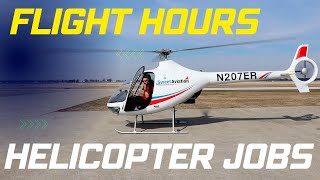
Kenny Keller breaks down the flight hours you need to become a professional helicopter pilot. Private pilot requires 40 hours, commercial 150 to 200, and jobs typically want 1,000 to 2,500 hours depending on whether it's VFR or IFR work. Posted minimums are often insurance requirements that employers negotiate around.
Questions this video answers
40 hours
150 hours (note: many people take longer)
200 hours
1,000 hours PIC
2,000 hours total flight time
Chapters
Yeah. Hours needed for first professional flying job. I'm Kenny Keller, creator of Helicopter Online Ground School. We've been working through a list of 19 different questions that are the top questions taken by our operations manager, Brian Relitch. This video is geared for the beginners, people just starting out looking at starting training or early on in their training looking for the professional pilot route. So let's start with some of the basic numbers. To get your private pilot, it's a minimum of 40. Most people take longer than that, but 40 is the minimum to get the private pilot. Next, to get to commercial pilot, you're going to have to have a total of 150 hours. Now, if you're going to teach in the Robinson, you actually raise that up to to 200. So at that 150 to 200 hours is where you're starting your career. And most people start out as a certified flight instructor. Yes, we know that seems backwards, but in the helicopter industry, the route that most people take to start building time is to become a certified flight instructor. So starting out, we've covered. You're going to be at 150 to 200 hours to get moving on the CFI route. Just start building your time. So it's important to understand there are some other routes in between where maybe it's 300 hours, 400 hours, 500 hours. What you're going to find is the majority of the time requirements or job requirements are based on insurance. So any given different company can have different requirements in order to hire you as a commercial pilot. So you can jump on the web yourself and start investigating. Let's jump over to the computer. From the start of our search, I'm just going to type in helicopter pilot job requirements, Grand Canyon. And I'm using that one because that's one of the popular jobs that people look for when they get a little further into their career. They get some time under their belt as a cfi. So this is the website for Papillon, Grand Canyon Helicopters. I scroll down here to job openings. We'll go to helicopter line pilot. So to get right to it, they're showing us 1000 hours pic, helicopter 100 hours cross country, 25 hours night cross country. No previous turbine time is required. Okay, so they're showing you at 1000 is for one company to fly a turbine aircraft, which the beauty here is later in your career, you're going to need some turbine time. So here's a job that you could get, build a lot of time and be trained into a turbine helicopter. So Finding turbine time is usually the problem for many, many people. So this is one avenue. Okay, so now I'm gonna go back to Google and type in helicopter pilot jobs. Let's just see what comes right up on our search. Okay, so right off the first page here shows something locally in the Indiana area where we're located. And let's go take a look. So in this particular job, line pilot for Air evac Life Team. 2000 hours total flight time 100 hours night unaided or 50 hours unaided with 100 hours aided rotorcraft helicopter commercial certificate, high school diploma or equivalent. This is a very standard hour requirement that you will see for helicopter ems. Okay. And then you can get online. And one of the, one of the most popular ones has been popular for years is helicopter pilot jobs at JF Firm. So let's go take a look. I'm going to go to helicopter pilot jobs. Go down here and pick one in Dayton, Ohio. This is with Air Methods Corporation. They're one of the largest out there as far as helicopter EMS jobs. So first thing that catches my eye, the last EMS job we looked at was high school diploma. This one shows associate's degree or equivalent from a two year college or technical school and two to five years related experience and or training or equivalent equivalent combination of education and experience, bachelor's degree preferred. Now this is for an IFR program. The last one I believe would have been a VFR program. So with this one, 2,500 total flight hours with a minimum of 2000 hours in category 1000 hours pic in category 500 hours of cross country flight time, 100 hours of night flight time, 75 hours of actual or simulated instrument time, at least 50 hours which were in flight in an aircraft including 20 hours in actual instrument conditions in category. So a quick review. 40 hours get to private pilot, 150 hours to get to commercial pilot. 200. If you're going to teach in the, in the Robinson helicopters Grand Canyon tours at a thousand hours with Papillon helicopters, then 2,000 hours for a VFR EMS program and 2,500 for a IFR program. One requiring a high school diploma, one requiring college education. So we invite anyone to go down below in the comments and put any kind of remarks about what you're looking for or what you've seen, you know, throughout. If you're more advanced into this and you're working through trying to get your professional pilot, or maybe you're a professional pilot that wants to share what you've done in order to get where you're at in your training or I should say in your helicopter pilot career. We have our HOGS wall of fame behind us and it's fun now that we are approaching 11 years online. So many fun stories where people started and where they're at now. And we're going to start highlighting some of those stories as we move further and further into the success of our members. But one thing that I want to mention is like on the hour requirements, one of our HOGS instructors, his name is Chris Hauser, he's up here on the wall. I helped Chris with his private commercial cfi and he is now out there working in the EMS industry. And what Chris found and what I encouraged him to do was he was getting close to that 2000 hour. So many turbines, so many night, but he was falling a little bit short and he was in an instructor job ready to move on. And even though he was falling a little bit short of the requirements that he was seeing online, I said apply anyway and keep applying anyway. And Kris got hired at one of those companies worth less hours on certain requirements as what was stated in their online posting for a job. Ends up getting hired and has now moved on to a second EMS company. Got his career started because he was persistent and he just went ahead and he just started applying, put his best, you know, try out there and stayed after it and got hired before he had met actually all those requirements. All right, so next I'll give you an example of how I did it. I did CFI all the way up to 2000 hours when I went to my helicopter EMS job and I started out teaching in the Robinson Angstrom, ended up moving to Schweitzer. And as I was building that flight time as a cfi, I got to go along with news reporting helicopter at the company I worked for. And at a certain point I then got to transition and be the pilot in the news aircraft, which was a turbine helicopter. So that's how I started building turbine time along with my normal flight time. And when I got to the 2000 hour mark, I applied for my first EMS job. And here's a good example. They liked hiring people with a thousand hours of turbine time. I only had 350. And when I was doing the phone interview with them, he made that statement. He said, well, you know, we like to hire people with a thousand hours turbine. And I said, yeah, Well, I got 350. And that was hard to get, so that's all I've got. And he ended up saying, well, we like to see a thousand, but it's not required. And then I ended up getting the job. So again, requirements are set out there, but sometimes they may overlook some of those requirements, depending, you know, on each individual situation. I'm sure there'll be some follow up videos because I think this is a great topic and a lot of people are going to have questions. Put your comments down below. And before we get out of here, free PDF top 10 checkride tips. This is down below the video in the description box. We have a free PDF for our Maneuver guide put together by our Operations Manager Brian Rutledge. That's a free PDF down below. And then there's also a link for our private pilot study guide put together by Operations Manager Brian Rutledge. Again has over 400 questions to help you prepare for the private pilot practical test. And yes, you could use it at the commercial level too, because private's a glorified commercial or commercial is a glorified private. I mean at the CFI level you have to teach this stuff. Link for that down below in the description box. So comment below. We'll see you next video. Peace out.










