Hover Pre Take Off Check Is A MUST DO
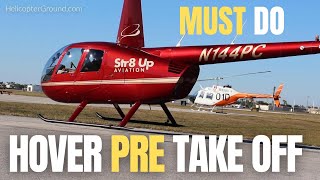
Kenny Keller walks through the hover pre-takeoff check that catches problems before you leave the ground, like a governor switch bumped off. He teaches the painfully slow hover-power-only takeoff for hot and high conditions, and a short running landing for partial power failures.
Questions this video answers
Hover Pre Take Off Check Is A MUST DO
Kenny Keller
February 9, 2023
March 1 (year of the video context)
50% off with code HOGS50
Chapters
There. I told you about my. About somebody cheating, right?
Yeah. Terry yesterday, right? Yeah. Don't cheat Terry, Right?
Yeah. I wasn't gonna name his name Terry.
Okay.
Yeah.
All right.
Back into a hover.
He'll be happy if that makes it into a video and he actually gets fun of him.
Did you hit the governor off?
I did not. I did not.
Okay, Maybe that was my thumb.
Good catch. See, there's why you do have a pre takeoff check. Know what? Right there. You look down during your hover getting ready to go boom. Yep. Governor got bumped off. How? For whatever reason. That's why you do a hover pre takeoff check. Oh, yeah, that's it.
I always pulled it up about right here. And I'll look at how much power I'm pulling and then say everything's for takeoff.
So let me add this. My examiner does it all the time. Pilots are not using pre takeoff checks. And this is a bad thing. And instructors aren't always teaching it. And flight schools aren't always. And they should be teaching this for every single takeoff. And we did it in ems, right? In ems, you must do a hover pre takeoff check every single time. And you just saw the reason why you caught the governor was off. What if you didn't catch it? It was off. And you went and did something and you were expecting the governor to handle it and whatever weird thing happened. But that's just an example of it only takes 5 seconds or 10 seconds no matter what you're doing to look down. Everything good. Gauge is green. Lights are off. How's your fuel? And then you can go. I see it every day. People don't do it right. I see them take off from the ground all the time. It's like you didn't do every pre takeoff check until you get it to a hover. You don't know how much manifold pressure you're pulling. You don't know how the engine is going to act until you have a load on it. Right. So nice job. That's why we do it.
All right.
Painfully slow takeoff. Let's see if I can do this. I'm just going to go cheat. Terry, don't move the collective. Just inch that cyclic Ford ever so slightly.
Yeah. Yep. Good job.
And maintain those pedals on that center line.
Yep. Just stay on top of them pedals.
Keep it low and don't touch the collective.
Yep. And if the skids touch, it's okay. Keep the nose straight and let them touch. And on a super hot day, it might happen. You know, if you're right here.
They might.
We might touch right there, maybe, but I think you're gonna get it. Yep, there it goes. But sometimes in the instrument, you almost had to touch. And then it would come up. It's like, you're going, you're going, and then it come down. You only touch for, like, a couple feet with that little bounce. And then it would bring back up and away you would go.
Right.
So as long as you got, you know, the skid shoes are in good shape and the nose is straight, you're on a good service, you're not going to have any problem. Of course, if you were in a rough field, okay, this might not work. Right. You might have to burn fuel, offload passengers. Wait till it cools off, whatever the case is, but keep that in your toolbox for heavy load, a bunch of passengers, a lot of fuel, hot humidity. Yep, yep.
Nice.
And you got it. Look at that textbook. 60 and 500.
Yeah.
And you didn't move it?
Didn't touch it? No, I mean, I had my hand there, but I didn't move it.
Yeah.
So think about students that are all over the place because they're jerking the collective around. If they would leave it alone right there. Yeah. If they'd hold the pedals where they should be, other than above and below 50ft, put the cyclic where it should be, and look how easy a takeoff is.
Yeah.
Perfect.
I like it.
That's nice. You're gonna see yourself inside hogs.
I appreciate that.
Thank you. Let's see. And those are again, to me, these.
Little things, like Charlie 2, contact ground point seven.
These are the things that I think make the difference. Oh, yeah, absolutely. There's a lot to learn to become a private pilot, commercial pilot, cfi, whatever. And a lot of that we learn stuff is really useful stuff that we learn, and we're gonna need forever. Some of the stuff we learn is stuff that you just. You're paying your dues, and you'll never, ever use it in your career. Right. But you pay your dues, and you learn everything they tell you you got to learn. It's these little things that people don't always teach. That damn governor's off again.
The light that's flickered, like, twice now.
So is that off or that's on?
Should be on.
Which way's on? On. I'll be darn.
6065, Runway 23.
I have to tell Gavin about that.
Yeah, well, Information Delta.
Right down one way.
Downwind.
Two three, report during the down one. So here's a Real world thing that I've never had happen in Robinson.
I've done some governor off training.
Yeah. Where the light's actually malfunctioning. I mean, you verified the switch is on and the light came on. Stayed on like 10, 15 seconds. Went off, came back on, went off. There's a real world thing where you go, okay, is something really malfunctioning or is it just the light? We think it's just the light. Right. Because it seems like it's operating just fine. Correct.
Do you agree? I'd agree.
So 800 kilo popper. You get that, you go to Gavin, say, hey, for whatever weird reason we had the governor on and the light started coming on. And then they take it from there.
And decide it definitely stuck out on that pre takeoff check.
Yep. So how do you feel about the governor off stuff when you do it?
Well, when I first started it, I always want to go like this with the throttle. But then once I got used to it, he's like, don't touch the throttle.
Yep.
He said, if anything, it's very, very fine movements.
Yep. And that's right. And, but I, when I was a.
Beginner, I always had a bad habit of wanting to overcorrect for it. He said, just leave it alone.
Everybody does that. And here's the benefit that I had by training in Switzerland and Enstrom's early on was I got that used to the manual. I like the governor. The governor's nice. But in turn I'm used to doing it. I've got thousands hours flying without a governor. But it's funny when somebody that learned with a governor they could be pretty intimidated over. Oh my God.
November 269 kilo mike. 10 miles to the west and bound landing with Delta.
What you said is absolutely correct.
Tiny move number two, six, nine.
If it comes down a little bit, roll on a little throttle.
269 kilo mike, right downwind.
Report downwind because the governor's only making small little minute changes.
There's a helicopter 11 o' clock and a mile westbound at 500ft.
So yeah, we have an intermittent governor light going on and off. So who knows? For some reason that light's going on and off. So what are we gonna do? We're almost home, right?
Right.
We're gonna just keep our eye on it and be prepared for it to quit working. Right. Probably just a faulty light shower. Coast Guard 8213, visual 23144 Papa Charlie.
144Pap Charlie, go ahead.
About mile west Excuse me. Mile east will be landing inbound at the L ramp with Delta.
Report. Actually approach the airport from the south side of Runway T3 for the L ramp. You can proceed directly out which you on the south side of the.
Okay, we'll.
We'll intact south side of the approach and be inbound for the L ramp at my own risk. Helicopter 144 Papa Charlie.
Well, I hope you learned something today. Oh, yeah. Sticking to what you learned is Basic Private Pilot 101. You know, learning the basics of sticking with the basics is what you need to know.
All right, that footage is from Florida. This is my first live video since we've been back. So much to talk about coming up. A lot of things transpired in Florida. I have a couple more videos we want to show that were with ryan in the R44. He was preparing for his commercial. And I flew with four HOGS members in Florida that were all working on the commercial. So that was really cool. And Ryan did a really good job and I was really impressed. And that hover pre takeoff check, he looks down. Governor was legitimately off. That's why the light was on. It got bumped. So he fixes it. And so I'm going. See, that's why you do have a pre takeoff check. And that's why I like that video. Because then we take off and then the governor starts malfunctioning. Well, the governor was working because I could feel it making changes. But the light was faulty. It would come on and it go back off. Come on, go back off. Switch is on. But you get the point. He checked before taking off. So he knew the governor was on because we had just verified it was on. So that why like that video that's inside commercial pilot along with a bunch of other videos inside commercial pilot. Full upgrade to commercial pilot. Now has quizzes in it on at least part of it. There'll be even more quizzes added. We had no quizzes before, so that's big. Whole bunch of updates to hogs. There's been new content that's went into pretty much everything except the R22. There's been new content going to private commercial. CFI recently updated all the instrument quizzes. So we haven't been emailing you with every single update. So anyway, a lot of different things going on. Lots of new updates to all the courses. And I'm gonna roll a couple more videos. And this is good stuff whether you're private or going for commercial. Ryan was working on a commercial. But the reality is I teach the Same way at private and commercial. So what we're going to show you is why not only why do we hover pre takeoff check, but why do we want you doing a takeoff with hover power only? We're going to talk a little more about that as we were doing a takeoff or I was actually out flying around. Either way, we're going to cover the reasons why behind. We want you to take off with hover power and not change the power till you get to altitude. And this wind is going freaking crazy. So before I roll those videos, March 1st will be 11 years online. Last year we did our big celebration each year. We started on March 1 and went to my birthday on the 15th this year because it's slow right now. February is always our slow month and I'm going to be going back to Florida to do some more flying. I'm going back to straight up aviation. They were, I have to tell you real quick, I highly recommend straight up aviation. In Fort Myers, Florida. Gavin did my flight review and flight refresher on Monday and then Tuesday, Wednesday, Thursday, Friday, I flew with HOGS members, filmed a bunch of content. And I'm going to go back hopefully before the end of the month. And that's why I want to go ahead and get the sale started. Because when I get back, I'm going to be wanting to edit a bunch more content. And then I got to make a decision about heli Expo too. So we brought back yearlies. We haven't had yearlies several years. We occasionally do a private yearly. But we brought back yearlies until March 1st. So you can get any of the yearlies for private, commercial instrument or CFI. 50% off with the code. Code hogs 50. And then the pro pilot, professional pilot, 50% off. Those links are down below. So you can go down below. You don't even need the code. But if you happen to not jump in later and you want to go to the website helicopterground.com later. Hogs 50. It's that easy for 50% off. So you got those videos ready, Heather?
Yep.
We're gonna roll a couple more videos for you and we'll be back.
Have you been taught the painfully slow takeoff?
I have, yeah, I've done. It's been a while since I've done it, but I have. Painfully slow. I can remember it being painfully slow. Just that.
Well, maybe we should stop at Buckingham.
Stop at Buckingham, do some maneuvers. Yeah, we can do that.
Okay. Because at the commercial level, you definitely want to know the painfully slow takeoff. And the best example I can give you is once I got. And you may have already heard us in the videos. I'm flying the Jet Ranger, doing the new stuff. And we always went up with 50 gallons of fuel.
Yeah.
And one camera operator. So that's the normal. When we had a student there, we would let them go on news calls, really. So I'm taking up an extra person this day because we're gonna go up for the evening news and they want us to stay up longer than normal because of an event going on. So we add a person passenger. The students gonna go along. And we took on extra fuel because the 50 gallons was perfect to go up for an hour and have plenty of reserve. But we knew we were gonna be up for a while and not for sure how long, so we took extra fuel. Summertime. Hot, humid, heavy summer. Yeah, Heavy day. I'm on the ramp getting ready or on getting ready to take off. And in the Jet Ranger, you have a torque limit. You cannot over pull the limit. You cannot over pull the Redliner otherwise, you know, torque. Right. So it's for the engine. You could damage the engine and that, you know, if you're flying a turbine aircraft and you damage the engine, you're. You're embarrassed and fired probably. Right. So I had to literally do the painfully slow takeoff in real life, because to hover on that hot, humid summer night, extra fuel, extra person. I was at the limit in a hover, so that means I can't pull any more power. Power, yeah. And I had to do the. Like. We are down. We got your skids just two or three inches above the ground to stay as close to the ground as possible for the ground effect. And then you just start creeping low. A little bit more, A little bit more. A little bit more. A little bit more. And you just keep doing that and you keep creeping forward, gaining a little bit of speed, a little bit of speed until you hit etl, push through it, staying close to the ground until you get your speed that you need to start your climb. And then this is what, 45, 45 knots? Yeah. You continue on, get through ETL, get to your speed and then let it climb. And most helicopters will give you your 60 to your 500ft per minute climb with hover power. It's nice for the commercial environment where you're getting ready to go work in.
Right.
Soon you're going to get your commercial certificate, then you're gonna go start helping them do commercial stuff. Right. And that includes hot, humid weather in Florida with you loading this thing up with People, any given day, you might be pulling max power to get off the ground. It's good to know. And then the other reason that we teach it and push it is they tell us if the engine's gonna quit, it's probably gonna quit during a power change.
Right.
Makes sense, right? You're driving down the road in your car. In your life, have you ever had the engine quit because you accelerated or de. Accelerated? Yeah, it doesn't usually just. It could, but usually you're driving along, it's running great. It doesn't just die. It usually dies when you like went to give it fuel and it went and then it died.
Yep.
So same thing in an aircraft. It could. Of course, an engine could stop anytime. However, making a power change is more likely. Like us now we have. We could go left, we could go right. We've got some open areas to go. We got time to deal with it. If you're during your takeoff, that's when you're close to the ground. Obviously that's a more difficult time to have an engine failure. It's gonna be harder to recover. Absolutely. So why not wait until you have altitude and airspeed to then either reduce your power to do whatever you want to do with the flight profile you're looking for.
All right, I want to reiterate those. Those are good no matter who you are. Student working on Private. We going for your commercial. You're teaching as a cfi. That's the essence of what we do and the way that we teach it here. And that's the way you should be doing it. Again, Ryan was working on his commercial and I just wanted to share some commercial stuff to let you know. Again, we've been updating the commercial whole brand new section which is awesome. Lots of updates. Will continue to bring to you again the links down below for the sale that expires month March 1st on our 11 year birthday since I launched helicopter and ground school hogs 50 is the code if you go to our website helicopterground.com but if you go below this video, there are special links down there. Click it. You don't even need the code. So this last video we're going to show you real quick. I wanted to show Ryan this going to the commercial level was a little more of a short slide in the running landing. And I've done this video a couple times times in the past. But I find it important that there's nothing wrong with the long slide if that's what you have to do. But there are times where just a shorter Slide is all you may need, depending on what type of a power failure you're having. So do you have that video radio? Radio, radio. Go ahead and roll that one.
Yeah. Let's do a running run on landing as if you've had some kind of a partial power failure. The engine's just not making the power it normally does. And we're gonna do a running landing. Okay. With a little shorter landing than what you're used to.
You want to demonstrate it or you would just want me to go ahead for it?
Where do you park after land? 293.
I have the controls, so I'm not going to do anything really different than what you're used to. Going to shoot a shallow approach, Runway two, three, turn two, Emperor, end of the Runway. And I'm just not going to be in a big rush to get it down on the pavement. I'm going to shoot past the numbers 1, 4. So I'm not, like, you know, scraping their numbers off their Runway, and I'm just going to ease it on down to the ground. And of course, the biggest thing people struggle with is keeping the nose straight. Yep. And the other big thing that people want to do is try to. They have a flare put on it. End up hitting on the back of the skids and then slamming the front down. The hardest parts, keeping that forward cyclic in there during the running landing. So I'm not even gonna worry about a particular spot, because I want to just show you the idea. Let's say you were coming in it and you had a Runway or a big open area. So it's just the fact that, you know, you need to land, but it's not like, oh, it's a small parking lot, so I gotta force this. It's just I got an area I can go to. I know I'm not making quite enough power, so I'm going to shoot a shallow approach. And as I get closer to the Runway, I'm going to make sure I just stay on top of those pedals, Keeping the nose straight, and just keep moving it forward, Keep moving it forward, keep moving it forward. And try to keep that forward cyclic in there, because it's just kind of a natural thing that people want to pull back, and that is the difficult part. So we're moving in towards the ground. Keeping the nose straight, staying on top of the pedals. Just keep moving it forward, Keep moving it forward. No rush to get it on the ground. Moving forward, moving forward. Keeping that forward cyclic in there. Stay on top of the pedals now. I'm just going to ease it down because it's making enough power at this point. I know I can't hover, but I just need to get it down forward. Keeping that forward cyclic in there. Trying to hit the skid. Straight, straight, coming down, coming down. There it is. Stay on top of the pedals. Break with the collective. And boom.
That's a good one.
We're on the ground.
I like it.
Have you ever seen one that short?
That was.
That.
That was probably the shortest one I've ever seen. But I like it.
It's an idea, Right?
That's a good one.
And maybe you need one that's mine.
Were definitely a lot longer than that.
And maybe you'd have to do that.
Yeah.
And that's the way most people do it. So. So just to show you something a little bit different. Sure. I'll give you the controls back.
Okay. And then I needed to mention a couple things that I meant to do earlier on. Study guide. You get a study guide with propilot. We'll ship you this. This has really become popular. There's a link down below this video, and people are giving us the feedback. And they're like, man, that thing is worth its weight in gold. People are using it. We've had some awesome feedback here. Brian's been using it to prep members. And I met this guy, heli expo a couple. Two or three years ago. He's the one in one of our videos. He is the gentleman who survived the engine failure in an instrument. Did a video with us. It's on YouTube. So Cole is going up for certified flight instructor. Heather just put these together. And then Robert Gardner. This will be his second time up for instrument pilot. He's getting ready to go up on the hogs wall of fame. And then we got a first timer for Tom walton. So there are the three members, new members going up onto the hogs wall of fame. As you can see, we're closing in. We don't know what we're gonna do next. We're gonna have to rebuild the whole thing with smaller pictures or something. But anyway, to wrap it up until March 1, 50% off. 12 months of private. 12 months of instrument. 12 months of CFI. 12 months of private instrument, commercial, CFI. And then ProPilot is lifetime pro pilot. You keep all of those courses. They never expire. And just so you know, private is just private. Commercial includes private. CFI includes private and commercial. And then instrument is standalone. So the links are down below if you want to grab the special before it ends March 1. Again, study guide and we'll reiterate, people have been using this at commercial level because the questions are so good and they start out the same checkride. They ask you all the same stuff. Brian even said even instrument commercial, you still start the checkrides out. And Brian said that. He said heck, somebody could even use it on instrument for those what you got to know starting off the checkride link for that is down below. And if you sign up for pro, Heather is going to ship this to you direct to your door. So to wrap it up, fly Florida was awesome. I'm going back to do more flying. I came home and edited up all the video for one week. When I got home, I did nothing but edit. I barely ate or slept or did anything other than edit videos for a week. I've edited it all up. The footage came out way better than I expected. And now that I've got a bunch of stuff that I've updated inside hogs. I learned a lot what I can do down there filming. And so now I have ideas how I'm gonna get even better stuff when I go back and fill in more places inside helicopter one ground school. Fly with some more members in Florida. And why not? It's February here and the weather kind of sucks. So I'm going back to February. Or I'm going back to February. Going back to Florida before the end of February. Shoot more video. Fly with more members. So leave a comment below. I'll see you next video.
Peace out.










