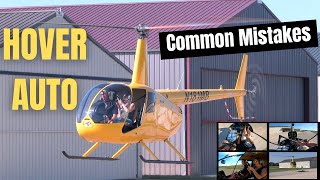
Kenny Keller teaches hovering autorotation, the emergency landing technique where you cut throttle, apply right pedal, pause, then pull collective to cushion down. The most common mistake: pulling too early, which causes a hard landing. Keep the nose straight and add slight forward-right inputs to fight the helicopter's natural left-back drift.
Chapters
Enter.
Boom safely onto the ground, keeping the nose straight.
Hey, we'll get you back to that hovering auto video here in about 30 seconds. Wanted to just show off the new hogs wall with all the screens. So we have new content going into Hogs 4 Camera View, which is all displayed here on the wall on our four screens. A lot of new stuff that we're.
Able to do with this.
It's so cool. So we're gonna get back to that hovering auto video, but first we'll put down below. We're updating videos just today inside the Robinson R44 specific sections. Get just R44. We'll put a link down below for that. And we're also uploading new videos to the private pilot section. We'll put a link for that as well. And then our maneuver guide. We have a helicopter maneuver guide, free PDF download. We'll put that down below as well. Lots more to come. So back to the video.
All right, so next we want to shoot some hover autos for you. So the hover auto, it's all about timing. So what we do is we repositioned our hand on the throttle, and when we enter it, we roll the throttle off and simultaneously the right pedal. And the real trick is to do a short pause before you raise the collective to cushion the landing. A lot of people will enter and pull up, or they'll enter and shove it down, or they'll enter it and do nothing and just slap it down the ground. And then the other thing is, you want to try to keep the nose straight. You don't want any sideways movement. You don't want any backwards movement, because you can imagine if you go sideways or backwards, you could roll the helicopter over. So I reposition my hand on the throttle. I'm going to count 1, 2, 3, enter. When I enter, I'm going to go, throttle off, right pedal, simultaneous count, one, one, thousand, and then do a nice smooth pull up. So here we go. Hover auto in 1, 2, 3, enter. Throttle off, right pedal, pause, pull, and boom. Onto the ground. If you notice, I just a little bit of forward movement, and I do that for a reason. When I was training, doing my commercial, the instructor that was helping me do the commercial rolled one over, and he was training the girl that worked in the office on doing hoverados. And we talked about after the fact, when they entered it, the helicopter had come sideways and back a little bit.
Caught that rear skid, rolled it over.
And because of everything aerodynamically going on, the helicopter has a tendency to Want to go a little bit left and maybe a little bit back. So I use when I enter it, a tiny bit of forward pressure and a tiny bit of forward into the right pressure. You won't even be able to see it in the camera. It's very minute. But because I know the aircraft wants to go this way or wants to go this way, I'm just counteracting with a little bit of forward and a little bit to the right. So let's do a couple more. We're going to use our two, our good two step process to pick up here. And the big thing that I tell people is keeping the nose straight is everything right. As long as you keep the nose.
Straight.
Even, whether you come straight down or you move forward, that's okay sideways, not okay. It can roll over backwards. You can catch the skids, hit the tail rotor. So straight down or straight down with forward movement. So here we go, we're going to reposition our hand the throttle, I count 1, 2, 3, enter. And watch how we do simultaneous throttle off, right pedal, pause, 1 1,000 and then pull. So here we go in 1, 2, 3, enter. Throttle off, right pedal pause. Now I'm going to pull. That was a little hard. See, they never come out the same. Sometimes they're really smooth, sometimes they're not so smooth. But I went forward, I didn't go sideways, I didn't go backwards. On the private pilot checkride example, the examiner will tell you, keep that nose straight. Whatever you do, going sideways or backwards is not really acceptable. Letting the nose go too far one way or another. Now let's, just for fun here, let's show you. If I don't pull collective, what happens. I'm gonna roll it off and just see what, see what it does. I'm not gonna add any collective, just for demonstration purposes. One, two, three, enter.
Okay.
Hit kind of hard, but that's okay as long as you're not there doing that to the aircraft all along. Keeping that nose straight, not letting it move, is more important than anything. Without the pull, you can see we hit a little bit hard. So let's lift it up and do one more time. And we're going to add that little bit of a collective pull and see if I can't smooth that out just a little bit more. I'm going to back up just a.
Hair.
Reposition my hand on the throttle. Get ready. One, two, three, enter. Throttle off, right pedal pause. Oh, look at that one pull. Yeah, I'll take that one and then collect it back down and that's your hoverado. So just be aware that keeping the nose straight is really, really important. Putting that little pause in there, you can imagine if you enter and pull. Well, let's try it once. Let's just, let's just show you for demonstration purposes, because this is what people do so you can see. Since luckily we have a helicopter outside the camera today so you can get a good view. I'm gonna roll it off and then I'm gonna do what some students do and I'm gonna pull too soon. So here we go in 1, 2, 3, enter. Throttle off, right pedal. I'm gonna pull now, see? And then boom, bam, back to the ground because I pulled too quickly, took that inertia away and then we hit the ground kind of hard. So that's the problem with entering and pulling. And it's common. That's what people do. So we didn't hurt the helicopter. Any VR ship don't. Bunch of fancy electronics. So for demonstration purposes, I feel okay with that. But that's real world, what you see. And then just for fun, I'm going to show you. We did a video on hover taxi, but I, I feel this important enough that I want to show it again, which is why you stay on top of those pedals, why you hover taxi nice and slow because of an engine failure. So say we're hover taxiing along. 1, 2, 3, enter.
Boom.
Safely onto the ground, keeping the nose straight.
Hope you enjoyed that video. In the 12 years of making videos, so many times, people have said, well, we want to see the cockpit, we want to see the controls. So there you go. We decided to leave all four screens up for the newest round of video so that you have the opportunity to see the collective, see the pedals, see the cyclic, and see what's actually happening in the cockpit. So again, we'll put a link down below for our R44 specific section, which you can get separately or it also comes along with the private pilot membership, if you're interested in that. And we also have commercial and certified flight instructor as well. So all those links down below, along with our PDF download of, download of our maneuver guide, all down below. So give us a thumbs up on the video. Subscribe. See you next video because lots more cool stuff to come. Peace out. Live to fly another day.