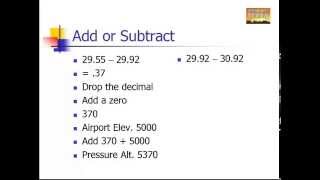
Instructional transcript from Kenny Keller explaining how to calculate pressure altitude by hand for pilots. Describes using current barometric pressure and airport elevation, shows worked examples for pressures lower and higher than the standard 29.92 inHg, and emphasizes memorizing the procedure ("drop the decimal, add a zero") and that a 1 inHg change equals 1,000 ft.
Questions this video answers
29.92 inHg
1000 ft
5,370 ft (difference 0.37 → 370 → add to elevation 5,000)
4,000 ft (difference 1.00 → 1,000 → subtract from elevation 5,000)
Chapters
Pressure altitude. And this is always fun. To figure pressure altitude, you need your current pressure setting and your airport elevation. Once you have those, you have to figure this by hand. And I want to start the story out by my very first student in 2001. I think it was airplane CFI. We didn't do a bunch of ground because he said, hey, I want to study on my own and I'll know this stuff and I'll learn it. He did a real good job and he was really sharp. And I never made him figure pressure altitude by hand. I just figured he could do it because he was a cfi. That was my bad for not making sure he could do it. And he was flying the Robinson R22 and he needed to figure pressure altitude and he couldn't remember how to do it. And he was like, I can use my computer, da, da, da. And the examiner's like, no, you have to do this by hand because what if you're in an aircraft and you have to figure out whether you're going to be able to hover somewhere when you land and you need your pressure altitude anyway. You've got to know how to do this by hand. The question is, is the pressure higher than standard? Is the pressure lower than standard? You're going to work the problem two different ways. Whether the pressure is higher or lower for the day when you're working your problem, depending on which it is, you're either going to add or subtract. So let's start with lower than standard pressure. Standard pressure is 29.92. Let's say your barometric pressure that day is 29.55. You're going to subtract that from standard, and that's going to give you 0.37. So after you get that, you're going to drop the decimal, you're going to add a zero, and that's going to give you 370. Now, I just made up an airport elevation of 5,000ft. For where you're working your problem, you're going to add the 370 to the 5,000 and give you a pressure altitude of 5,370. Again, this is because the pressure is lower than standard. You add to airport elevation seems kind of backwards, possibly, but this is the way you work the problem. So let's work one in reverse. Lets go to a higher than standard pressure setting. Let's use 30.92. So we're going to subtract standard 29.92 from the larger number 30.92. It's going to give us 1.00. So we're going to do the same thing again. We're going to drop the decimal, we're going to add a zero. That's going to give you 1000. So then take your airport elevation again at 5000ft and you subtract 1000 from your airport elevation of 5000, which gives you a pressure altitude of 4000. And if you remember, I'm not sure if I've covered this earlier in the ground School, a 1 inch change in pressure equals 1000ft. So right there is where you can see it. There's your 1 inch change and it is directly related to 1000ft change. So there is how you figure pressure altitude. As I said, you have to know how to do this and you have to know how to do it by hand. So the key is to remember. Drop the decimal, add a zero. If the airport elevation. I'm sorry, if the pressure is lower than standard, you add to airport elevation. If the pressure is higher than standard, you subtract from airport elevation. I just got through doing this. I did it two hours ago and I'm remaking the whole thing because I actually screwed this up. It's very easy to make a mistake with this. So practice with it. Commit it to memory, because you're going to have to know how to figure pressure altitude to work some of these charts. Sa.