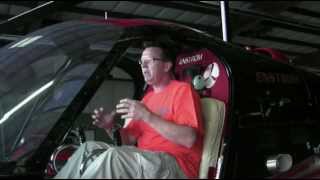
Kenny Keller, a helicopter flight instructor, breaks down the three controls beginners need to master: pedals for yaw, collective for altitude, and cyclic for attitude. He recommends learning them in that order, starting with hovering practice, and stresses small inputs and muscle memory over overthinking.
Chapters
So the next thing I want to talk about is learning the control inputs. You have to think about the fact that you're going to be learning. You're going to be moving your right hand, you're going to be moving your left hand, you're going to be moving your pedals left and right. So you're moving your right hand, making small adjustments here, you're moving your left hand going up, going down, also turning a little bit this way, a little bit this way, and then on top of that, you're also controlling the pedals down here with your feet. So the trick really is to learning to fly these things is working all the controls together, learning that coordination and that smooth, gentle touch that it takes to fly the aircraft in a smooth manner. When we first start teaching to fly these things, we're going to go out and let you work each control independently, give you a little practice with each one. For example, we'll start usually with the pedals, and we'll go out in a hover. And I'll say, okay, I want you to point the aircraft at that tree over there. And if the nose starts to go a little bit bit to the right, you're going to push a little bit of left pedal. If the nose starts to go a little bit to the left, you're going to want to push a little bit of right pedal. Then we're probably going to give you the collective and we're going to say, okay, we're three to five feet above the ground. If the aircraft starts to rise, just push the collective down very gently. Aircraft starts to sink, pull the collective up very gently. Then we're going to move to the cyclic. And this is by far, I think, the hardest one to learn. And it's the hardest one for me to teach. What I try to explain to people is the helicopter wants to act like a pendulum. So when you're hanging by the rotor system, the weight of the helicopter suspended by the rotor system, the helicopter wants to do this. It's what we call pendular action. So that's why when you go by an airport and you see somebody out in the field learning to fly a helicopter, you see them out there going, I like this. That's what they do. And it's totally normal. And everybody does it. So it takes a little bit of time. It takes learning those reactions. It's all about muscle memory, and we learn through repetition. Nobody jumps in here in the first hour of their first lesson and just masters it. I don't believe there's any natural helicopter pilots out there. There's probably some people that think they are but I haven't seen one and training a couple hundred people in over 10 years. It's all about repetition. It's about practice, it's about being calm in the aircraft and that's very hard to do because when you're learning you're nervous and we all want to tense up on the controls and you have to constantly tell yourself relax, relax that monster grip. Breathe in and out. So bottom line is I like to say I should just sometimes wear something around my chest that says smooth control inputs because that's the biggest thing. The hardest thing about learning to fly is over controlling and making the movements too big. When you go to adjust this control it affects those controls so then when you move those it affects this control and when you affect that one then you're back to this one again and it's a constant flow of always making tiny, tiny minute. Sam.