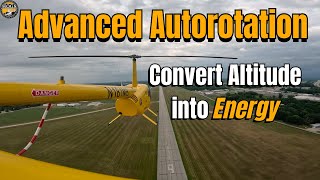
Kenny Keller and Gabriel demonstrate advanced autorotation for flight instructors only, not student or private pilots. They use 2,000 ft altitude, enter near 50 kt, maintain 40 kt descent, and recover around 40 ft. The technique requires instructor supervision and isn't recommended for R22/R44 helicopters.
Chapters
Gabriel, if you want to lead us in to what we're going to go do now, and the premise of this video or two are you just did your CFI checkride with an FAA designated examiner and there's a couple of things you did with him that we're going.
To go out and you're going to.
Show me what you did with him and explain the maneuver.
Absolutely.
And we want to say that this isn't for private pilots, this isn't for student pilots. This isn't for average guy, bought his own helicopter, he's going out. We really don't want you doing this kind of stuff.
Okay.
So this is, this is advanced training because he is a now a certified flight instructor and he was with a Designator examiner of 38 years. And they. He wanted to go a little beyond the norm. Right. To give a little real world kind of what the aircraft can do. So if we do put this out there for the world. No, this is, we're sharing this with you, but it's not something we want you to go do unless you're with a qualified instructor competent in teaching these types of maneuvers.
Absolutely.
So with that being said, you can take it away and explain what it is we're going to go do.
Yeah, absolutely. So we want to make sure that we have enough altitude to do a safe auto rotation. What I mean by that is that of course, in our pockets of energy, as we've been calling them, we are going to deplete most of our airspeed bucket, our kinetic energy bucket, and we need to compensate by having some more potential energy, some more altitude. So we're going to set up at 2,000ft, which is about 1,200ft AGL. And this orientation is going to look like this. We're going to do an entry at about 50 knots and we're going to keep our speed at about 40 knots all the way down. We're not going to do a fault and auto rotation because of course that increases some of the risks that we're doing. But we are going to recover our power at about 40ft or so, like we would do naturally, because we're not carrying that much kinetic energy, which is what produces our flare and transfers a lot of that energy to the rotor. We are not going to do a big flare and if anything, we're going to try to keep our nose level or just slightly higher above the horizon, about 3 degrees or so to make sure that we have all of our descent energy, our potential energy and our rotor energy stored so we can Pull our pitch and recover safely in the green. We have no warning lights. Carb heat, temperatures out of the yellow. 70 knots or so. We're at 2000msl. We're going to start reducing our speed. Like any maneuver that we do in a helicopter, the setup is key, and we're not working on precision with this maneuver at this very moment. We're just working on demonstrating the ability of the helicopter to maintain RPM with a lower energy status than what it would usually have on a normal auto rotation. Perfect. 50 knots. We're at 1950ft, which is acceptable. We're within 50ft of the target, and we're going to enter our practice auto rotation in 3, 2, 1. We're going to lower our collective and split the needles, and we're going to check slightly our collective. We're going to keep our 40 notes down, as our viewers might be seeing at the moment, because we don't have that much speed, Our descent rate might look a little bit faster than in a normal autorotation. And we are also having a steeper angle of approach at this very moment, because we're not gliding the same way that we would if we had carried speed.
Yeah, it's way steeper.
Way, way steeper. Right. So passing through. All of our parameters are looking good. And as we said, we're going to recover our power at about 40ft. And there we bring our power up, and then a slight pull, and then we would have it down.
Interesting.
The helicopter, of course, it behaves different because we don't have that much speed, that much energy. However, in the case of the R44, and strictly the R44 in the R22, I would not recommend this maneuver by any measure. We can store enough energy with our descent and our inertia in the rotor to be able to effectively touch down under this configuration.
It really shows you how you could make a spot that's closer to you. There's a spot, you lose an engine, and it's not out, it's not far off your nose. You could slow it down in order.
To make that spot. Absolutely, of course, within the safe boundaries of your skill and within the safe boundaries of what you have.
Right.
I'm not sure. The recommendation is, of course, always to keep our speed above 60 knots anyway to gain the most energy that we can. That's where we're the most efficient. However, if we are in dire circumstances, this is a maneuver that could be done to save your life.
It could work. Absolutely. And we have more free resources like this. Free video Private Pilot 101 helicopter training blueprints our Amazon number one best seller. We'll put a link around this video where you get a free PDF or the paperback copy. Privateblueprint.com all kinds of free info in there to help you get started on your flight training journey.
Peace out.
Peace out.
When you feel the pressure to fly, but know the right decision is to stay on the ground, hit the hogs no go and live to fly another day. Helicopterground.com.