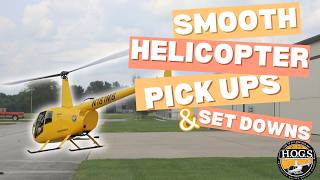
A short instructional video by Kenny Keller teaching smooth helicopter pickups and setdowns. Keller demonstrates a two-stage pickup (slow collective raise while looking outside, pause to neutralize, then lift fully) and explains the air-cushion effect when skids are about 6–8 inches above the surface that commonly causes pilots to wobble controls during landings. He emphasizes slow, deliberate control inputs and practicing setdowns to avoid overcorrecting.
Chapters
What you'll see people do. And you have a nice set down going and all sudden you're like, okay, I should be there. And so then you start monkey with the controls. And this is, this is exactly what people do. Hey, have you ever struggled setting the helicopter, getting it clear down on the skids during your set down? We're gonna go right back to that video. So hang on, we wanted to mention the private pilot study guide. We're gonna put a link down for this down below. This dude has 400 questions. People are digging it. You can get a copy down below. So we're gonna roll that video. And this video is gon learned from an examiner of 50 years of why people can't seem to put the helicopter nice and smoothly down on the ground. All right, we're going to talk through a two stage pickup. Every time you pick this helicopter up should be in a two stage pickup. So step number one is we're going to start raising collective real nice, super slow looking outside 50 to 75ft and glance back in at RPM or manifold pressure. Look back outside. You can check gauges. Look back outside. But your main focus should be outside. So I'm gently raising collective very just a little bit by little bit. And it's going to start getting light at a certain point when it starts getting light, the nose is going to want to move left or right, maybe dip down, come or come up. So you want to pause. That's step number one. Pause. Neutralize all those movements. So I'm doing this super duper slow start to get a little bit light. I'm going to go a little more, A little more, a little more. Okay, now starting to move. Okay, so there the nose wants to come up. So I'm going to go here forward cyclic feels pretty straight at the moment. I'm going to raise a little more. Collective, step number two, gently lift it up. All right, so that is your two step process. Lift to a hover. And now while we're up, we're going to do a set down. Now here's the key that if nobody showed you, there's a little bit of an air cushion when we get the skids down to about 6 or 8 inches above the surface. So I'm going to start coming down, coming down. I'm lowering collective. Got some pedals, just little minute changes right there's your air cushion. So I got to push a little more down and down to the ground we go. So I'm going to do is I'm going to lift this back up and we're going to do that again. And I'm going to come down just a hair slower. And this is where you'll see people. Or you may do this self do this yourself in the aircraft. If you're coming down nice and slow, you'll get to that air cushion. Then the helicopter doesn't go and further, and that's where people start wobbling all over the place. So let's see if I can demonstrate that. I'm going down, collective down, collective. Coming down, coming down now, right there. See how it's hanging? It's going to go back up and it's going to come down. This is where people start doing. They start wobbling the controls and you see somebody doing all this. It's because they got to that air cushion and they think they should be down, but it's not quite getting there. If you come down faster, I'm going to do that now. I'm going to come down kind of quick. You'll push right through the air C and there won't be a problem at all. Okay, so I'm going to pick it up one more time so we can really demonstrate that. And I'm just making this point clear because anytime you see somebody struggling with setting it down onto the pavement, it's usually because they're hitting that air cushion. And that's where the problem starts. So it's coming down, coming down, coming down, coming down. All right, there it is. So I'm not changing anything. And the aircraft will go up a little bit. It'll come down a little bit. It'll go up a little bit and come down a little bit. And I'm going to demonstrate again. So here's what you'll see people do, or you might do it yourself. You're coming down and you have a nice set down going and all of a sudden you're like, okay, I should be there. And so then you start monkey with the controls. And this is. This is exactly what people do. And it's nothing more than just a. I don't know what you want to call it, but it's a mind thing. Just know on these set downs, but there's that air cushion about 6 to 8 inches. We're gonna do it one more time. Coming down, coming down. This is kind of fast. It's gonna go right ahead and touch because I came down faster. All right, so let's talk through pickup one more time. Pick up the set downs. Practice these as many times as you need. Step number one, get the aircraft line the skids so I'm raising Collective Raise them Collective Raise them Collective Looking outside airc Getting light so the nose is going to the right, so I'm going to add a little bit of left pedal. I'm going to raise a little more Collective feels pretty good. Step number two go ahead and raise the collective to lift it up off the ground and adjust the cyclic and pedals as necessary. When you feel the pressure to fly, but know the right decision is to stay on the ground, hit the hogs. No go and live to fly another day. Helicopterground.com.