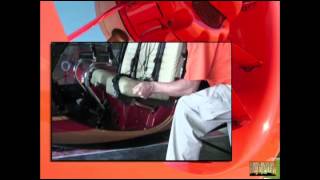
Kenny Keller from Fort Wayne Helicopters walks through helicopter training basics: what controls do, how instruction works, and what to expect. He stresses checking refund policies before buying block hours, warns that training is costly and hard, and notes pilot retirements may open up jobs soon.
Questions this video answers
About 15 years.
Over 10 years.
Chapters
Hello everybody, it's Kenny with Fort Wayne Helicopters and I want to answer some questions about learning to fly helicopters. I spent a lot of time with emails on the phone answering a lot of questions about learning to fly helicopters. So I thought I would go ahead and do a segment on a little bit of what it's going to take and give you some of the good, some of the bad, give you my opinion of what I've seen In the last 15 years of learning to fly myself and then being an instructor for over 10 years. And then if we don't scare you away, we're going to go down and take a look at the aircraft, take a look at the aircraft controls and my daughter is in the background making faces at me. So if I look like I'm kind of silly. So ground school with your instructor, what is it going to entail? It should entail all the subjects in the pts, the practical test standards. No matter where you go flying the country, the training should be based on the pts. You may be going to a flight school that has a syllabus. That's great. A syllabus is a laid out form of training. Or what if I get sick and something happens and I can't continue the training? Am I going to get my money back? Many flight schools do not offer refunds on block time purchased. So this is subject that I could go on and on about. But you really have to investigate it. You're going to have to do what's right for you and just be very careful in going out and handing somebody a big check for a 40 hour package. Make sure you understand that you're probably not going to get this helps stabilize the aircraft in forward flight. And we have the tail rotor, also called anti torque rotor. This counteracts the effect of the engine torque. And you're learning how to fly. It's learning a nice, very smooth, very slow upward and downward action with that collective. And you're also learning to move your wrist a little bit left, a little bit right to maintain the rpm. In the green range, the helicopter flies by the rotor rpm. The, the rotary RPM is the, a number one most important thing that we're managing the whole time we're flying. At all times you have to maintain the rpm. So again this is the collective. When we want to go up, we move it up. When we want to go down, we move it down. Depending whether we're hovering or in forward flight, it still basically functions the same. We pull it up to go up, push down to go down. RPM gets low we add a little bit of throttle. RPM gets a little bit high, we reduce a little bit of throttle. The whole key to learning to fly these things is a smooth touch. And for all the interested women out there, women can fly these aircraft every bit as good or even better than a man. Most of the guys don't want to hear that because we're all macho and we want to prove that, hey, we're cool helicopter pilots. But the truth is, it doesn't take brute strength. The truth is it takes a nice gentleman smooth touch. Fly the aircraft in a smooth manner. When we first start teaching to fly these things, we're going to go out and let you work each control independently, give you a little practice with each one. For example, we'll start usually with the pedals and we'll go out in a hover. So the next thing I want to talk about is the instruments. And you probably can't see them really good in this video, but that's okay because I want to just give you kind of a general overview. In the beginning, you can get overwhelmed by the instruments. And in reality, for VFR flying, for learning to fly in the beginning, you don't have to get overwhelmed by this. The main things we're going to be looking at is if they're saying, yes, you can do it, but it's going to be hard. It's not going to be easy. You're going to spend a lot of money, you're going to run into problems where you're going to get frustrated, you're going to get tired, you're going to have some times where you might need to take a little bit of break. And then, as I was saying earlier, it is a hard road. It's not necessarily the easiest thing close to retirement age. And a lot of them are going to be retiring in the next few years if they haven't retired already. And in turn, that is opening career Outlook Island.