Loss Of Tail Rotor Effectiveness Awareness Cabri G2
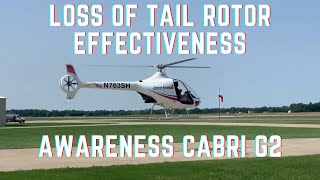
A YouTube video (Kenny Keller, Oct 22, 2020) in which Chris Hauser demonstrates and explains Loss of Tail Rotor Effectiveness (LTE) in the Cabri G2. He emphasizes LTE is pilot-induced (not mechanical), occurs below effective translational lift (ETL), and shows corrective actions: full pedal (full right pedal in the G2), if that fails build airspeed to fly through ETL, and if unable to fly out roll throttle off to remove torque and perform a hover-auto. He advises teaching LTE early (within first ~5 lessons) and practicing when transitioning between clockwise and counterclockwise rotor systems.
Chapters
Alpha, hey, it's Kenny with Helicopter Land Grout School going out with Chris Hauser today in the Cadbury G2. And Chris Hauser is going to give us a demonstration of what you need to know to prevent LTE and be aware of about LTE loss of tail rotor effectiveness in helicopters. We're going to do this kind of at the private pilot level and talk about what he's going to introduce to somebody brand new and also talk about somebody that's switching going from counterclockwise to clockwise because just like me makes you think and have to use your brain a little bit. So real quick, before we get started, top 10 checkride tips, free PDF down below. And we'll also put a link where you can get the a paperback copy for seven bucks. We'll ship it anywhere for seven dollars. That's it. Top ten checkride tips. It's a thin book, a quick read, but a lot of people are really enjoying it because Dan, Taz, Chrisman, and I am, let's see, Dan is 2018 Flight Instructor of the year. Dan and I put this together, combined our 40 some years of experience and all the things that we see people screw up the top 10 things are in this book. So free PDF or paperback copy down below. All right, Chris, so just take us out to your practice area or wherever you would want to do that or whether it's right here, whatever the case is and just kind of talk me through. Let's say I'm a student pilot and about what my kilo is on a.
Midfield crosswind Runway nine at the ocean. We have the departing Cessna in place.
About what point do you think that you'd be starting to introduce the concept of LTE to somebody brand new?
I do it early. Early, I mean, because first 10 hours or so. Oh yeah, probably the first five hours because I want them to know how important LTE is. I want them to know how certain wind asthmas can really cause them to have a bad day if they're not careful.
Gotcha.
So yeah, I would say probably within the first, probably within the first five lessons because you know, we're starting off already learning left downwind Runway pickups and set down hover taxi and that kind of stuff. So I want them to know about it early on. So lte, loss of tail rotor effectiveness. The number one thing that you need to know is this is an issue that the pilots put themselves in. It's not a mechanical issue. We're not talking about loss of tail rotor thrust. We're talking about that the efficiency of the tail rotor is not being basically 100% efficient. It's not producing adequate thrust to maintain directional control. It's all about the pilot has put himself into that position to cause this. So it has nothing to do with mechanical issues. Maybe that's a later. Maybe that's a later date on tail rotor thrust issues. But anyway, so LTE loss of tail rotor effectiveness. The tail rotor is not producing adequate thrust to maintain directional control. In the clockwise rotating system like the G2 is, we are concerned about winds from the right side. And you mentioned the private level. I pretty much teach my private students that wind from the right side is bad. Okay. Now you can break that down into the right quartering headwind, the right crosswind, and then the tailwind. But pretty much if you just say, you know, be aware of issues or be aware of wind direction from the right side. And that just kind of keeps it simple for them. Okay. Now another thing is that this condition can only occur at less than ETL. So obviously, if we're cruising at 80 knots, we're not going to get into LTE. This is a hovering maneuver. When you've got a strong right wind and you're hovering around less than ETL in a clockwise rotating system, as the G2 is, if we start to have tail rotor issues, we are going to start spinning to the left. And I'm actually going to do a right pedal turn here. Just kind of check my tail here. Since we're on the taxiway, make sure nobody's coming up behind us. Look good on the right there?
Yep, clear on the right.
And they're using nine, so we should be out of the way. So anyway, in the clockwise rotating system, if we have tail rotor issues, the nose is going to spin to the left with lte. It's going to start out gradual and it's not going to get fixed on its own unless the pilot fixes it. Okay, so if we got into an LTE situation, the nose is slowly going to start to come left, which tail's clear on your side, clear on the right. So it's slowly going to start to come to the left. And if we don't do anything about it, it's just going to get faster and faster and faster. Now, the natural reaction is obviously should be full right pedal. Okay. So if your aircraft is starting to go to the left, then you just need to put in full right pedal. Part of the early issues in the G2 in the US is that guys were not putting in the full right pedal. They Think they had full right pedal in there, but they didn't. And then that would cause a spin and then they would crash. So as I'm putting in full right pedal now, that's our power pedal. So it is going to take, it's going to take a lot of power to come out of it. But Gimpel states that if we get into spin to the left in an LT situation that the aircraft should come out of it. Now it may not do it in the first turn, it might take a turn and a half. But as long as you're maintaining, you're not going to run into anything and clearance from obstacles. You should be able to come back in or you should be able to pull out of it. Okay. And also remember, if you pull collective up and we're spinning to the lot to the left, you're just going to make that situation worse. So you can't really pull up when you're spinning to the left. It'll just make it worse. Okay. So just for a quick little demonstration, the onset of LT is going to happen slowly. If you don't correct it, then it's going to get worse until you're finally going to have to do something about it. Okay, so here we are spinning to the left a little bit. What I'm going to do right now, full right pedal. And she came out of it. Now you can see that my power, maybe Kenny will get a shot of the console here. You can see my power skyrocketed, but the aircraft came out of it. So we'll do it one more time. So here we are hovering. I got a little bit of a right quartering headwind here. So I'm going to simulate that. I'm getting into it. So here's slow and gradual. It's getting worse, it's getting worse. And now I'm going to go full right pedal and you can see how much power I pull in there. But the aircraft stopped. Aircraft stopped it and off, you know, here we are. Now we're back to hovering normal here. Alright, so let's presume, let's say that nlte, here we are hovering, we start spinning to the left and we go full right pedal. But it doesn't. We don't come out of it. So what's our next option? Well, I've already mentioned that this only occurs less than etl, right? Less than the effective translational lift. So if you have the room, one of the corrective actions is naturally full right pedal. But that doesn't stop it. So then we're going to fly out of it. Okay, so what we're going to do is a little demonstration here. And see, now this part of it I don't have. Students do. I'll demonstrate it, but I don't have them perform it just because it can get a little crazy here. Alright, so here we are hovering slowly, going to start to turn to the left. Okay, so let's say that I'm putting full right pedal in, but it's not stopping now. It's getting worse and getting worse. So you know what? I'm going to try to fly out of this. So I'm just going to start building some airspeed and then we're just going to fly out of it, pulling low power, push a nose forward and fly out of it. Once I get through etl, then I'm out of it. Okay, now you can see that it gets a little crazy there. But right now we're just concerned about trying to get out of the spin.
That made my heart race a little bit.
Yeah, it can do that. Wow. Pop this up. Okay, so what I tell students is full right pedal. If that's not stopping it, then fly out of it. And as you can see, it gets a little crazy there. But the main thing is to build air speed and get out of it. Okay, now what if you can't fly out of it? Okay, what if you're hovering up to the pumps and the pumps are right next to a parked airplane, which are parked next to a building and whatever else and you can't fly out of it. Okay, so now we have a situation of we're starting to spin to the left, we can't fly out of it. So what do we got to do? Well, we have to stop that spin first. How do we do that? We roll throttle off. Okay. Rolling throttle off eliminates the torque. You stop spinning. But now since you rolled throttle off, guess what? We can no longer hover because we don't have the power. Right. So now it just becomes a hover auto. Alright, so we're going to simulate LTE situations that we can't fly out of. Okay. First thing we have to do is pull right pedal. That's not stopping it. Next thing you do, roll throttle off, stop the spin, then it becomes a hoverado. Now we always like to practice our hoverados into the wind, but when you're spinning like that, you're not going to be into the wind. Wherever you stop spinning, that's where it is. And then you just turn to your. Hello. So here we go. A little bit of a left spin here. Simulated lte. It's going to get gradual. It's going to get worse. I can't fly out of it. I got full right pedal. It's not working. All right. I got to stop this spin first. What am I going to do? Roll off throttle, cover auto. And it happens pretty quickly. And that and that torque will go away as soon as you roll that throttle off. Alright, so I'll do it one more time. We'll get our parents back, get us back into the wind. Coming up. Alright, so one more time. So a lot of students, they realize that they want to say one of the corrective actions is, okay, you're spinning, you can't fly out of it. Well, just push the collective down. You can't do that. You got to get rid of the torque first, then becomes a hoverado. Okay, so here we are again. Little bit of a spin to the left here. It's gonna get worse. Gonna get worse. Here we go. Roll throttle off, stop the spin. Upper auto. And that one was a little bad, but get the point.
Hey, you got it on the ground, didn't roll it over.
That's all it takes. So again, LT things to take away from this is that it's all about the pilot, the pil. Put yourself or the aircraft into that situation. Clockwise rotating system wins from the right. Okay. Right quartering, headwind. Right crosswind, tailwind. Okay. Winds from the right, aircraft will spin to the left. Okay. Full right pedal. If that doesn't stop it, try to fly out of it. If you can't fly out of it, you got to roll throttle off to get rid of the torque. Then becomes hub Roddo. Cool.
What would you. What would your advice be to people that are rated pilots and have been flying for years and have LTE in their mind? One way. What's the best way to get comfortable like you've been able to do? Because you started in counterclockwise many years ago, flew them for 10 years probably, right?
Yeah.
Before you moved into the clockwise. So would be just a tip for someone like me who's trying to get used to the clockwise. What's it take?
Just got it.
Practice.
Yeah. Train the brain. That's all you got to do. Because I'm still constantly thinking, you know. Okay, clockwise, right, Clockwise, right. So remember, clockwise rotating system, tail rotor issues, we will spin to the left. LTE wins from the right. Counterclockwise, tail rotor issues, spin to the right. LTE wins from the left. So everything is just backwards. You just Got to train your brain to be like, okay, this is clockwise rotating. I'm worried about winds from my right te. Tail rotor issues, nose comes left, engine issues, nose goes right.
Okay, so ending note would be, don't just think that, oh, I'm just going to jump in this clockwise and I'm going to go master it in 10 minutes. Spend some time thinking about it, read about it, get with a qualified CFI and go practice and get used to it. Don't get too cocky too quick. Just trying to go, oh, well, I'm just. This is going to be no big deal.
I think people, I think pilots could handle the aircraft, per se, because you're really just doing opposite of what the aircraft wants to do, right? So when we pick it up, if the nose wants to go right, then I'm just adding a little bit of left pedal. I'm going to do that. And. And a counterclockwise aircraft also. However, I think guys, forget about the different scenarios like that. And the clockwise or counterclockwise is. You don't think about, okay, well, in the counterclockwise, I'm worried about winds from the left, but they don't think about, okay, now it's going to be different. It's going to be the opposite. So guys that have been flying counterclockwise and they're out there flying, all of a sudden you get a. You're hovering and you get a huge gust of wind from your right side, and all of a sudden you start spinning to the left. If they haven't had training or aren't thinking about it, they may actually do the incorrect or opposite corrective action because they're so used to the counterclockwise method. Remember? I mean, it's just like in law enforcement, you know, we practice drawing and how many times we do that because it's muscle memory. And that same thing with the rotor system is if you. If you know nothing but counterclockwise and you're like, okay, concern about winds from the left, you jump into G2, which is clockwise, you're not thinking about winds from the right. And like we said at the beginning of this, I would say probably within the first five hours, I'm talking about lt, because I want them to know how dangerous it can be, especially when you get around obstacles. When you're hovering up, like here in Goshen, we have an island or a fuel pump or even Smithfield, you have one place that you can get fuel and you gotta hover up there to get it. And you're surrounded by parked airplanes, hangars, whatever else, there's no way to get up there. Except you may have to hover up there with a tailwind. So you got to be aware of what's going on.
Awesome. Well, hey, do us a favor. Subscribe the channel, click the bell. So we notified of our next video. Go down below to get that free PDF of top 10 checkride tips and or grab the paperback for just 7 bucks shipping and handling. So subscribe, click the bell, and we'll see you in the next video.
Come find me. Sweet Aviation.
There you go. I keep forgetting. Sweet Aviation.com they have two aircrafts and two locations.
Yep. Fort Wayne, Indiana, or Goshen, Indiana.
Awesome. So there you go. Sweet aviation dot com. Click the bell, subscribe, see you next video. Peace out.
But I'm also flying out of it.
Yeah, I'm not on the controls. I'm holding cameras.
I don't really like that, flying out of it. It's kind of difficult because you. You can really screw it up if you're not careful. All right. How do you think it went? You think it went?
I hope so.
I hope so. That's the thing.
Until you sit down and look at the footage, you don't know.
Right?
Right. You just don't know. I think it'll be fine every time. I mean, one of these days we're going to have one where I'm going to go, guess what? We got a.










