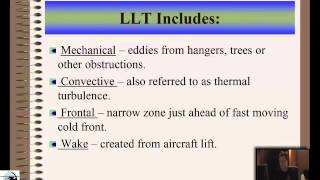
Kenny Keller breaks down five types of low-level turbulence pilots encounter: mechanical eddies from terrain and structures, thermal updrafts from ground heat, frontal zones ahead of cold fronts, wake from other aircraft, and clear-air turbulence that hits hardest above 15,000 feet. A Plymouth runway surrounded by trees and a gully shows how mechanical turbulence can shake you during climb and approach.
Questions this video answers
Usually when a front is moving at 30 knots or more.
Usually above 15,000 ft (but can be anywhere).
Chapters
Low level turbulence includes mechanical eddies from hangers, trees or other obstructions. Convective also referred to as thermal turbulence. There's that heat again I keep mentioning frontal, narrow zone just ahead of fast moving cold front wake created from aircraft lift. Now these all make sense, mechanical for us guys in the helicopter, we get a lot of mechanical turbulence, especially around hangars, out hovering around by a fence row. We get mechanical turbulence taking off and landing here at Plymouth where we're flying, the Runway is kind of like in a gully and there's a big long line of trees down both sides. And we always get that turbulence right about treetop level when we're climbing up and when we're coming in. So there's example of mechanical, they can be from hangers, trees, other obstructions. So the convective turbulence, this falls back to the heat again, surface heating, thermal, anytime that's involved. And that means thermal heating, ground heating, frontal turbulence, narrow zone just ahead of fast moving cold front. And there's a famous number here, 30 winds, usually greater than 30 for frontal. Any front moving at 30 knots or more, hence the three again, you can have frontal turbulence and wake turbulence created from other aircraft. Clear air turbulence, they say usually above 15,000, but can be anywhere. That's what I just read going back to my private pilot manual I just reviewed before firing up the camera tonight. Usually above 15,000, but it can be anywhere. And this can come from different layers of air moving at different directions in speed, basically mixing with others. How you can get the clear air turbulence.