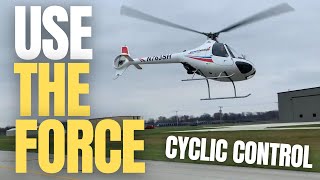
YouTube video by Kenny Keller explaining how to master helicopter cyclic control, emphasizing small, precise inputs and the ‘force loop’ technique to avoid pendular overcorrections; includes brief promotion of Kenny’s Helicopter Online Ground School and books and a call to subscribe.
Chapters
Are you struggling with using the cyclic? This one is the hardest one for me to teach someone and for me, this was the hardest one to learn. If you're struggling with this, put them in the comments down below. We want to hear about your struggles with it. If you came up with some kind of a technique to help you learn a cyclic, put those comments down below. Or if your instructor told you something, a good tip or trick. I had a coffee cup for this today. It said use the force loop. Picture of Darth Vader on it and I forgot it at home. But that's the point. Use the force loop. When we do these videos and we're talking about it, we're always over exaggerating the movements of the cyclic. The real trick is once you learn how to really master the cyclic, you can literally hover with a finger. I mean, your touch could be just so slight and you're actually moving it. Just a tiny, tiny pressure change. Rarely are you ever making big inputs with the cyclic. When you enter an auto, you do a small aft pull. When you do a quick stop, you're gently pulling it back a little bit. Most everything that we do is going to be a small minute movement, a very small change. Again, why we say use the force loop, what gets people into trouble, I think most is when you start doing this, okay, pendular effect, pendular action. So when you start wobbling around the helicopter, pretty soon you're doing this number. To try to describe this the best, let's say you're in a hover, you have it going kind of decent and the helicopter starts going to the right. You're going to have to counteract that with a little bit of pressure opposite. What happens is helicopters going to the right. Student pushes back to the left too much, so then they pull back to the right and then pretty soon you're swinging back and forth. So I kind of call it going back to neutral. If you start moving to the right and you want to counteract that, it's a small pressure back to the left to stop that movement. And then you almost kind of go back to the right again when it stops to what I call neutral, if that makes sense to you. So the common problem, and this could be forward, it can be this way, it could be whichever way. But for the, you know, explanation in the camera, I thought this would be the best way to try to make you understand this. If you're going to the right, you're going to counteract with pressure back to the left. When it stops, you're almost going to have to go back to the right again. Otherwise pretty soon you're just going to be doing this and you're going to be swinging out of control. No matter what you're doing, remember you're always counteracting and then going back the other direction just a little bit to stop that movement and hold you in place. I am Kenny Keller, creator of Helicopter and Line Art Ground School. Put a link down below for our ground school. We have two Amazon number one best selling books. Did this one with Taz Chrisman 2018 Flight Instructor of the Year top 10 checkride tips. We bought a whole pile of these books. Bought them for you. We will ship you one or the other. You just pay shipping. So I'm going to put those links down below as well. We have Helicopter on lane Ground School that helps you of course all the way through every rating, written test, oil test, flight test. But there's all these things that come up. Do us a favor, subscribe to the channel, click that bell and we will see you in tomorrow's video. Hell yeah.