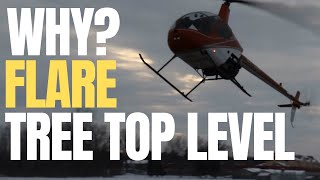
This YouTube video (created/uploaded by Kenny Keller) records a conversation between instructors Chris and Kenny Keller about teaching autorotation flare in helicopters. They contrast using fixed POH numeric flare altitudes (e.g., the G2 POH says 60 ft) with a visual "treetop level" reference to keep students' eyes outside the cockpit. Chris advocates starting a small/"mini" flare at treetop level and progressively increasing the flare, using "hold off" if the flare is initiated too high; Kenny notes the method applies across many helicopter types and that local tree height can vary.
Chapters
You stated about a member who talked about they didn't like the term treetop level for the flare because their trees aren't that high or they're too short or they didn't have trees or something to that.
Yeah, trees were a lot higher. And he's probably, I think he was, if I remember, he's in California. I could understand that. He. Where he's at, the trees might be much taller than what we have here in Indiana. The thing that comes to my mind is one poh says flare at 50ft. One poh says flare at 100ft. One poh may say flare at 75ft. Number one, you got to go with the aircraft are flying. What's the poh say?
Correct.
Can you differentiate 60 between 50?
Well, that is my thing. If you want my two cents here.
Go ahead, jump right in.
Obviously, we all know, everybody knows that you are my primary instructors. Instructors learn from other instructors. So you know, you taught me treetop level. So that's how I continue to teach my students. And I'll tell you why I like treetop level. The POH for the G2 says flare at 60ft.
Okay, good example.
If you're a brand new student learning how to do an auto rotation, I want your eyes outside. If you tell them flare at 60ft, what are they going to do? Their head's going to go right down to the altimeter gauge and they're going to stare at it until it says 60ft. And then by that time, we already just plummeted right into the ground. I use treetop level. It's a visual reference inside the helicopter.
And usually there's trees around the airport.
Most of the time. So you can look, I mean, like Goshen's a good example. I can look right down two seven and I can see a tree line all the way at the very end. So I'm just looking outside when I see that. When I get level with the treetop, I start my flare. One thing that I teach, I start off with a mini flare, treetop level. I'm not telling you to yank back on that cyclic and really get that nose up.
Exactly.
I'm telling you at treetop level, start a mini flare to start decreasing that speed. And then I teach that that flare gets more aggressive the way I teach it. If you, once you really get into that aggressive flare, you're at your 60ft or your 50ft or whatever that is. And guess what? If your flare a little too high, I teach hold off as you're starting to push forward. Let the aircraft start to settle a little bit, then come up on your collector. I like to tree top level because it keeps the students outside. Hey, real quick, point to 880 on that. On that altimeter, please.
Exactly. Who can. Who is that good that you can look down and go 57ft by flaring?
Right?
R22, R44, Bell 47, Instrument BK117, Easy 135 Jet Ranger. I don't care. Across the board. Everything I've ever flown, I use. Treetop level. Yeah, you've got time to change that flare. Like Chris said, start small, make it bigger. Make it bigger. And depending on your situation, you can make that pull gradual or you could make it more aggressive using treetop level. You can still adjust as needed going in to the amount of flare that you need to make the auto rotation.
Successful, but it's good. I think we beat that. Good. Because I want people to understand why I do it. As you learn, as, you know, as an instructor, if your students don't understand why they're doing it, a lot of times they're not going to learn if you just tell them, you know, like now.