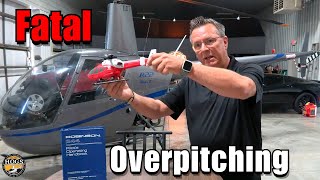
Kenny Keller explains why overpulling the collective on max takeoff can drop RPM and kill your climb. Instead of pulling to the armpit, he pulls halfway between hover and max power, which often gives better climb and obstacle clearance. He's taught this counterintuitive technique for 15 years in EMS helicopters.
Questions this video answers
October 3, 2025.
R44, BK (BK powerhouse), EC135 (earlier model).
Over 2,000 hours.
About 15 years.
Hover ~30–31 in; max ~39 in; suggested partway ~34–35 in.
Chapters
So we had an FAC member. We go out here to do the maneuvers, and I say, okay, show me a max takeoff. And everything he's doing was pretty good. So I didn't expect anything out of the ordinary. And we're in the R44, and he yanks that collective. I mean, he pulls that thing to his armpit. We start coming up, RPM starts dropping. Low rpm, horn goes off. Of course, I grab it and go, whoa. What are you trying to do, kill us now? I'm not going to mention any names. I'm not going to mention any names because I don't want to embarrass the individual. He did really good in the aircraft, and he's a personal friend. So I know he. He doesn't care that I teased him there a little bit. Who it was and why. That particular day, he got so aggressive with the collective. I don't know if it was nerves or what. I don't know why this happened. So I want to cover with you is many of us, or most of us are trained from a hover pull all the way to max power to your limit, do your max takeoff and go. All right? Many of us trained that way. However, I want to tell you about something I learned in EMS. So at that point, I had over 2,000 hours. Been flying however many years. And I originally in ems, flew the BK powerhouse. All the power you needed to muscle out of anywhere about any time. A couple of years into it, I switched to another base and start flying the earlier model, the EC135. Very limited on power. The engines had the power, but they were tearing up transmissions, so we were very limited on how much power we could pull. So when I switched to the ec, I find myself going, we're going to use this as our tree line right here, this manual. You'd pull to max power, and you'd be coming up on a hot day, summertime, maybe the patient's heavier than what they told us because we try to go with the amount of fuel we need. So you'd end up somewhere where you have a patient. Heavier than expected, Hot, humid day. You go to get out, and you get almost to the tree line or the building or whatever you're trying to clear, and you. And you're out of power, and the helicopter won't climb anymore. So standard thing we would do, we'd set back down, burn fuel for a few minutes, try it again. Or you could try to offload equipment, but you'd have to redo weight and balance real quick. So there was a couple options there on what to do, but that was a very common thing. So the Czech airman that originally trained me stops by our base and he said, hey, how do you like the EC compared to the bk? And I went, oh, the EC is really cool, but I sure miss the power in the bk. Half the time I can't get out of a confined area on a really hot day, especially if we have a heavier patient. And he said to me, I want to tell you something, a little trick that apparently you haven't heard. And he goes, and I want you to go out and try it. So what this Czech airman said to me was instead of pulling to max power, pull about halfway between hover power and you're the max power that you can pull, pick a point about halfway in between. So I'll just pick some random numbers. Let's say I'm thinking back to the instrument days. I think it was 39 was our manifold pressure setting. Maybe you hover at 30 or 31, so pull about 34, 35, something like that, partway between hover power and max power. And if you do that, and people ask me why, and I still to this day really can't tell you, and somebody in the comments will probably tell us, but if you do that, you can actually climb higher and actually at times clear your obstacle and then be able to start moving forward and fly away. And he said, next time you're out, try that. So I go out in the ec, I try it and it freaking works. I'm like, I've been flying all these years, couple thousand hours, how is it that I've never heard of this or how come nobody ever talked about this in training? So at the time I had the instrument helicopter that was operating on the side. So on my days off I go, you know what, it worked in the ec, I'm going to go out and try it in the, in the instrum, go home, try it. Same damn thing. By pulling less than to your max, you could actually climb higher before it starts, before it stops climbing. I've been teaching it that way ever since. So that's 15 years now that I've been teaching it that way. And I've showed, shown this to a lot of people. Some people have actually seen it and have been taught it and do it, but most people that I bring it up to, they've said, I've never seen that before, so something you can do again. We were myself, like many of you, we're taught, get everything ready to go, pull to Max power and go like a madman. There's a limit to that. And if you don't believe me, go out and try it. It's pretty freaking amazing. Alright, so there's another good tip that can kind of help you in a day to day thing that we saw during a check ride. We're doing 30 videos on 30 checkrides we've done over the last 30 months because we love the number three, comes up in training all the time. So that's, that's the next one. And then today we already mentioned him. It's Todd Ketterman. This was. We'll mention him for his second time in these videos. He first did his commercial with us and then came back and did his CFI with us, then came back and did his SBAR sign offs and he's been a bunch of videos with us and we've done some interviews with Todd. So he's been a good sport and a good friend and we've enjoyed doing his checkrides. And Todd was super sharp, did really, really well on his checkrides. Why he got so aggressive on that and max takeoff that day is beyond me. Do us a favor, subscribe to the channel, click the bell so you'll be notified of the other videos we got coming out. We're in like we're about eight videos in. I believe we're like about eight of the 30 checkrides so come back and then we've been mentioned every day. We have our clone now or my clone installed inside the HOG site. It's actually been there over a year, but I recently had a gentleman who just started the private pilot, young guy and he was like, hey Kenny, I just want to let you know I'm new member to your private pilot and I'm going through the videos and he goes, I love that you have your AI below every video. So as I'm watching the videos, if I have a question, I can just go below and get my question answered. Well, of course our AI, my clone is built off of all of our content. So we've piped 14 years of my blogs, podcasts, videos, YouTube free content, paid content, everything is piped in there. So here's a resource that you can use 24 hours a day, seven days a week as you're going through the courses. And also you can use it free. Anybody can go there right now and use it directly@askhogs.com get your helicopter training questions answered 24 hours a day, 7 days a week. We'll put a link down below for that. And yeah, that's all I got for now until we get to the next video. See you tomorrow. Peace out.
When you feel the pressure to fly, but know the right decision is to stay on the ground, hit the hogs no go and live to fly another day. Helicopterground.com.