Kenny Keller walks through helicopter operations: how fully articulated rotors work with lead, lag, and flap movements, why tail-rotor failure causes uncontrollable yaw, and how to read pressure altitude on the Colzman window. He includes a story about Air Defense calling over a TFR violation and explains vortex behavior you'll see in flight.
Chapters
I got a call from Air Defense and they said, you, one of your airplanes just busted a presidential tfr. And I said, we don't have any airplanes. And they said, your helicopter such and such is out on the ramp shutting down right now. Well, I glanced outside and sure enough, there he was on the ramp shutting down as the F16s are doing go around. So needless to say, between the cord line of the airfoil and the direction of the relative wind. So airfoil could be a rotor blade on a helicopter, could be the wind wing on an airplane. Anything that moves through the airplane. Fully articulated rotor system that can lead and lag, flap and feather and all the blades can do that. When you dial in 29.92 in the Colzman window, you can read the pressure altitude directly.
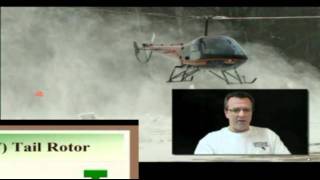
Here's a picture of Danny Martin out flying the instrument in the snow. And the only reason that I have this on there is because you can see some vortices here. And I've got another video that's going to come up later on in this presentation where we're out actually hovering around and you can see some awesome vortices going around. But if you really look here, you can see nose is going to go to the left. If you lose the tail rotor, nose is going to go to the right. ET Remember that? I think that's a super memory aid. And ever since he told me that a long, long time ago, I've never forgot it. To the left engine, to the right tail rotor. In Indianapolis, the helicopter air to air is 12305. A lot of other big cities use 12302, like Chicago, Cleveland, but it makes sense. In Indianapolis, since The heliport is 12305, it is common for the helicopters just to talk to each other on that frequency. Makes complete sense.