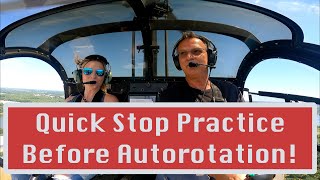
Kenny Keller and Heather Heit show how to practice quick stops as prep for autorotation, focusing on smooth flare inputs instead of jerky movements. The quick stop is basically the flare portion of an autorotation, and they walk through the control cues that make it work.
Chapters
All right, Hover over that pool. I'm gonna jump in.
Yeah.
Have you ever jumped out of a helicopter?
No.
For an airplane?
No.
Would you?
No. I have no desire.
I totally would.
I have no desire whatsoever. All right, Kenny Keller, check. Negative stop, start over. Blah, blah, blah. Hey, I'm Kenny Keller, creator of Helicopter outline ground school. Heather Heit, your hogs member concierge. We are going to talk about a really key term that I heard, not a concept I heard about when I first started training years ago. It's practice quick stops before practicing auto rotations. So let's go do a couple and talk about that. The key thing is your quick stop is essentially your flare in your auto rotation. So if you think about that, it's in the quickstop, it's a little slower, it happens faster in the auto rotation. I'm going to say we're going to do a quick stop and I'm just going to be nice and gentle. One, two, three, enter. So down collective, right pedal, aft cyclic. I'm going to blare. I'm going to keep blaring. I'm going to keep blaring. I'm going to keep blaring. I'm going to keep blaring. I'm going to level the helicopter, raise collective, adjust pedals, adjust throttle. Okay. And you can get a super aggressive with these. You can do a mild mannered. Millions of ways of doing quick stops. I'm gonna do another one. If you haven't heard this concept, just think about it again when you're coming down that out of that auto rotation somewhere somewhere between 50 to 100ft, you're gonna probably start your flare somewhere in that vicinity. Depending on the aircraft. First talk traffic. November 9466, 12 miles to the east, inbound for Runway. So I'm going to go, I'm going to do this one a little lower, a little slower. 1, 2, 3, quick stop. Be a little more aggressive. Flare, flare. Keep flaring, keep flaring, keep flaring, keep flaring. Forward cyclic to level. Race collective. Adjust pedals. That would. That's the end of the auto rotation back to a power recovery. And if you really lost the engine, all you do is just level it out and raise collective. That's pretty much it. So I'm going to go around. Maybe we'll do one more. But I just want to talk just a little bit more. We're looking for an airplane here. Keep an eye out for him, Heather. That's just a really good method to use to warm up for the auto rotation and the quick stop. So then when I became a cfi, company was owned by a weekend warrior private pilot. And we went out to do some autos and we had a couple of them that went really ugly and really bad. Luckily we didn't wreck the helicopter, but it scared me to death. And so I had hired instructor with like 4000 hours in Robinsons to come in and work with me. And I said, hey, you know, I'm brand new CFI and I'm scared to teach autos after this incident. And he goes, all right, we're gonna get together for like two or three days. We're gonna start with ground school. And he talked heavy about quick stops and he said that's where we're gonna start before we ever do the autos, we're gonna go out and do quick stops first. So we went out and really worked on quick stops, talked about how it rel in the auto rotation and we really worked on that. And he got me to where we perfected the quick stop where I'm looking over the top of the dash in R22 and learning how to adjust the controls to keep a certain point in the distance on the horizon, like buildings or whatever, adjusting the collective to keep that height, which makes a lot of sense. It's you're learning to control that player. So then we went did straight ins or we did 90s straight ins and 180 autos. And he was big on pushing quick stop and he's the one that told me and he wrote it on the board. I remember it. We probably shouldn't call it quick stop. We should probably call it slow stop because everybody wants to jerk the controls in the maneuver. When you call it a quick stop, it's actually a slow stop because the maneuver when you do it, the control inputs are gentle and smooth. You're not jerking them and grabbing them. You're just smoothly adjusting the controls to do your flare. So there you go. That's just a really good thing to use if you're flying somewhere. Ask your instructor if you can do some quick stops at foreign autos. Maybe your instructor's already doing that. If he is or she is, great. But just a good little tip, something that can help you out in your training. So did we tell them about the sale? Well, if we didn't tell them again, yep.
We are doing a 50% off July 4th sale. You can use the code July 50 from our website helicopterground.com 50% off any course. Good time to get that professional pilot. If you've been wanting it. We hardly ever do this. 50% off sale. Let's see here. If you just go to the links below the video, it'll take you right to the checkout. No code needed. And you can reach me at 574-767-1797 or heatherelicopterground.com if you have any sign up questions.
Are we done with our 10 videos or is there another one?
We're done.
That's it. Oh, my gosh. I guess. I guess you better go down below because when you see this video, you're gonna be hours away from the end of the cell.
That's true.
So you probably better take Heather's advice. Lima, eight miles to the east, 2,500 inbound over the top, Runway 13. And either go below and click one of those links for private pilot, advanced pilot, or an option on pro pilot, or go to helicopterground.com and use the code JULY50. If you have any question. New member, returning member up. Current member, call or text Heather 574-767-1797 and we'll dream up something cool. Next. What's coming? Don't know.