Ride Along In The R-44 As We Prepare For Full Down Autorotation Filming
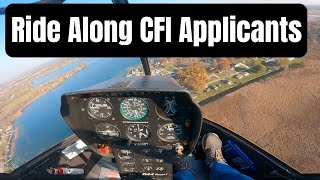
Kenny Keller (and co-speaker) record in-cockpit instruction while preparing to film full-down autorotations for new CFI training content. The video mixes announcements about CFI-month content and merchandise with practical flight instruction: preflight checks, quick stops, straight-in and 180 autorotation setups (recommended entry ~500 ft AGL, enter slightly above 70 KIAS and trim to ~70–75), emphasis on training to standards, and notes about obtaining a full-down autorotation endorsement for the CFI checkride.
Chapters
And I'm gonna say 1, 2, 3, enter. I'm gonna go down collective right pedal, aft cyclic. I'm a little aft pull when I enter. So here we go. In 1, 2, 3, enter. Collective down, right pedal, roll off the throttle.
Hey, we'll get you back to that video in about 60 seconds. I'm gonna go ride around while I film new content for the CFI section. So stay tuned, don't go away. Next, set of rounded ball caps for Thanksgiving special coming up, patches. And we got some new flight jackets on the way that we're going to show you soon. As soon as they arrive. So we'll get back to the video. What I thought this morning I was thinking about having November is CFI month. And I also thought auto rotation month. And I thought, you know what, let's just make it. Let's rebuild the CFI section inside hogs, the certified flight Instructor section. I'm going to grab the camera and show you. These are our members from the CFI section or these are members that have got no go buttons set in their picture after passing their checkrides. So I'm going to go out and film maneuvers instead of scrapping a bunch of footage that may have not worked out. I'm going to share it with you here on YouTube. Maybe I make mistakes, maybe the traffic pattern gets busy and I can't shoot what I was getting ready to shoot. Regardless, there's some good content in there. So all month we're going to be shooting new content for the CFI section and I'm going to put out sections of it just to let you kind of sift through. And I'm just going to be out doing what instructors do, fly and talk. So we're going to get right back to that video where I'm not just doing CFI stuffs, stuff I'm getting ready to do full down auto rotation. So that's what I'm working into. That's what we're going to be filming. And real quick, before we go back to video Private pilot study guide, you can sample this thing. There's a link down below where you can sample chapter one for free as a free PDF. And you can also check out the paperback version as well. That's a link down below. Enjoy the video and give us some feedback on what you want to see coming up the rest of the month. Because I'm going to be out flying every day that the sun's shining. That's decent. I'm going to be out flying filming new content. So interact Below, give us some feedback, and I'll keep these going. If I don't get any feedback and nobody cares, then I'll stop doing it. So you want to see some more of what I'm going to show you now? Leave us a comment down below.
All right, time to start updating the certified flight instructor course. This past summer, I've done nine checkrides, and the majority of those have been CFI applicants coming from around the country. And I can tell you a common theme direct from the examiner. Many applicants for the CFI have been weak on the fundamentals of instruction. And I know that's the last thing you want to hear. I guess it's like paying your dues. We've all done it. We've all been there. You just have to work through it. I know it's a lot of memorization. It's a big hassle, but you got to put your nose to the grindstone and just get through it. And as you're studying the fois, try to think of some things that you can use for most of the fundamentals of instructing. If you think about it, you can find scenarios like, oh, let's just make one up. Let's say the building blocks of instruction, like how you learn one thing and then it builds on another. You know, let's talk about auto rotations, because I'm going to do some auto rotation stuff today. It's always good to do quick stops before you start doing auto rotations and explain to a student how the quick stop is essentially the flare in your auto rotation. So you're gonna definitely be teaching quick steps before you start teaching the auto rotation and the flare and the auto rotation. So you can think of plenty of scenarios through your training. You've been through private and commercial if you're doing the cfi. So a lot of these things you can apply, you know, like, you know, an instructor needs to make the first experience for a person pleasurable, right? Maybe you had a first experience that was pleasurable. I know my first two instructional flights ever, the guy was yelling at me, and I didn't like it. I didn't go back for six months. And when I did go back, the instructor said, that instructor that was here when you were here before was a real a hole. And I was like, I'm glad to hear you say that. And he said he ran a lot of people off that never came back because of his attitude. And I'm like, you know, I almost didn't. And he goes, forget that guy.
Go out today.
And start over. So in the pts, I put in the appropriate place, I wrote the guy's name that I did my first flights with because that's how I would remember about how you should treat a person, you know, and how students need to be treated with respect and give them a pleasurable experience, not start yelling at them the first two lessons. So I'm going to do a clearing turn here. And we just did our normal approach. This is a little tip for you as a cfi, I heard a long time ago you should always go out and do a normal approach, warm things up before you start doing auto rotations. And I'm a firm believer in that. I think that's exactly the way it needs to be. And also always do quick stops before autotracements just to warm up. And I think that's great advice as well. So let's do a few warning. Caution lights are out, gauge is in the green, I'm out of the yellow on the carpet. So I'm gonna get rolling along. Most of us teach quick stops, you know, like 40ft, 40 knots, something like that. But just note they can be at any altitude, in any airspeed. As long as the maneuver safe, that's what's important. You'll find that people do a lot of different methods with quick stops. So let's do 1, 1, 2, 3, quick stop. So gentle flare. Keep flaring, keep flaring, keep flaring, keep flaring, keep flaring. Gonna wait till the speed's almost gone. Now I'm gonna level the helicopter collective, adjust pedals as necessary. And if you think about that, that is essentially the flare and the auto rotation. Let's do another one. Taxiway changed angle here, so I have a little bit of different wind. It's pretty light, so not going to be a big deal this one. Maybe I'll get a little more aggressive today. My autos are going to have to be more aggressive because there's not much wind. 1, 2, 3, quick stop. This time I'm gonna get a little more aggressive. I'm gonna keep flaring and flaring and flaring and flaring and flaring. Because if I go to do a full down, I want to make that speed almost gone. Aircrafts are almost ready to drop. Level it out. Race collective, adjust pedals. Alright, so also we're gonna try to work our way into full downs. But I'm not gonna go straight into fold downs either. I'm gonna go around and I'm gonna do a straight in first. See how it feels. There's only about 4 knots of wind, but it is coming down the Runway in the taxiway. I'll be using both today, probably mostly the taxiway, just because I could do right traffic and go back the taxiway. So highly recommend a pre takeoff every time. Check out your time. I didn't do it. So warning caution lights are out, gauge is green, timers running out of the yellow. I just took fuel on before I took off, so I know I'm good on the fuel. Okay, so back to our conversation. I'm going to go around and I'm going to do a straight in first. I don't want to go right into full downs. Kind of want to see what kind of a day I'm having and see how the wind's going to react. So we're going to start out with a straight in auto rotation. So from an instructor's point of view, you have to train to a standard. You need to train to a standard and train your students to a standard. And you're going to have people are going to tell you, oh, but that's not real world. Well, you're going to be training your students to the private pilot standard or one of the advanced ratings. So we have to have that standard and we have to train to a standard. Yes. You should also take your students out and do some scenarios for auto rotations that are out of the norm. You should go out and do things with them other than just straight ins and 180s. We do those to get them prepared for the practical test. But if that's all we ever do with them, then that's kind of like that's all they think they can do. Sometimes after you get them confident with straight instant 180s, do 90s with them as well, do 3 hundreds with them, do 60 degree auto rotations, go out and find different scenarios, different altitudes and so on to give them some, you know, experiences outside of the normal. I just think that's really good practice when training people with odd rotations. Like any other maneuver, I'm going to preach to you a good setup. A good setup is key. If you enter it nice, it's going to be nice. If you enter it sloppy, it's going to be sloppy. That's just the way this works. So in order to get your student in line with a good solid auto rotation, you want to teach them a good setup. So I'm going to do this from about 500ft AGL. I want to be just above 70 on my airspeed. I'm going to make a radio call Warsaw traffic helicopter one Mike Bravo ride base. Turning final, letting the taxiway parallel 27. Warsaw. So I'm going to line up with the taxiway and I'm going to go for the first intersection. I'm about 70. I raise up a little collective, get rid of that descent. And I'm gonna say 1, 2, 3, enter. I'm gonna go down collective right pedal aft cyclic. I'm a little aft pull when I enter. So here we go. In 1, 2, 3, enter. Collective down right pedal, roll off the throttle. I got 80, so I'm a little fast. I'm gonna slow that down a little bit. And I'm in trim. Looking good. I'm not moving anything now. I'm just kind of sitting here waiting. I'm waiting. I see treetop. I'm going to start a gentle flare as I come in. I'm going to make it bigger. I'm going to make it bigger. I'm going to make it bigger. I'm going to make it bigger. Try to get rid of that speed. And I'm going to roll it on, add the throttle. And if I did a full down with that one, that would be a lot of forward speed. So let's go around and try that again and see if I can get a little more aggressive and get rid of more of that speed, which is going to be hard for you to do when the winds are light. When you have more winds, of course, it's going to be a lot easier. So takeoff check should pre takeoff check. But I'm in the middle of my takeoff warning. Caution lights are out, gauges in the green. And my examiner says there are a lot of flight schools and instructors out there that aren't teaching a hover pre takeoff check. And that's a bad thing. And you'll find out there in the real world, there's a lot of people not doing them and it's just not good. I've made a mistake today of not getting that verbalized for you. So I'm gonna do better every single takeoff. Pre takeoff check. We're gonna go around and we're gonna set that up again about 500, about 75. And I'm gonna try to do a little bit more of aggressive flare to get rid of some of that speed because I'm maintaining this aircraft and I'm paying for those skid shoes. So I really don't want to slide any farther than I have to. I have my 300 AGL so I can start my crosswind. Teach your students normal takeoff climb to 300 AGL before you start your turn either direction. And that's not just a private pilot thing. I can tell you from the professional environment in EMS. We stuck with that. It was climbed to 300 AGL before starting your turn. So that's a 135 operation. And it's textbook. Just like private pilot training. They want you to climb to 300 AGL. Traffic. Mooney 7 0X Ray is 10 miles to the west inbound on RNAV Warsaw traffic. Helicopter 1 Mike Bravo is on a right downwind. We're landing on the taxiway parallel to seven or so. Okay, so we'll be paying up and listening to that guy. So where was I? Oh, yeah. So the 300. And then they also wanted us in the EMS environment to line our approaches up at 300 AGL. So that's how you should teach your privates. That's how we flew it in a professional environment. So that guy was 10 miles out.
So I should have plenty of time.
To get in and get another straight in auto. Done. So again, consistency, setting it up every time is how your students are going to find success. And I can tell you from doing a bunch of advanced ratings this summer, a lot of guys from around the country have come in and city traffic Skyhawk 7, they don't have a really the best setup. And they are kind of varying. I'm like, hey, you know, you're a commercial, you're going for cfi. Be consistent. Set these approaches up every single time so they look the same. And that's how you get consistency or get consistent in flying nice approaches over and over. If you're varying airspeeds, varying altitudes, it's not going to work. You need to have a nice setup in order to have consistency. All right, so I'm lining up with the taxiway. I'll make a radio call. Orsa traffic on Camper one Bravo right. Base turning, final landing. The taxiway parallel to seven or so. All right, so I get lined up with the taxiway about 75 on the speed. That's good. I like being a little faster than my glide. I like to glide at 70, so I like to enter a little bit above 70. So when I go aft cyclic, I can pull back to 70 so the nose doesn't drop and I can keep my RPM nice. So I'm lining up for the Runway. Got my 70, got my 1350. I don't want descent, I don't want out of trim. I want everything nice and neat. Coming up on our spot. I'm gonna go 1, 2, 3. Enter Down Collective right pedal. Roll up throttle, and I'm not doing anything. And on any given day, you might be able to do this in R44. Just hold it. Got it.
Nice.
At 75 RPMs in the middle of the green. Beautiful. There's treetop. I'm gonna start at jumbo. I get closer, I'm gonna make it bigger. I'm gonna make it bigger. I'm gonna make it bigger. I'm gonna make it. Wait for that speed. I'm gonna level it out. And I could have set that one down.
I still would have had some ground.
Slide, but I could have got it on the ground traffic. Mooney 70x Ray is 5 mile, final Runway niner, low pass only, departing to the east Orpho. All right, so that guy's going to be coming in opposite. He's just doing a low pass. So he's going to land a little bit downwind. The wind's out of 270. Be aware of that Fixed wing will do that with a little bit of a downwind. We don't do that in helicopters. We take off and land into the wind. So while we're doing this stuff, prepping you for CFI stuff, I can't stress enough. You want to do everything you can into the wind? Train students into the wind? No, downwind. Five years in EMS flying, I could always find a way to land into the wind. No matter where we were, on a rooftop, helipad, or going to a scene, I could always find a wind into the wind or a crosswind. I was never forced to downwind to fly downwind or land downwind. Some places actually teach downwind landings. I do not. And I think in a student environment, I don't think you should ever teach a downwind landing. They happen sometimes because of accident. I've misjudged the wind and have actually landed downwind only by mistake. And it's an uneasy fling. You'll know, like, you're like, man, this thing's going squirrely. Why am I messing with the pedals? Why is this thing acting funny? Because I misjudged the wind. So teaching your students in the beginning, always looking back at that windsock, looking at flags when you're flying. Look at smoke. This is fall right now. I can see smoke, people burning leaves, see a flag over to the left, keeping a good eye on what's where that wind's at at all time. And you got to beat this into their heads because you're responsible for creating this person you're creating their pilot abilities so you want to do it right. All right, let's talk about the endorsement for auto rotations as you're preparing for your certified flight instructor. So the way it's working as of now is the making of this video. You can get your full down auto rotation endorsement from whichever structure you're flying with at your flight school. And as long as you do the pull down auto rotation training with your instructor, he gives you a sign off stating that he's completed the straight in and 180 pull down rotations with you. That goes in your logbook and then he signs you up to take the CFI checkride. So when you go to the CFI checkride, you won't have to do. The pull downs for the examiner, which is kind of nice, right? You can do those auto rotations with your examiner or I'm sorry, you can do those auto rotations with your instructor in the aircraft you're normally flying with. Hope at your own airport. And then you won't have to do that during the checkride. So that's nice. That takes a lot of stress off that certified flight instructor checkride.
When you feel the pressure to fly, but know the right decision is to stay on the ground, hit the hogs. No, go and live to fly another day. Helicopterground.com Yep.
Because that's why people get killed for making bad decisions and taking off and flying into bad weather when they shouldn't.
Helicopter online ground school member as you see on the wall behind us here, these are all of our members that have passed checkrides.
So they use our training to get.
Through, let's say private pilot. Once they pass their checkride, they send us in a picture. As you can see, with their checkride helicopter. Usually either they're with their instructor or.
Maybe they're with the examiner.
But when they send us a picture.
By the aircraft and we like them.
Right after the checkride because that's when they're excited, right?
They just got that certificate in their hand and a lot of these people.
Have that in the pictures.
You'll see when they send us a.
Picture to tell us they passed.
And they usually just write a sentence or two.
We don't ask for a, you know, 10 paragraph story. We just say, hey, how did hogs help you?
And they'll usually say something like, hey, couldn't have done it without hogs.
You know, I could have never studied.
This big pile of overwhelming information on my own. Once they send that in there, then you, Heather ships them the no go button.
So how many no goes are you shipping today? Today I am shipping six no go's.










