Robinson Helicopter Safety Tips Every Pilot Should Know
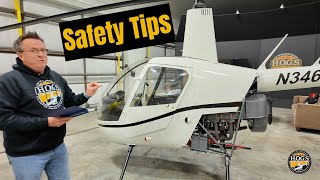
Kenny Keller covers 17 Robinson helicopter safety tips from the manual. Don't let the low-fuel light come on, never switch magnetos in flight, and keep your strobe lights on when engaging the drives. The video includes practical anecdotes and links to free PDF downloads.
Questions this video answers
Above 3,000 or 4,000 ft.
Within two seconds.
Never attempt a magneto check in flight; leave the key in both positions and land as soon as practical.
Chapters
Hey, we want to go over safety tips out of the Robinson helicopter manual. And this is something that I think you can benefit, whether you're brand new and just getting into this or you're a pilot and going back and reviewing some of the things that we need to think about. I really like the safety tips and notices inside the manual. Luckily, I'm sure one of my instructors pointed out when I first got started that said, hey, take the time to go in there and hit safety tips and safety notices and kind of like checkrides. We talk all the time about how people do stupid little things that make a checkride fail. Same thing happens with helicopters getting wrecked and people getting hurt or killed. Usually it's some small thing that happened. That's why I think the safety tips and notices are super important to go through. So we're going to review the safety tips. Just go through them one by one. The first one. Never abruptly push the cyclic forward in the helicopter. And you're going to hear this in the awareness training when you go, before you take your first lesson, before you're allowed to manipulate the controls, you have to have the awareness training. And one of those topics is never abruptly pushing forward on the cyclic. And they can call that a low G maneuver. And that's why here they have low G pushovers prohibited. Bad things can happen from a large forward abrupt input in the helicopter. So you're going to hear about that often. Number two, never allow the fuel to get so low that low fuel light comes on. And that goes for any helicopter. So again, good tip for any aircraft. You never want to get to that point that your low fuel light's coming on because you've only got minutes of time left. You're not going to have time to go to the next airport, get more fuel. So you want to plan your fuel accordingly. Use your timer. Understand how much fuel you're burning. Never get to that point. Next, never leave the helicopter unprotected, where curious onlookers may inadvertently damage critical parts such as tail rotor blades. We'll have Lindsey come back here and take a look at the tail rotor. So this is not only the danger of somebody back here messing with the equipment on the back of the aircraft. Something could get damaged. But this is something that we're always concerned about is the tail rotor. This thing's spinning really, really fast and it's very hard to see. So anytime you're in and around the helicopter, the tail rotor is a danger. And you have to always be making efforts to keep people away from that tail rotor number four, turn the strobe light on before engaging the drive system and leave it on until the rotors stop turning. So what I was trained to do and I always do, is I leave the strobe switch on all the time. I never turn it off that way, anytime that master comes on, the strobe light is flashing that warns people that you're possibly getting ready to start and take off with the helicopter. So it's a good idea just to always leave the strobe on at all times. And this can save you as well at some point by leaving that switch on all the time. You'll be warned if you get ready to walk away and you haven't remembered to turn the master off, you'll see the light flashing and go, oh, hey, I need to go turn that master off. So when you come back out, you have a fully charged battery. Number five, never carry an external load, except when using an approved hook. Anytime you add something to an aircraft on the outside, it needs to be something that's approved and has an STC with it, a supplemental type certificate. But it also talks about putting anything on site the aircraft you want to take special care. Of course, a lot of people are mounting cameras on the outside of aircraft now. So just be very, very careful about what's approved and what you can and can't add to the outside of an aircraft. Number six, avoid abrupt control inputs or accelerated maneuvers, particularly at high speed. These produce high fatigue loads in dynamic components and could cause a premature or catastrophic failure. So everything that we do in the helicopter is a nice, smooth, coordinated movement. There's never a time to really jerk hard any control. The only one time kind of exception is with the collective in the R22 is if the engine fails. That has to be. This collective has to be lowered within two seconds to make sure that you don't get into blade stall. In general, the maneuvers that we do, the control inputs are nice and smooth. Example, on a quick stop, they call it quick stop. But we say you should call it a slow stop because people get the idea that they should quickly yank the controls and you don't need to. So everything that we do can be done with a nice, smooth, controlled input. Number seven, a change in the sound or vibration of the helicopter may indicate an impending failure of a critical component. And what a lot of people like to do when they're starting up the R22 or other aircraft, they leave their headsets off, start the aircraft, and as they're starting to do their run up, they put an ear outside and kind of listen and make sure everything sounds as normal as they're doing a startup before they put their headsets on. So, vibrations. I was involved in a ground resonance accident back in 2005 and we were having some vibrations before that happened. And I wish that the maintenance would have dug a little bit farther before the aircraft blew apart. So anytime you're having a weird center of vibration, make sure that you get that checked out and find out what's going on. Number eight, we already mentioned this in the video, but be sure ground personnel or onlookers don't walk into the tail rotor. We can't harp on this enough. People love the helicopters, at least most people anyway. Sometimes you upset somebody landing a helicopter, but most of the time people want to run out and they want to see what's going on. Right here is the danger. Also people getting in and out of the helicopter. Best practice is just to shut the thing down. Unless you have a rated pilot or trained personnel to make sure people stay away from the tail rotor, this is really, really a big danger. And people do get hurt and killed from walking into tail rotors. Number nine, Never allow allow rotor RPM to become dangerously low. Most hard landings will be survivable as long as the rotor keeps turning and is not allowed to stall. So during your training in this case, we'll say that we'll talk about the R22. Anytime the RPM's low, we're trained to lower collective and add throttle to try to bring that RPM back up into acceptable ranges. RPM is life. It's the a number one thing that keeps us flying and keeps us in the air and keeps it safe, keeps us safe. Number 10, never make takeoffs and landings downwind, especially at high altitude. The resulting loss of translational lift can cause the aircraft to settle into ground obstacles. This is one that I train and live by. Taking off and landing downwind has only happened when I've made a mistake and I misjudged the wind. I don't do it in training. I don't do it purposely. Even in the five years of EMS flying I did, I could always find a way to land somewhere and at least use into the wind or at least with a crosswind. I was never, never forced to land downwind. So keeping it into the wind, not doing a tailwind landing is always a good idea. So number 11 is kind of furthering along with that. Never doing a downwind takeoff and landing. A vertical descent or steep approach downwind can result with sign of Power. And now the acceptable term used most of the time is vortex ring state. If you are descending into an area with too high rate of a descent, you get into this thing called selling with power. And as a helicopter pilot today, that's one of the biggest things that you really have to be concerned about. So that's all about being trained with good technique, doing the best you can at landing into the wind or with a crosswind, and being very nice and slow and methodical on these approaches to avoid selling with power. Number 12, I like this one. The helicopter is stable on its landing gear as long as ground contact is made vertically or with the aircraft moving forward. I like this one because when we're teaching people to pick up and land, a lot of times people struggle with that point right when you get down close to the ground. So if you use a little bit of forward movement, that means you're not going sideways and you're not going backwards. Going sideways, you can catch something and you can actually roll the helicopter over. That's dynamic rollover. If you go backwards, you can catch the skids and stick the tail boom. So anytime you're near the ground, if you're using a little bit of forward movement and you're keeping that nose straight, most likely nothing bad's going to happen sideways and backwards, we don't want to do so as far as getting operations near the ground, either straight down or straight down with a little bit of Forward movement. Number 13, this is fresh on my mind. When operating at higher altitudes above 3,000 or 4,000ft, the throttle is frequently wide open and RPM must be controlled with the collective throttle. Collective correlation is not effective under these conditions. And Governor, response rate is fairly slow. So extreme care must be taken to roll throttle off as collective is lowered to prevent an overspeed. I recently did some plan out in Las Vegas with Taz Chrisman in our R44 and had my eyes open real quick when we were out doing some stuff out in the desert with four people on board and a good load of fuel. On a hot day, you get up in those higher elevations and the aircraft performance definitely goes down. So anytime you're at the higher altitudes, there's a lot of care that needs to be taken in the different operations we do with helicopters. Here's something you'll see people do, and it's not a good idea. Do not use collective pitch to slow the rotor during shutdown. So you've shut the aircraft off and the blades are slowing down and people get in a hurry and so they Want to, like, pull collective to put more pitch on the blades, or they want to push pedals, or they want to get out and grab drive shafts. That's never a good idea. You're putting extra stress on components, and you want to either let the aircraft blade slow down, just let the momentum go away, or if you have a rotor brake, use a rotor brake. But purposely slowing down the aircraft blades, not a good idea. And I'll throw another one on that. I see on YouTube all the time, people get out, they shut the engine off. Blade's got a pretty good, you know, spin going on. They get out, and they just walk away. The helicopter's sitting there, blade spinning, tail rotors going around. Not a good idea. Stay with the aircraft until the blades are done moving. Another good one. Number 15. I just made this mistake last year, and nothing bad ever happened. We were doing a favor for Heather over here, doing a baby drop or whatever you call it. What do you call it? You put this gender reveal thing. Of course, we weren't dropping babies. Never land in tall, dry grass. The exhaust is low to the ground and very hot. A grass fire may be ignited. We went over and did this job last summer for that event, and we were looking for a good place to land, and I picked what I thought was a good spot. And once we got in there in the R44, I realized the. The weeds were really tall. Luckily, we were dumping Heather off, so we hurried up and got her out of the helicopter so I could get the hell out of there, because I was worried, because you can see the exhaust is really, really low. R22 or R44. So landing in tall grass, you could start a fire and obviously catch the helicopter on fire, and that'd be a really, really, really bad day. Number 16, always check an area for wires or other obstructions before practicing auto rotations. Sure. I think that should be. Always check an area for wires or other obstructions. Anytime you land a helicopter. Right. That's kind of an obvious one, but it's in here. Why? Because people have hit wires, towers, all kinds of obstacles. Here's another one for you. You see on YouTube all the time, these people are out flying rivers and valleys and lakes and getting real low. Not a good idea, because what happens over rivers, valleys, people drape wires across them. So all this YouTube stuff you see with people down there low, flying over a river, not a good idea. Number 17, the last of the safety tips. Never attempt the magneto check while in flight, if one magneto is malfunctioning, and the pilot grounds the other one. The engine may stop completely if a magneto malfunction is suspected. Leave the key in the both positions and land as soon as practical. And I can tell you what will happen when a magneto goes bad. When one of the two goes bad, it's probably going to run really, really rough and you're going to have a loss in power. A loss of power and you're going to want to get the thing on the ground. So self explanatory. But if for some reason you had this thought of chucking a magneto in flight, don't do it. They might have to do an auto. Yeah, if that. If a magneto fell in flight, if you could keep flying it, if you had enough power to fly and land without doing auto rotation, that would be best. But that might be a choice. It might be. It's running so rough that you have to do an auto. So that is a possibility. So that's an update. The video we're replacing inside Hogs is really, really, really old. This is going inside the Hog site. We're going to do some more videos on the safety notices. Those are a little bit more in telled. So we're going to make some other videos on the safety notices just because again, those are a little more at length and those dive more into a lot of the reasons why people get hurt and people get killed. So before we go, we have two free downloads for you below. Top 10 Checkride Tips Private Pilot 101 Both of these Amazon bestsellers. This is Tips for a Checkride. This is general helicopter flying techniques. Practices thoughts and ideas while working on your Private pilot. We'll put both of these down below the video so you can get a free PDF copy. And also don't forget to check out helicopter Online ground school@helopterground.com Peace out. When you feel the pressure to fly, but know the right decision is to stay on the ground, hit the hogs no go and live to fly another day. Helicopterground.com. Hairball Are you putting that in my face? This is a booger chip.










