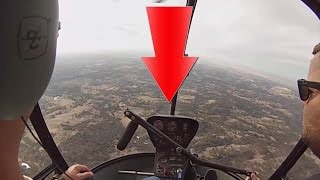
Kenny Keller, David Redman, and pilot Ravi teach autorotation entry in a Robinson R-22. Lower the collective slowly while applying back pressure to keep the nose up, watch manifold pressure drop to 10-11 inHg, and stop when rotor RPM separates from engine RPM. Small, smooth inputs prevent student panic.
Questions this video answers
Approximately 65 knots.
About 10 to 11 inches of manifold pressure.
Rotor RPMs start to separate from engine RPMs (after manifold pressure drops to ~10–11 inHg).
Chapters
And I start to lower collective. I do nothing else, but I start to lower the collective. Watch what happens to the attitude of the nose. So here I'm going to start lowering, and you see how the nose drops.
Hello, I'm Kenny Keller, the creator of Helicopter Online Ground School and author of the Amazon best seller Helicopter Checkride. These videos are courtesy our new operations manager, Brian Rutledge, and the owner and instructors at Odyssey Aeronautics. Stick around to the end of the video to find out about our test flight, where you can go and look at our training and also more about our membership.
Hey, this is David Redman at Odyssey Aeronautics doing some more videos for Helicopter Online Ground School. And today we're going to do some stuff on auto rotations. Now, the videos we're shooting are two parts put together. It's going to be both for the new student trying to learn how to do an auto and also for a CFI trying to teach how to introduce an auto and techniques. Now, before we even get started, a couple of things we need to go over. This has to do with all the flying, but in general, especially in auto rotations, you want to be kind of do this stuff very slow and have very small, smooth inputs. You don't want to, you know, be moving the thing all over the place because you're just going to cause RPMs to go everywhere. Also, as a flight instructor, you have to choose your words carefully. You don't want to be in the auto and go recovery or, you know, go, okay, roll on, because the student's going to panic and roll the throttle on. Always choose your words that make the student feel relaxed and do slow inputs. For example, when I'm ready to remarry the needles, I don't say roll on up. I say crack the throttle or like, ease the rpms up or gently bring the RPMs up. That way the student does it slower because that's what he or she should do. The first step, when I am going out and starting to introduce auto rotations, the student must understand the correlation between raising and lowering the collective and the attitude of the aircraft. When you're entering an autorotation, Ravi's going to take and lower the collective. Well, when you do that, the nose is going to drop. Now, to keep the nose from dropping as you're lowering collective, you have to be giving aft cyclic. Now, we're not trying to give aft cyclic to climb. We're just trying to give aft cyclic so that the nose stays level and stays at about that 65 knot attitude. So as you're lowering the collective, you're giving a little aft cyclic just to keep the nose from dropping.
Alright? So first of all, I'm going to start like we start everything with the lights are out, needles on the grain, 1, 2, 3, in the grain feels good. Pump a little bit of carbine because it's a little cold today. So it's important to understand the relationship between the collective and your attitude. So if I'm flying along, I'm doing, let's say I'm doing 65 knots and I start to lower collective, I do nothing else but I start to lower the collective, watch what happens to the attitude of the nose. So here I'm going to start lowering and you see how the nose drops. Now if I raise collective, watch what happens. The nose comes back up. I'm doing no cyclic inputs at all. So it's important to understand that the collective will control your attitude as well. And think of it this way, when you raise collective, you're producing more lift. So nose coming up when you're lowering nose drops. So when you're going in or auto, the reason why you're lowering collective and aft cyclic is not that you're trying to climb, it's that you're trying to keep that nose level.
Alright, now that you and the student have understand the correlation between collective and attitude, now we're ready to start doing auto entries. Now, I don't actually like to take students out and just go, here's how you do an auto. Three, two, one, boom. Now copy me. There's too much going on, they don't understand it and it's just too much all at once. So kind of like how I approach almost any maneuver is I break it into its parts and I slowly build the student up to where I want them to eventually be. Step one is I do what I call a slow auto entry. Now, when you're flying along, you're under powered flight. And then if you just start lowering collective, first of all, the nose will start to come down a little. So you have to go a little bit aft cyclic. And then if you just keep 65 knots with the cyclic and you start lowering collective a little more and a little more and a little more, your engine is going to be working less and less and less. Now if you just slowly keep lowering collective, eventually you're going to be in an auto rotation. And that's basically what I'm doing, is just doing a nice slow entry. I'll be flying along and I'll say, keep 65 knots and I'll start lowering collective and I'll watch the manifold pressure going down, down, down. Now, I'm familiar with my ship. The engine usually idles between 10 and 11 inches of manifold pressure. So I know when the manifold pressure gets there, the engine's not really doing anything. So I'll just continuously, slowly start lowering collective. Lowering collective. And then when the engine gets down to around 10 to 11 inches, it's not really doing anything. And you'll feel the helicopter kind of start to yaw a little bit. And I say it's like the engine's confused. Am I powering the rotor system? Am I not? Am I powering it? Am I not? And right about there, you slow down a little on lowering the collective and go a little more. And then you'll start to see your engine RPMs will start to separate from your rotor RPMs. As soon as they start to separate, you are in an auto rotation. Just stop lowering collective and at that point you can gently roll throttle off. And that is the smoothest, easiest way of just going from powered flight into an auto rotation. You're doing all the same stuff. It's just you're doing them much slower so that you can learn it and it makes sense.
Now we're going to start our slow auto rotation entry once again. Lights, needles. One, two, three. Feels good, Carpet. I'm going to go and pull full up for this. Now what I'm going to try and do is maintain 65 knots, and all I'm going to do is start lowering collective. And at about 10 to 11 inches of manifold pressure, the engine will be idling. At that point, I can roll throttle off. So maintaining 65 knots, I'm just going to slowly start lowering collective with right pedal and gentle aft cycling. Just trying to keep 65 knots, keep that nose from dropping. There's 14 inches of manifold pressure. 13, there's about 12. Helicopter's going to start to yaw a little bit, and that's the engine being a little confused. If I push through, you're going to see my rotor rpms start to separate a little bit. As soon as that rotor RPM starts to separate from the engine, I'm just going to stop lowering collective. So right about there, you can see them start to separate, and then I can go ahead and roll to idle. And we're in and out of rotation. Nice and easy. Now if you want to, you can go ahead and throw a turn into this.
Hey.
Hope you enjoyed the video. There are links below this video for our test flight where you can go in and take a look at our training, see how it's all laid out.