Robinson R-44 Autorotation Practice With HOGS
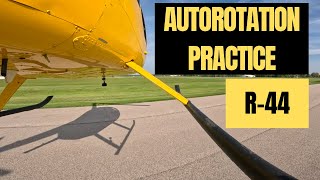
Kenny Keller walks through autorotation practice in a Robinson R-44, covering quick stops, straight-in and 180-degree entries, flare technique, and the setup parameters pilots use: 70 KIAS target speed, 500-700 feet AGL practice altitude, and the '40 and 40' reference points.
Chapters
Okay, we're gonna take you along with us for some auto rotation practice. And first thing we're gonna do is warning. Caution lights are out, gauge is in the green. We got fuel timers running. Everything looks good. And we are gonna do some quick stops. Just because quick stops are a really nice maneuver to just do a little practice before you go out to do autos. Because it's very similar to the flare in your auto rotation. I like using 40 and 40 for standard. It could be any airspeed, any altitude, but 40 and 40 or so. 1, 2, 3, quick stop, down collective, right pedal aft cyclic. Oh, just keep flaring, keep flaring, keep flaring. Wait till the speed's almost gone. Forward. Cyclic, raise collective. And in essence, that is your flare in your auto rotation. So I'm going to do another one and back as a new cfi. Had a, had a bad auto and I was, I was scared to teach them as a brand new cfi. So I had a high time CFI come in and help me. And he goes, let's do some ground. Let's do some quick stops, some straight ins, 90s and 180s, then we'll see how you feel. We spent a couple days on that. Here's our flare. Keep flaring, keep flaring, keep flaring, keep flaring, keep flaring, keep flaring. Keeping the same altitude. So I'm kind of looking out towards the horizon and fixing something I can use. Now I'm going forward. Cyclic, raise them collective and adjust some puddles. So back to my story. That was a very valuable lesson from a 4000 hour Robinson pilot when I was new. And he just said, you know, we worked through it and then I felt better and then went back to teaching autos. But we broke it down and he said, can he always do quick stops first? And I met a guy 20 years ago that had a handwriting the rotorcraft flying handbook or the helicopter flying handbook. And he was like, Kenny, as a new cfi, you should always teach quick stops before doing autos. It's great advice. So warning, caution lights are out, gauges green, timers running. I'm looking for traffic over there. I don't see anybody, don't hear anybody. So we're gonna do is we're gonna go around and do a nice setup. Because any maneuver, a good setup maneuver will probably good dinner sloppy. It's probably gonna be sloppy. So I'm gonna go around, set it up a little above 70. I want to be about 500 AGL. I want to be in trim. No rate of Descent and count it off. 1, 2, 3, enter. So right now I'm climbing to my 300 AGL before I start my turn. And while we're coming around here, exciting stuff. We have a pro member coming in two weeks for a commercial initial check ride with us in the R44. Another professional pilot member is coming in August for final approach course. He'll be here with us for seven days. Talked to another gentleman today who may be coming from the same flight school, the third guy from the same flight school in another state. And none of them are unhappy with their school. They're just unhappy. What, they can't get on the schedule Hardly. And they're short on. Short on instructors. And something just changed there. Did you hear? Did you notice that? I've noticed it the last couple days, but we've been on the other side. Okay, that's what you asked me about. Yep. Well, hopefully the audio is still going. So anyway, so this third guy we talked to today, again, not he didn't badmouth his flight school. He's just like. We're having all kinds of problems with the aircraft and their instructors left and they're trying to get instructors in. So three guys coming from the same state to come fly with us. But that's cool. That's what we want. I want to get stabilized on my downwind. I got 70, I got zero a descent. I need to climb up another hundred feet. So we're gonna keep flying along here. My raise, a little bit of collective just because I would like to get to 500 AGL. And again, I'll set the maneuver up nice. Set it up nice. It'll be nice. Set it up sloppy. It will be sloppy. That's how it works. So we are helicopter land ground school. We have our link below for our website. Check out all our memberships. Helicopterground.com Private pilot, commercial pilot, instrument pilot and certified flight instructor. And then we have the professional pilot. Like I said, two of the three guys coming are pro pilot members. Okay, so let's just get in the mindset of a auto rotation. I don't see anybody. Let me make a radio call. Warsaw traffic, helicopter 181Mike Bravo, left downwind for Runway 18, Warsaw. So again, I've heard my examiner that we've used for 22 years, the one that's gonna be doing the checkrides for these guys in the Robinson. I've heard him say it over the years. For 20 years. If it takes you 10 minutes to get set up for an auto, take 10 minutes to get Set up for an auto. He'd rather you take the time, get set up nice, and execute a nice auto. And people argue all the time. They go, well, that's not real world. Well, no, but you have to train to a standard. So, yes, you want to go out with your instructor, do more real world scenarios, different airspeeds and altitudes, but for training, we need a standard. All right, there's our clutch light. Should go out. Yep. Went out almost right away. There's 70 on the speed. I'm gonna pull up just a hair collective overshot my Runway just a little bit, but that's okay. So I'm gonna enter with the 18. The number's 1 8. A little bit above the top of the dash. So we got our 70. We got 450. I'm gonna go with it because we're at zero. We're in trim. I'm liking it. So let's just see how far we can judge after this one what's the wind doing. So we're gonna go 1, 2, 3. Enter Down Collective. Right pedal half cyclic. Roll up the throttle. All right, we got 70 on the speed. Looking good, looking good. Get it in trim. Rpm's looking nice. I'm gonna raise just a hair. Keep that 70. Ooh. We're gonna be pretty close to the 1.8. Looking good, looking good. There comes treetop start. A gentle flare as I get closer. Make it a bigger flare. Bigger flare, bigger flare. Race collective. Roll throttle in. And I like that one. Not bad at all. Awesome. Yeah. So that was our first auto. I'm practicing because our member that's coming is a initial commercial. And I just want to make sure I'm tuned in and fresh and ready to go when he gets here. Clear on the right. Since we had this helicopter home, we've had it here a week. We flew it five hours back here from Tennessee. So I've been doing all the standard stuff, you know, getting used to the aircraft takeoffs, landings, different maneuvers. And I kind of saved the autos until yesterday. And we went out, had a good flight, and then the audio didn't come out. So hopefully the audio comes out on this one. So we're gonna go do it again. Warning, caution lights are out, gauges green. Looking good, looking good. So I'm gonna do this without any adding any power. We're about 20 inches. 20. About 20 and a half. 21. Heather, if you want to look at the. Or put the camera on the collective. I'm just going to take my hand off just enough so I Can prove I'm not going to add any power. I'm going to keep nosing forward. Nose and forward, nose and forward. A little bit of air speed. I'm still not going to add any power. We're going to keep it going, keep it going, keep it going. There comes 20. We're starting to climb. We're staying trim until we get to 50ft or so. There's 40 and about. Almost 200 still added no power. I'm gonna look left, look right, looking for traffic. There's 50 and 300ft per minute. Okay, we're gonna get it. We're now at 20 inches of manifold pressure. We're more effective. It went down a little bit and still there's 55 and 400. Almost. A little bit more. There's 60. Come on, give it to us a little bit more. A little bit more. Come on. There's 65. So if I go half cyclic, I should be able to get me 500. And there we go. There is our standard 60 and 500 climb with adding no power. Love that. Okay, so what we're going to do next is and Heather's filming the instruments for you because you know, for 12 years or more of making helicopter videos, I haven't had that many opportunities to really. Well, let's just say this. People have been saying, hey, we'd like to see more of the instruments. We want to see more than just you guys talking. And I get that. Right. So Heather's getting more of the instruments. We've got a skid mount or a strut mount that we just put on a couple days ago. Hopefully we're getting a good shot on that. And again we're practicing. You know, that's what we decided to share this video with you, was give you some updates of what we're doing. And we're. I'm professioning up my skills, my teaching skills and my autos and we're testing camera positions ultimately to make the best videos hogs ever made. I mean it's. We've already said, we've already decided. We're like, we're watching the stuff we did and we're like, oh my God, this is, this is what we've been wanting to do for years. And now we finally got a really nice aircraft, fresh out of overhaul, has now has 11 hours on it. I think since overhaul, maybe this will be hour 12, something like that. No, that's not right. Because the five hour trip home. So we should be like 15, 15 hours on it since the overhaul. Very happy with it. So here we go. Better make a radio call so they know what we're doing or the traffic. Helicopter 181 Mike Bravo be entering base and final practice. Engine failure to the numbers 1 8. So I'm going to try to pull this off. I'm going to try a 90. So I'm going to turn earlier than I normally would because I like doing the 90s. It's an alternative. Instead of just doing straight in and 180, straight in, 180, straight in, 180 all the time. It's nice to break it up and do some stuff, do some different stuff. So we got 70, good. About zero rate ascent. We're gonna go 1, 2, 3, enter down collective right pedal roll, throttle up. I'm delaying my turn a little bit. I'm gonna overshoot, but that's okay. I'm gonna go ahead and do this. I'm gonna raise some collective, keep that under the limitation turn back toward the Runway. So yeah, I misjudged, but you know, it happens. So looking still looking good. It's got 70. Beautiful, beautiful, beautiful treetop level start. A gentle flare as we get closer. We make it bigger, we make it bigger. We make it bigger, we make it bigger. Now we roll in the throttle. Race collected. Very nice. All right, warning and caution lights out gauges in the green. We're gonna get on the go because these cameras we know get hot and they may puke on us. So I want to get as much recorded as I can. So the beauty with the 90s, and that's what this 4,000 hour CFI taught me 20 some years ago, was, hey, sometimes people struggle with 180. So do 90s. And then you can put two 90s together and turn that into a full 180 turn. And I've showed people this over the years. Some people like it. I'm clearing the Runway left, clearing the Runway right for the east, west Runway. And some people like it. Sometimes you might have a student that's struggling with that full 180 turn. And you go, hey, you know what, let's do some 90s. Start out just doing a 90 and then try two 90s. And for a lot of people, sometimes a light bulb comes on and it really helps. Some people just don't really like it and go, eh, I'd rather do the full 180 sweeping turn. But I'm gonna show it to you just to give you a food, food for thought. Sometimes I mess it up, sometimes it works out just perfect. So we're gonna give it a try. So while we're getting ready, let's see. Oh, yeah. Our memberships come with a 30 minute consultation with our, our operations manager, Brian Rutledge, 38 year aviator and airplanes and helicopters, CFI and both. And you get three 30 minutes with him. And also when you sign up, you have an opportunity to add a special one on one checkride preparation with them for two hours during checkout at hogs. You can get that option as well. So that's really cool. And what else do we want to talk about? Make sure all these links are below. And we wanted to pimp our private pilot study guide. Brian put that together. Over 80 pages, over 400 questions. Spiral Brown notebook opens up. We'll put a link down that below as well. People are digging it. I'm using it right now, prepping our commercial checkride guy. Even though it says private pilot, it's still all that stuff you got to know at the commercial level. And it's good stuff. And I'm. And I'm using it and I'm remembering stuff that I had forgotten and it's come out super useful. Okay, so for the 180, I want to get in a little farther than normal. And I'm up about 600 AGL, so. So that's okay. I'm gonna cheat a little bit, give myself a little more time. Heck, I'm gonna go up to 700 AGL, because I can when I give myself a little more advantage. This is just practice. I'm just demonstrating an idea to you. So. And I don't know if you can tell or not, but I'm sure Heather's over there grinning in the camera. She had a blast with the autos yesterday, and I had fun watching the video. Even though the audio was gone. I could see her grinning every time we entered the auto. She was digging it. She was like today, like, can we do auto? As soon as I get there, they're all right. Everything's looking nice. Good setup a little over. Beautiful. This is beautiful. So we're gonna go 1, 2, 3, enter. I'm gonna go down collective, right pedal, aft cyclic. And I'm gonna start my turn because you don't want to wait too long. Very common students wait too long. I'm gonna raise a little collective. Or he's a little more collective. Keep that speed in there. 65. I'd rather have 70. And I'm gonna go ahead. Horns on, but that's okay. I'm gonna go ahead and turn towards the Runway. I got 65 and we're still looking pretty good. Oh, this is actually kind of. This is actually. This is actually working out. Looking good, looking good. There's treetop. Start a gentle flare. Make it bigger, make it bigger, make it bigger, make it bigger, make it bigger. Roll on and level out. And boom. We got it. We hit our spot. Very nice. Yeah, I like that. I'll tell you what, I'm liking this machine. This thing is just, you know, like all helicopters. I say it all the time. By the way, warning, caution lights are out. Gauges in the green. We got fuel. 21 minutes on our timer. I am digging the R44. I've had R44 time in the past. I have the sign off. I've taught before in the past, but it's been since about 2016, 17. So I did a refresher this winter, flew with Gavin at Straight Up Aviation and spent a day with me, getting me all freshened up in the R44, giving my flight review. And then I spent the next four days flying with HOGS members in Florida. As soon as I got there, it's like, well, hey, can you fly with so and so tomorrow? Can you fly with somebody else the next day? Can you fly with somebody else the next day? And by the weekend, he's like, well, hey, I got people want to fly all weekend. And I was like, well, I gotta spend the weekend with my daughter because part of this is business, part of it was pleasure. They want me to fly Saturday, Sunday, Monday with more of them. And it was great. And then that's wonderful. But what a great experience. So what else am I forgetting? Heather, you touched on everything. The study guide. Yeah. So we'll just touch on what we're doing now. The R44 is here. We're taking phone calls. Heather's taking your text or calls at 574-767-1797. However, I'm gonna put a link down below if you want to schedule time, a 15 minute Zoom call to talk about coming out to fly with us. Please keep it for that reason. Not to just get on for joker reasons or whatever. I'm gonna put a link down below for short term where you schedule a 15 minute zoom with me and we can talk about your training. And what we've been doing basically, is just we have an available examiner, so that's not a problem. We're in class G airspace. That's not a problem. I'm available to fly with you, and we're only doing one person at a time, so you're not sharing a schedule with anybody else. We're keeping it limited so we can get the maintenance done. Because we're doing progressive maintenance. We're going to have a mechanic come in at least once a week depending on how much we're flying, minimum once a week. So even if nothing's wrong, we're going to have a mechanic come in, take a look, wipe things down and just that extra, that extra, that extra. Now I'm trying to, can't think of the word I'm looking for, but we've always got somebody looking and the thinking is he could say, hey, you know what? That one pitch link is a little bit loose. It's okay, it's safe, it's within a tolerance. But we know we're going to have to change it. Let's get one ordered. Boom. You have your link shipped, it's there on the workbench and then when you need it, boom. You change it versus oh man, helicopter's broken. Now we got to order parts. So we're trying something different, you know, and I'm, I'll admit when I was running a flight school before I blew the helicopter till it broke right, I did the normal maintenance, oil changes and inspections, but I didn't do progressive maintenance. I only took it in for inspections or when something was wrong with it. So we're hoping to buy doing a more progressive style maintenance. We'll be able to keep the aircraft in service for when you do come. And, and I'm not going to overbook. We still have to run hogs every day. I want people to fly, but you know, we got May booked, August booked, May have the guy coming in June. So reach out to Heather 574-76797. If you are interested in coming to fly with us at hogs. And we do smaller packages too. We have a one day discovery package, six hours of time with me and two hours flight, lunch on the grill. You can do two days, three days. You can build some build, do time building. We do rental. So we're gonna try another auto here in 1, 2, 3, enter full down right pedal, A little bit of aft cyclic. Nice, I like it. Nailing that speed, I'm telling you, I've learned over the years is key. If you can nail that speed with that little app pull at the beginning, the auto is going to be nice. If you screw the speed up in the beginning, you're chasing it all the way down. So I look over to see the trees. So tree top level. So gentle flare, make it A bigger flare. Bigger flare. Bigger flare. Bigger flare. A little high on rpm, but kept it within the limitation. All right, there you go. I think we're gonna wrap it up. These cameras get hot fast. Heather wants to go home. So subscribe to the channel because you can guarantee that you're gonna see potent. Didn't know it, more R44 content to come. We're enjoying it. Yeah, we've upped our game a little bit and I'm. And I'm very proud of that because, you know, over the years I had helicopters when I could. I hadn't always had the best equipment. And cameras, we've upgraded, you know, everything, equipment, cameras, style, what we do. You know, in the beginning, I didn't have big enough computers to do multiple files. Big go profiles, they're huge. And now, you know, I got the, I got the good. I got the good computer. I got the badass editing computer so I can pull four GoPro files in there, pick out the shots I want and arrange things because the computer could do it. In the old days, you know, I was operating with hand me down computers. I couldn't afford a big fancy editing computer. That's 11 years of hard work paid off, paying off. And now we got the equipment, we've got the cameras, got the computer, we got the examiner, we got the hogs. Hangar, class G airspace, lunch on the grill, laid back atmosphere. We fly with you and you only. You're not sharing the schedule with Tom, Dick and Harry or Martha and Jane. It's just all you. One day, two days, three days, seven days for final approach. If that's what you need. So that's it. We will see you in the next video. Peace out.










