Robinson R-44 Final Approach Course Returns To HOGS
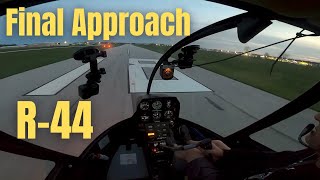
A first-person YouTube video (May 6, 2023) by Kenny Keller demonstrating flying and training in a freshly acquired Robinson R44. Keller describes camera setups for multi-angle instructional video, rehearses approaches, takeoffs, hover pickups and quick stops while narrating technique, and promotes Helicopter Online Ground School (HOGS) offerings, a May 2023 pricing/special, and a private pilot study guide.
Chapters
All right. I don't know how much of that sunset you can catch. All right, here's my first video in the yellow R44. Don't make fun of my white legs. It's springtime. I haven't been on the boat yet to get some color, but I am testing out some cameras. Picked this thing up Tuesday in Tennessee. Did a five hour flight home at fresh out of overhaul. And I spent the first day after I got home, the whole day just pre flight and taking a look, going over it with a fine tooth comb just to get to really know the aircraft. Look through the logbooks, just check everything out. That evening I took my daughter out for sunset flight. And I'm out by myself for Sunflower Sunflight. Sun flight, sunset flight right now. And I'm gonna do an approach here while I'm talking. So I'm gonna go full car. Pete. I did some filming earlier today and I had a helper, Lindsay. Heather's still helping, but Lindsey's also helping me do some filming and some downloading of files and editing and so on. So I took Lindsey out. And we were having a really good flight. Cool stuff. We get back and the cord was screwed up on my audio. So that's okay because here's what we're doing. I got three cameras running right now. I have two more to use and I have two mounts coming. One for that little ball on the nose and I have a strut mount coming. So this is my first video. Just get out a little bit of practice in the R44. I was just in up an approach here and I'm way too steep, so I'm gonna go around. All right. So I was out today earlier, got our initial filming because we thought, you know, let's try to do something a little bit different, get some really good ang. And the one thing we were practicing was keeping a camera on the instruments. Because of course, many of you asked over the years, hey, you, you're flying around talking. But we want to see the instruments. So when we start putting out our fresh videos, our flying videos and the videos that we're going to use to update the courses inside hogs, we'll have at least five, probably six cameras running and one of them will be on the instrument. So when we edit up fresh videos, we can be giving you the insight and get to see the gauges when we look at the VSI and the altimeter and the airspeed indicator. So that's going to be cool. So I just want to tell you, I just want to Do a short video, see how it comes out my shares on YouTube just for fun. So we're excited. We're bringing back the FAC course, which I actually booked one for August before I even made the deal on the helicopter. It's kind of funny, I was waiting on some information on this aircraft. As I was waiting for the information to come through, one of our HOGS members from Florida text or send me an email, he said, hey Kenny, do you still do that final approach course and do you have an R44? And I'm like, well, it just so happens I'm working on one right now. He's like, good, I'll give you a deposit. Put me down, I want to come up. And then just today, another hogsmember called, good friend of mine, he wants to come up and he's coming from Florida as well to finish up his rating. So I have two guys ready to come up, finish their rating. Same old story. They're flying with an R44 and they're flying with the structures of people that they like, but they're having trouble lining up the checkride and that seems to be a problem in a lot of places. Lack of DPEs, I guess, lack of scheduling. Brian Rutledge, our operations manager, he works out in California and they send their pilots clear to Oregon from California for checkrides because they're so booked in his area of California. So that's what we got going on. And we're also going to do some one day packages, like a discovery package. You come and spend six hours with us, do two flights, have lunch. We're going to offer some time building. I do get renters insurance. So yes, if you're a rated pilot, I can rent to you after a checkout with us. And then we're gonna offer some time building packages. So if you need 5 hours, you need 10 hours for the SFAR requirements, you'll be able to come out. We'll block the schedule for you. Anybody that comes, the schedule gets blocked. We're not gonna do the traditional Bob at 5, Mary at 2, the next day, Joe at 4. When you come, you got the schedule. You have the helicopter for a day or you have the helicopter for two days or you have the helicopter for three days. Whatever the case is, we block it off for you so you can come in, get the training you need and head back home. So let's go full car. Pete, probably make a radio call here, start setting up my approach. Warsaw traffic helicopter November 181, Mike Bravo, turning right, base and final four, Runway 18. Landing at the numbers Warsaw. Okay, so I want to slow this thing down, see if I can get it set up and talk at the same time. So on my approaches, I always preach a nice setup. So I want to be 300 AGL, about 65 or so in trim, zero rate descent when I approach my angle. So let's do a practice normal here while we're just out goofing off, having fun. This thing wants to fly. Man. The last flight I was doing last summer was in that H269 and that thing drops like a rock. With this thing, you got to push that collective down because it wants to keep going. Let's keep flying. My approach angle is coming into view. It's right there. So I'm going to go down collective, right pedal, aft cyclic, like we always do at the beginning of every single approach. Collective controls the angle, cyclic controls the speed. And I want to look like I'm always approaching those numbers at the same speed. So I start at 60 and then I go to 60 or 55 and then to 50 and then to 40. I'm gradually slowing the aircraft down, all the way down, keeping it in trim until 50ft below. 50ft will trim with the Runway. So my angle is looking good. I like it. The winds are pretty calm, don't have a lot of wind. My numbers are right on my angle. I'm liking it. Looking good, looking good. I'm digging this aircraft. I'm really digging it. We're going to call that 50ft. I'm going to line up with the Runway. I'm going for my numbers. 1 8. Let's keep raising collective. Let her sink down. I'm actually gonna nudge a little forward cyclic, trying to keep it level. There's the numbers. 1, 8. And here we go. Right down to the numbers. I like it. You know, I did my flight review with Straight up aviation, flew with Gavin in January. He spent a full day with me and did my refresher. And then I spent four days flying with HOGS members. I flew with four different HOGS members down at Straight Up Aviation. That was cool. So I did that. So I like 10 hours in January. So now I've got about 10 hours again. So I'm repression in my skills. I still know how to do it, but I'm just out there going around practicing talking, practicing flying, getting used to this aircraft. And I'm having a blast. And I'm gonna pick up, do hover pre takeoff check as we do every single time. Two step process Picking it up. I got it light. Now I'm gonna lift it up, and I'm gonna kind of do a clearing turn here, look around the area, see if I see anybody else coming in. It's quiet tonight, which is good for me to go out and kind of practice. Right at sunset, I'm digging it. So while I'm doing my clearing turn, I'm just gonna look down and look outside. Warning, caution lights are out. Yep. I'm also looking around gauges in the green. Yep. I started my timer. I've been up for about 17 minutes. I always try to keep it right. About an hour. I got plenty of feel for about an hour and have some reserve. All right, let's talk through a takeoff, and then we'll talk a little bit more about what we're gonna be doing. So I'm gonna show you. I'm hovering right now about 19 and a half, 20 inches. So for demonstration purposes, I'm taking my half the collective. We don't normally take our hand off the collective. Especially, we don't let students take their hand off the collective. But to prove to you I can do this with hover power, I'm still like 19 or 19 and a half. I'm going to keep moving the helicopter forward. Keep moving the helicopter forward. Keep moving it forward. Now I'm pushing through ETL. We're about 30. I'm going to keep it low, build a little more airspeed, and this will give me 60 and a 500ft per minute climb. So I'm keeping in trim. Best I can with the Runway. Right now there's 45 still going. Our climb is increasing. There's 55. It's down about 19 or just a little 19 inches. But we're more effective now. There's 60. There's 300ft per minute climb. Still not touching it. If something happened, I could get my hand down there quick. There's 65. So I go a little aft, and that will give me right there. Come on, come on. 60, 60, 60. 500ft per minute. That camera can probably see that. So, you know, I'm not. I'm not making that up the whole entire takeoff with hover power, 19 inches and just a little thought, you know, I'm checking our limit for the day, and I'm like, I always make my limit just a little bit under. And this thing's powerful enough even with another person and full of fuel. I can do the takeoffs well under the max power. Well under the max power. All right, clear right. Clear left. Make a right hand turn. I've got my 300 AGL, which we want for our standard turn before or the standard altitude before we make a turn. Even in helicopter EMS. That was the 135 reg climb to 300. Start your turn. And that's kind of a standard helicopter pattern. So I'm gonna throw it down here. Hopefully you get a little view of that evening sky. The lights are starting to pop on. This is my most favorite time of day to fly. Absolutely love it. Okay, so I want about 70 and 500 AGL, my downwinds. So let's clean this thing up. Let's get her in trim. And there's 65. There's my 500 AGL. So we're good there. I need just a little more speed. Let's push the cyclic forward just a hair. I got it. There's 70, there's 1300 pretty much in trim. Awesome. Warsaw area traffic, helicopter November 181 Mike Bravo right downwind for the number 20 or so. All right, see an airplane down there getting ready to pull out. Marion Traffic 277U form Sierra 8 miles west of field. Gonna get a straight in final for 15 Marion traffic. I'm gonna go down collective. A little bit of right pedal, a little bit of aft cyclic as always. And I want to lose 200ft between now and the time I set up my normal approach a little fast. A little aft cyclical. Gonna keep an eye out. A guy that's down there on the taxiway but looks like he's doing his run up. I got my road down here for my bait or my base. Yeah. Now I like to make two radio calls into one. I just call base. Turning final. That just makes it easier, especially with short little pattern with a helicopter. Warsaw traffic, helicopter 181Mike Bravo, right base. Turning final for the numbers 18 Warsaw 300AGL. Got my turn line up with the Runway, so let's clean this up. I got zero rated ascent, so I'm good there. I'm in trim in my 1100. So my 300 AGL. Perfect. I like it. I like it, like it, like it. And I see my angle, so I'm gonna go down collective right pedal aft cyclic. Collective controls the angle, cyclic controls the speed. We keep it in trim above 50. I'm just gonna start gradually slowing this thing down a little bit by little bit. There's a bunch of wind, so I got to work a little harder at it. If it's windier, it's a little easier keeping My angle keep slowing down my speed airplane, the taxiway. So once I hit my numbers I'm going to jump over out of the way just so he can get going. He hasn't made a radio call yet. So there's. We'll call that 50ft. So a little bit of right pedal parallel with the Runway. I'm going to keep controlling my angle on down to the numbers 1 8. Use my cyclic to slow it down. And bring her down to a nice hover. So yeah, God, it's the best time of day to fly. Absolutely the best time of day to fly. It's not dark yet but the lights are starting to pop on the lights and head tail lights and headlights of cars are showing up real well. All right, clearing it right. We'll get out of the way here so he can get going if he wants to. Warsaw Traffic Helicopter 181Mike Bravo, clear the Runway. Warsaw. So like I said, you can go to helicopterground.com. we'll keep our current rates posted on there. As of right now we're doing a May special. This is May 2023. So we're gonna do a special must set this thing down, run that for May because we want to get this thing flying. And I'm not in a huge hurry because I'm having a lot of fun just going out and getting freshened up. I got a lot of video to shoot for hogs. A lot of updates. I'm going to update the R44 section. There's a specific R40 section, 440 section, R44 section that we now allow people to purchase without the like monthly private or monthly commercial. I'm going to be updating that. So the price is going to go up. I'll put a link down below. If you want the R44 specific section, it's a one time fee that will go up since we update all those videos so you can grab it now and you're locked in at the current price. So we'll be updating private pilot videos. Commercial pilots got a lot of fresh stuff in it. CFI I need to work on. So I'll go out get some CFI stuff fresh for hogs. So I'm super excited about all that. Let's talk through pickup. So a good two step process is what that should be for a pickup every single time. I'll never forget when I was doing my training for private had a couple instructors and the one was Adrian. Thank you Adrian for saying make sure you picked it up in a two step process. Experienced Pilots roll these helicopters over from not using a good two step process. So step one, get aircraft light in the skids. I'm raising collective now. Nice and gentle. Aircraft's getting light. That's step one. I'm going to make any pedal adjustments and any cyclic adjustments I want. And when I think it's about ready to come up, I'm just going to gently raise it up and then further make corrections. So Here we go. 1, 2, 3. We're light. Here we go. Collective up and off the ground we go. Warning caution lights are out. Gauges in the green. 25 minutes of flying. Let's go. Go find another pattern. So here we go. So don't forget we're helicopter land ground school. I'll put the link down below for helicopterground.com Private Pilot, Commercial Pilot, Instrument Pilot, CFI all have monthly options and then we have a pro pilot course. Price is gonna be going up on that soon because we're gonna add some additions to it and make it more exclusive, more one on one type of thing. So the price is gonna have to go up. All those are listed@helopterground.com you can go to helicopterground.com for self sign up any options and you can also text or call HOGs member support 574-767-1797. Private pilot study Guide haven't mentioned that in a while in any of the videos. That has turned out to be really cool and we've had a lot of people really excited about that, including some examiners that are excited about it. That a great tool for students to use. I'm going to put a link down below for that. The Private Pilot Study guide was put together by operations manager Brian Rutledge, 35 year aviator CFI in airplanes and helicopters. Over 400 questions you could be asked at the private pilot level and he went through the PTS and just thought of everything you could think of 80 pages, it's a spiral bound book so you can lay it down, lay it open flat and you can it has the each chapter duplicated so it has the questions and then the questions again with the correct answer. Cool thing is you can go the the first half of the chapter and write in your own answer. See how well you do. Clear on the right, clear on the left. So I'll put a link down below for the Private Pilot Study Guide. And all time people say well you're going to make one for commercial and cfi. Well what we've been telling people is hey, every checkride starts out the same. They ask you what do you got to do to be current? What do you have to have on you? All the aircraft stuff. So much of it is relative. And at the commercial level, it's glorified private. Right? It's everything you learn at the private, but knowing it in more detail. So it works for the commercial. Same thing for cfi. You're teaching them all that stuff you learned. It's still pretty darn valuable, even for commercial and CFI and for the prep stuff, even for an instrument. Just to make sure, I'm telling you, all the checkers I've in my life, even 135 checkrides for EMS. Your 135 yearly checkride, it's like any other FA checkride. I mean, they come in and just ask. I start asking you that same stuff. So I want to put the study guide down below. That is a real nice addition that people have been enjoying. So I start slowing this thing down. Oh, I had about 500 ago, good with talking, and I wasn't even looking. I had the right altitude just from going by feel horse Average area traffic. Helicopter 181, Mike Bravo, left base turning. Final numbers one eight, Warsaw. All right, let's do this again. And you know, we learned through repetition. And we do this over and over. And if you're struggling, don't worry. I remember struggling, too. And I can remember when I finally hit a normal approach instructor, I was playing with Brad and he was like, I got the praise right. When I finally nailed a normal approach, he was just like, yes, yes. Like he was even cussing and going, oh, my God, that's. That was. Can you do that? That's what I want you to do. And that praise helped me remember what that normal approach should look like. So if you're learning and you're flying, it'll come to you and it'll. You'll get there by practice over and over and over again. So guess what? That's sloppy. I didn't have it where I wanted it. I could pull this off, but you know what? I don't want to. If I didn't make it sloppy all the way down, I didn't have a good setup. So what do I do when I set it up sloppy? I just go around and set it up again. That's it. Do a little more flying, let you all go. Subscribe the channel. If you haven't, give us a like on this video and come back because we're going to do a lot of R44 stuff. I'm excited to have an R44. You know, I've had instrument in the past, and I like instrument. But now's my opportunity to really have some good time with an R44 and teach out of it and work with our students. And, you know, I did do all my ratings in the. In the R22. Got my R44 sign off later. And I have taught in the R44. I did have one that we used kind of as a lease in the past, like a soft lease. Private owner, I was teaching him, he let me use it on the side. But this is the first time I've had an R44 exclusive for Hogs, and it does it for me. So I'm excited. Great machines. And I think for a training slash commercial operation, hard to beat the R44. Hard to beat the R44. And I know I've on both sides, right? I've flown Schweitzers, Enstrom's, Jet Ranger. I've flown a lot of different stuff. I like them all. They all have pros and cons. But I'm gonna. I'm gonna say what my examiner says when he says someone, someone bashes a Robinson. He's like, anybody that's bashing a Robinson probably has 10 hours or less than 1. 10 hours or less than 1 1. And he's been doing this forever. And I kind of go along with that, right? I know what people said about him until I got flying in them. And I think if you fly them the way they're intended to be flown and you follow the rules, the basic rules we learned private pilot, helicopter 101, and the maintenance is done properly, you're going to be just fine. It's when maintenance isn't done properly, when you go out and get aggressive and do the different things that we shouldn't be doing anyway in any aircraft, that's what gets people into trouble. And then, of course, there's the good old pilot error that you can hurt yourself in any helicopter by making a mistake. All right, I'm gonna. I want to focus on some more stuff. I'm gonna do some quick stops and just really hone. This is the first time I've had a loan in the aircraft. I've had somebody with me every time, which has been great. But I thought, you know what? Let's go out and just do a little more practice, a little more flying by myself. So stay tuned. More cool videos coming. Gonna be a lot of them now that we've got one here. The other beauty is I'm excited about you. Know, let's. For example, when I did the Cadbury videos, I had to get in the car, load up all my gear, drive to Goshen, get out. I'm renting the helicopter. I'm paying the. Paying the instructor. I gotta set all my stuff up. And then when you're done, you gotta take it all out, take it back home, edit. And then, you know, I did that 30 or 40 times driving up there, back, Driving up there back. Well, now I can set my cameras up. And once we like our. Our camera positions, like if I like this one, I like that one, I like that. We go, okay, we can leave the mounts in, figure out what we like as far as the ball mount up front and the skid mount. I can hone that in. And when we get done flying, we just park, put the helicopter in, boom, pull the batteries and pull the cards. I can leave the cameras where they're at for the next flight. Lindsey that's helping us now, she's helped, helping me specifically with charging the batteries, downloading the cards, doing the filming. And I like doing all that stuff, but I've been doing forever. Right. So as students come in, Heather's gonna keep doing what Heather does as your member concierge, talking to people, taking care of people, still fly with us. She'll do cameras as well, part of the time. But Lindsay will help help me specifically with make sure the cameras are ready to go, make sure they're the charge, batteries are charged, and that those cards we've taken late, properly taken the files, organized them, and cleaned the cards and put them back in. I do it all myself. I know how to do it, but it's just nice to have help with that. That frees me up to fly and do other hog stuff and. And I'll still be, of course, editing and doing some of that myself. Like right now, I'm gonna go back and edit this up and if it comes out cool, throw it up on YouTube so you can know what we're up to. Helicopterground.com below study guide down below, the number for Heather. You can text or call Heather. 574-767-1797. Put that number down below and we'll see you in the next video. Peace out. Oh, you're still here. Okay, let's go do some quick stops. I've done a few since I've been back, so Warning, caution. Lights out. Cage is in the green. I like 40ft, 40 knots. Of course, that's just a good reference point. These could be at any airspeed. Any altitude. They can be aggressive, they can be non aggressive. There's we're going to call that it's about 30 and maybe 40, 50ft or so. One, two, three, quick stop. I'm going to go aft cyclic right pedal. Adjust collective as necessary. Try to keep the keep the same altitude. Starting to sink. Forward cyclic raised collective. I didn't feel like the best one ever. Let's go do another. So again, my examiner of 22 years says there's a million ways of doing a quick step. As long as it's done safely, that's all matters. They could be aggressive, they can be shallow. Whatever it takes. Let's do another one. One, two, three. Correct that. Keep flaring, keep flaring, keep flaring, keep flaring, keep flaring, keep flaring, keep flaring, keep flaring, keep flaring, keep flaring. Forward cyclic race collective. Adjust pedals as necessary.










