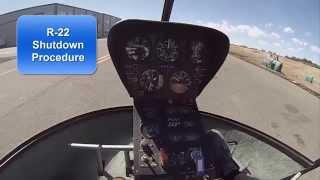
Brian Rutledge and David Redmond walk through shutting down a Robinson R22 helicopter. Roll RPM from 100% to 75%, confirm cylinder-head temperature drops below 300°F, pull mixture to kill the engine, then leave the master on while rotors spin down.
Questions this video answers
75%
Below 300 degrees (°F)
About 30 seconds
Alternator and magnetos are turned off; the master is left on for the strobe (and radio is left on to hear communications).
Chapters
All right, so now we're going to go ahead and run through our shutdown procedure. We've just got it back down on the ground. Our RPMs are still up at 100%. So before we pull out our checklist or anything like that, we want to go ahead and roll our RPMs all the way down. You're just going to override the governor and just manually roll them down to 75. Now, at that point, that governor is no longer active, so it's not going to roll them up. But we want to go ahead and get that governor off. Just so if we forget to pay attention to the RPMs, that governor doesn't ro those RPMs that we don't want it to. So now our RPMs are at 75%. Our governor's on. We want to get our frictions back on, make sure that those aren't going anywhere. So our cyclic friction's on, come back to our collective friction, and that's on. And then we can go ahead and just put one foot on the pedals and make sure our cyclic is centered there. That way we free up one hand to do everything else. All right, so everything. All our frictions are on. Cylinder head temperature dropped. So what we're looking there is that our temperature has come down below 300 degrees. So you can see there already we're at 300 degrees because we didn't do a long flight. So now that we've confirmed our cylinder head temperature has dropped, we go ahead and close the throttle. So I just like to go ahead and put my hand all around the throttle again and just roll that throttle all the way to idle. And now we've confirmed it's all the way to idle. Once we do that, we'll get our clutch switch to start disengaging, so that way those belts start losing some of that tension. So we'll let that disengage for 30 seconds now. So I'll look at the clock and wait. We hit about 30 seconds and just let that clutch give that time to disengage. All right, so now we've got our clutch disengaged. We waited 30 seconds. Once you hit 30 seconds, we'll go ahead and pull our mixture guard off of our mixture and push down the button and just pull up our mixture all the way until you hear the engine shut off. Once you get that off, you want to go ahead and grab our alternator and our magnetos, confirm that those are off. Now we're going to go ahead and leave our master on. That way our strobe is still running because our blades are still turning. We want people to still see that the helicopter is still running. Go ahead and make sure we get our leave our radio on so you can hear us. We'll go ahead and get our transponder off. And then at this point, if you have a rotor brake, you're going to wait another 30 seconds and then you're going to start gradually pulling that rotor brake to slow it down. We don't have a rotor brake, so we're just going to let those blades slow down and we're just going to wait in the helicopter until a good spin.
Hey, guys, it's Brian Rutledge with Helicopter Online Ground school. Today we're out at the Auburn Airport with my good friend David Redmond with Odyssey Aeronautics. We're going to be in the R22 today and we're going to do a pre flight video for all of you.