Robinson R44 Helicopter Training Video Limitations Excerpt from Online Ground School
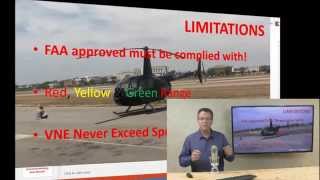
Training excerpt (YouTube) by Kenny Keller reviewing the R44 helicopter Pilot’s Operating Handbook (POH) Chapter 2 — Limitations. The instructor emphasizes memorizing instrument markings, operating limitations, placards and emergency-return actions, with many specific numeric limits for airspeed, rotor RPM, engine/ oil temps and pressures, weights, fuel capacities and CG/doors/flight restrictions.
Chapters
Welcome to the updated R44 limitations section. Remember that you are responsible to check the PoH for the aircraft that you're flying. This is a guide to help you learn the information you still have to go through the POH for your aircraft. This is a very important section. The examiner is going to ask you stuff from this section, 100% guaranteed. He's got to cover emergencies, he's got to cover limitations. A lot of this is just memorization. Some of the things you're going to learn, you have to interpolate and use common sense. Some things are memorization. This is one of those times where you have to memorize. Some examiners are big on numbers, some examiners are not. Some examiners are fairly happy if you understand the difference between yellow, green and red range and know a majority of the numbers. But again, to be on the safe side, I would know and memorize as many numbers as you can. So the limitations section is chapter 2 in the R44 PoH. As I already stated, this is a very important section. Examiner is going to ask you stuff from this section. The limitations section is FAA approved and contains operating limitations, instrument markings and basic placards that you're going to find in the aircraft. These are all geared for safe operation of the helicopter. So limitations section, FAA approved and must be complied with. Understand the red, yellow and green range and the VNE never exceed speed. When you are in the green range, life is good. When you start moving to the yellow range, that should be drawing your attention to what's going on. Should be drawing your attention to the other instruments and gauges in the aircraft. And be cautious of why is this happening, what is changing what is going on? Because you don't want to get into the red range, which would be exceeding the limitation. If you do exceed the limitation, you must notify the mechanic of what you went over. How long did you go over, how far did you go over, and what things were going on? You know what led up to that point where you exceeded that limitation. And also remember, if you exceed a limitation, try to get that under control as soon as possible. And depending on the emergency, or depending on what limitation it is, it may require to get on the ground right now, or maybe you can lower power, continue flight and see if you can bring that back into the green range. So you have a red crosshatch on the airspeed indicator indicates power off vne. Here's an example of green, yellow and red range on a instrument. In this case, it's a manifold pressure, but it could Be any gauge. Green is good. Yellow. You need to figure out what's going on in limitation you don't want to exceed. If you do get back in the yellow and then green range as soon as possible and notify your mechanic what happened. You know, and this is a big one too, that you have to think about. People go out and they make a mistake, they exceed a limitation or they do something to the aircraft. It's hard to go back sometimes admit that fault or admit what you did. But you need to do that for the safety of the other people that are flying it and for your own safety. Because if you fess up to what you did, you let them know about it. They'll appreciate the fact that you came forward and let them know about the problem. And then the mechanic can check the aircraft and make sure that the aircraft is okay. Because a number one, we all want to be safe. We don't want to have our own accident. We don't want it to happen to somebody else or be responsible for somebody else's life. Airspeed limits at 2200 pounds takeoff gross weight and below 130 knots. Indicated airspeed is your limit over 2200 pounds takeoff gross weight it's 120 knots indicated airspeed. And your airspeed limit for auto rotation is 100 knots. Indicated airspeed additional 100 knots. Indicate airspeed maximum at power above MCP and a limit of 100 knots. Indicated airspeed maximum with any combination of cabin doors removed. Rotor speed limits power on maximum 102% tachometer reading actual RPM 408 power on minimum 100% tachometer reading actual RPM 404 limits for the rotor speed power off a maximum 108% tachometer reading actual RPM 432 rotor speed limitation power off minimum 90% tachometer reading actual RPM 360 power plant limitations for the Lycoming model IO 540 AE1A 5 engine max speed 2718 RPM 102% cylinder head max temperature 500 degrees Fahrenheit 260 degrees Celsius oil maximum temperature 245 degrees Fahrenheit or 118 Celsius oil pressure minimum during idle 25 psi oil pressure minimum during flight 55 psi oil pressure maximum during flight 95 psi maximum oil pressure during startup and warm up 115 psi oil quantity minimum for takeoff 7 quarts weight limits max gross weight 2500 pounds or 1134 kilograms minimum gross weight 1600 pounds 726 kilograms maximum in any baggage compartment. 50 pounds 23 kilograms. Center of gravity limits. See figure 2. 4. Reference datum is 100 inches forward of main rotor shaft centerline. Center of gravity limits. With all doors installed. A solo pilot weight of 150lbs or 68kg or greater will ensure CG within limits for lower pilot weight. Compute weight and balance. Removable ballast may be required to obtain CG at or aft limit. See loading Instructions in section 6. Flight and maneuver Limitations Aerobatic flight prohibited. Don't even think about it. Famous last words. Watch this. Don't mess around. If you fly these aircraft the way they intended to be flown, you will probably never have a problem ever flying one of these aircraft. That is, if you're flying within the limitations, using good pilot technique, not doing stupid stuff, you may never have a problem. Low g cyclic pushovers are prohibited. You learned this from day one in your SFAR training. Never ever do a low g cyclic pushover flight prohibited with governor off exceptions in flight malfunctions and emergency procedures training. Otherwise that governor should be on flight in known icing conditions prohibited. The Trust me. Don't do it. I've got into icing. It's not fun if you are anywhere near the freezing level. Anywhere near the freezing level and you have visible moisture. Don't do it. It's not worth it. Trust me. Maximum operating density altitude 14,000ft maximum operating altitude 9,000ft AGL to allow landing within 5 minutes in case of fire. Alternator RPM governor low rotor RPM warning system. OAT gauge and cyclic trim or hydraulic control system must be operational for dispatch solo from right seat only. Minimum crew one pilot. Doors off. Operation up to 100 knots indicate airspeed approved with any or all doors removed. Caution no loose items allowed in cabin during doors off flight. This is in one of the Robinson safety notices about a door was removed, a knee board went out the window and a person was in a fatal crash due to something flying out the window. Kinds of Operation limitations VFR day is approved. VFR operation at night is permitted only when landing navigation instrument and out ant collision lights are operational. Orientation during night flight must be maintained by visual reference to ground objects illuminated solely by lights on the ground or adequate celestial illumination. And you need to note there is may be additional requirements in Countries outside the US approved fuel grades 100 low lead grade aviation fuel 100 to 130 grade aviation fuel. I just want to back up for a second and talk about the night a little bit. Make sure you are current at night, when you go to fly at night. If you haven't flown at night for a while, you may want to go up with an instructor and get yourself current and get yourself comfortable at night. I can tell you over the years that, you know, you fly a little bit at night and you feel good and then you go. A couple months goes by and you go ask me that long since I flew at night and you jump in and it is a total different scenario. Make sure you take the time to do a good pre flight. You have your flashlights, give your eyes time to adjust. Don't be in a hurry. And the other big thing, you got to have better weather at night. You have your minimums for the daytime, the weather at night. You need to make those minimums even higher. It's very easy to get yourself into trouble, taken off on a night flight and you don't see that low layer of clouds until you're in it. So I just wanted to add a little bit extra there on the night flying. And you really got to think about it and make sure you're prepared. Fuel capacity Tanks with bladders Main tank 30.5 gallons 115 liters is total capacity Usable capacity 29.5 gallons 112 liters that was for the main tank. Auxiliary tank 17.2 gallons 65 liters Total the usable 17.0 gallons 64 liters Combined capacity of the two tanks Total 47.7 gallons or 180 liters. Usable capacity between the two tanks 46.5 gallons or 176 liters. Note for the R44 Service Bulletin SB78B fuel tanks without bladder should no longer be in service Instrument markings Airspeed indicator green arc 0 to 130 knots indicated airspeed red line 130 knots indicated airspeed red crosshatch 100 knots indicated airspeed rotor tachometer upper red line 108% green arc 90 to 108% lower red line 90% engine tachometer upper red line 102% green arc 101 to 102% lower red line 90% oil pressure lower red line 25 psi lower yellow arc 25 to 55 psi green arc 55 to 95 psi upper yellow arc 95 to 115 psi upper red line 115 psi oil temperature green arc 70 to 245 Fahrenheit or 24 to 118 Celsius. Red line for the oil temperature 245 Fahrenheit 118 Celsius. Cylinder head temperature, green arc, 200 to 500 degrees Fahrenheit, 93 to 260 degrees Celsius. Your red line, your limitation is at 500 degrees Fahrenheit, 260 degrees Celsius. A lot of memorization. I know, I understand, but you got to do it. We're getting close to the end, so bear with me. Manifold pressure, green arc, 15 to 23.3 inches. HG, yellow arc, 19.1 to 26.1 inches. HG, red line, 26.1 inches. HG, yellow arc denotes variable map limits. C placard 2. 9. I'm just going to show you one page of placards. You have fuel. Ox. Fuel. Fuel on, off. You need to look around inside the aircraft and understand what placards are in your aircraft. They are there, and you must adhere to these placards. So, yes, it's a lot of memorization. I want to reiterate again. Some examiners, yellow, red, green, as long as you know most of the numbers. Other examiners, they go right through boom, boom, boom, and hit them all. So it depends on who you're taking a checkride with. I really recommend memorizing as many of these different things as you can remember. Red, yellow, green range. If you're green, you're good. When you're in a yellow, you need to start figuring out what's going on. And you don't want to exceed that red line or that limitation. If you do, you got to keep track of it. You got to fess up to it, get it back under control, get on the ground as soon as you can safely, and then report everything to your mechanic. So again, be very familiar with the limitations section. Know it's chapter two. Don't be afraid to go there and look things up. Don't be afraid to refresh these in your memory anytime you need to. Anytime I go somewhere to fly an aircraft that I haven't been in in a while, I swear, I always grab the POH and I go through and I review limitations, and I review emergencies every single time for every aircraft that I fly. So next up is emergency section. Any questions about limitations, put them in the box below. Somebody else probably has the same question. So we'll see in the emergency section.










