Settling With Power From Live Training Tuesday Halloween Edition
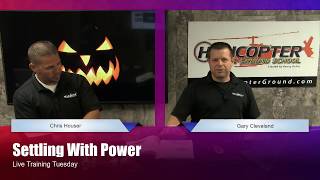
Kenny Keller, Gary Cleveland, and Chris Hauser explain settling with power, a dangerous helicopter condition where the aircraft descends despite full collective. The 30-20-10 rule marks the hazard: descent rate 300+ ft/min, power 20-100%, airspeed below effective translational lift. Recovery requires gaining airspeed or lowering the collective.
Questions this video answers
Rate of descent ≥300 ft/min; power being used (20–100% available); airspeed less than ETL (effective translational lift, ~16–24 kt).
"30–20–10" (30 = 300 ft/min descent, 20 = 20–100% power, 10 = historically <10 kt; modern ETL ~16–24 kt).
Recovery is accomplished by increasing airspeed and/or partially lowering collective pitch; the handbook also notes lateral cyclic plus lateral tail-rotor thrust often gives the quickest exit, assuming no barriers.
Yes — listed under Emergency Operations in the Practical Test Standards (task D: settle with power).
Chapters
Hello again, everybody. I wanted to shoot a little video outdoors today. After a whole winter of driving down the road and in the trailer and inside here and on and on and on. I want to do a little aerodynamic tip of the day. Been talking about a lot of things and I haven't hit really anything on aerodynamics yet. So I want to do something about settling with power real quick. You might just leave that in there. The wind just had to blow my camera over. So what I want to talk about is settling with power. All right, this will be for a blooper reel later. We're still recording. This works out really well. I wish the wind would kept blowing my camera over. It's pissing me off. All right, here we go again. Win keeps blowing my camera over. I'm gonna shoot this one more time. Settling with power. I haven't talked much about aerodynamics yet, so I thought I'd do a quick tip on aerodynamics and memory items for your private pilot. Commercial pilot. CFI doesn't matter. Examiner I've been using for 10 years says the most important thing that you need to know about that will get you into trouble as quick as anything is settling with power.
So.
I guess I need a tripod. Here we go again. Settling with power. Three things. Rate of descent, 300ft per minute or greater. Power 22. Using power 20 to 100% airspeed less than ETL. Combine those three things together. Guy in the airplane has to just start, doesn't he? Anyway, there goes the camera. Settling with.
Hello, it's Gary Cleveland with HelicopterGround.com and Chris Hauser here as a guest instructor today. Guest, guest instructor. That's what the box is for. See, I got my side of the box. You got your side. That's the guest side.
So I cannot come into your side, right? Not so I can't violate your space. That's what you're telling me. Can't violate your space. Right on. Might be a police report there.
As promised, we are going to talk about settling with power and the recovery techniques that are involved. We will use the helicopter flying handbook as a reference because that is our bible. When you go to your checkride, it matters. What's in the helicopter flying handbook? To pass your checkride, we will include some footage from helisafe Facebook where they have a video about the Vachard method, which is lateral recovery. And Chris has experimented with this out in some flight instruction scenarios. And he'll discuss that.
I will, yes.
Anything else to say before we.
I didn't know the guest speaker was allowed to talk. So. Yeah.
Courtney.
Is anybody here logged in saying hello?
Yeah. Am I allowed to talk? All right. Hey, Happy Halloween. As you know, Gary just kind of gave you the intro. We're going to go over some selling of power stuff. Make sure you let us know who you are, where you're from. Make sure you subscribe to our channel. You should be watching us on YouTube feed. If you're on YouTube channel, please subscribe. And there's some links down below for some different things. So we shall. What should we do first? Roll the. What should we do first, Gary?
Well, what kind of got us talking about this was members sending us links to this video. Numerous members. And it is a good video. It shows the vortices. Basically, it's a helicopter with a spray boom dispensing water so you can see the vortices. So let's show them a picture of that. If you want to do a screen share here. Are we at it?
There you go.
Okay, so here's Helisafe's Facebook page and we've kind of stopped this video in a spot where you can really see these vortices as this helicopter is in the vortex state or settling with power. Chris, go ahead and comment on what you're seeing in the picture there.
I see exactly what you're seeing. Ok. See the vortices. I mean, this is probably the best video I've ever seen talking about this. I mean, this really hones in on what exactly? And if you look in the helicopter flying handbook, I mean, they show a picture where they drew it, but this is actual real world, as you can see it. Vortices. I mean, this is excellent footage. I mean, this is perfect, right?
And there's so much to get from it. Not just the lateral recovery, the Vachard method, but just to show you the vortices that are present during this with that spray boom going. Let me back this up and just play this short video clip for everybody to see.
Zoom in so you can get all that out.
I can go like this. There we go. There.
There.
Nice. What kind of helicopter is that, Chris? Is that a bell?
No, that is Alouette, isn't it?
Well, I'm not sure.
I think it is. Or a llama, one of the two. Or maybe it's the same one. I'm not quite sure, to be honest with you.
It's a turbine helicopter, isn't it?
Yeah, I think it might tell you. I think it's an Alouette.
There you can see the spray boom on There, which is typically used for agriculture applications. So here they're kind of leading you into how to get it into the settling of power. Increasing the collective to maximum power.
That's actually when you're. I think you're in it.
Applying power pedal lateral cyclic.
Now this aircraft is a. This aircraft you're seeing is a clockwise rotating.
So so his power pedal will be the right pedal.
Correct. So he's actually making inputs opposite of what most of us are used to for counterclockwise system.
So he. He would do right pedal and left cyclic to push the helicopter to the left. And in the NSTURM of the Robinson, we would do left pedal, right cyclic to move to the right.
Right up. Left is how I was taught.
I see.
Right in collective up left pedal. You can really see that. You can see all those vortices just.
So if you're doing lateral recovery, collective up. Why is that?
Do you know? Because as soon as you get out of that, as soon as you make that input to the right, you're going to. You're already dropping. You're falling. You're right now you're falling in the vortices. So as soon as you make that rattle, rattle, that lateral input to the right, you're going to need to come up on that collective to stop your descent.
Nice. Shit.
And then of course, since you're adding collective, you need to add that left pedal. So yeah, once he starts to fall like that, you're just robbing the engine of power. It's not doing anything.
We're having a read next. Who's here?
Okay.
We'll talk more about this video here in a little bit. Possibly. Plan is to go to Courtney's camera to read off any of the comments.
Yep. Whenever you're ready, we'll go to Courtney now. Okay. Hello, Sam and Taz and Mark and John and T. Gregory Berry.
Welcome.
All right, back to you, Gary. What do you want to do next?
Well, Kenny has some video footage from the ground school that's really pretty awesome. We previewed it yesterday to make sure that it was current and accurate, and we can't do much better than what's already in the site.
Actually.
We'Ll hit it with a little bit of a backup from the Helicopter Flying Handbook to reinforce what's already there. But I say roll that video from the site real quick and then we'll discuss it.
Awesome. Here we.
Go.
Today, I want to cover the general safe rule for flying your helicopter approach. And this is a general rule. It's not anything in a Reg anywhere. And it's kind of conservative, but that's okay. In order to keep yourself out of settling with power, always keep a minimum of 30 on your airspeed until your rate of descent is below 300ft per minute. If you follow this, you will not get into selling with power. It just plain won't happen. If you have all three of these flight situations together, this can cause you to get into selling with power. Take away any one of those three and you're not in it. So let's break these three down just a little bit. Rate of descent, 300ft per minute or greater. If you are at 300 or higher on your VSI as you're flying your approach, that's number one, using 20 to 100% of available power, meaning you are using power. You're not out of rotation. You are using available power. Airspeed less than ETL, effective translational lift. Remember that ETL occurs somewhere between 16 to 24 knots. So if you're at 30 or above, again, you're not in that zone. So there is a little bit of fudge factor figured in there, but that's to keep you safe. So remember, if you always keep 30 on your airspeed until your rate of ascent is below 300ft per minute, you will not get into selling with power. Avoid selling with power. If you always keep the wind off your nose, as in this picture right here, and the turbulence behind you, you're never probably going to get in selling with power. Selling with power is one of the most important things you need to be aware of as a helicopter pilot today. First, you need to know a simple definition for selling with power. And a simple definition is settling in your own downwash. That's exactly what it is. You're settling in your own disturbed air. So there are three things that you absolutely have to commit to memory. These are the three things that if combined together, they can get you into selling with power, which are rated Ascent, 300ft per minute or greater, using 20 to 100% of your available power and airspeed less than effective translational lift, or ETL as we call it. So again, you must have all three of those things combined together to get in sailing with power. There are three situations conductive to selling of power. Three situations that pilots commonly put themselves in. Number one, attempting to hover above the hovering ceiling. Number two, attempting to hover out of ground effect without pursuit, precise attitude control. And three, a steep power approach, airspeed near zero. So if you find yourself in this situation selling with power, you can increase Forward air speed to get out of it, you can lower collective to get out of it. You can do both. Altitude permitting, you could perform an auto rotation to get out of it. Altitude permitting, you could fly sideways and even fly backwards to get out of it. So Remember, rated ascent 300ft per minute or greater. You using 20 to 100% of power, airspeed less than ETL. Those three things combined together, you can get into selling with power. Take any one of the three away. And you're not in slang with power. Common situations people put themselves in, attempting to hover above the hovering ceiling of the aircraft, hovering out of ground effect. Without precise attitude control and a high power approach, airspeed near zero, how can you get out of it? You can fly into clean air, sideways, backwards, whichever direction to get into clean air, you can lower collective, altitude permitting and. Or you could get gain airspeed and lower collective simultaneously. So those are some of the basic elements of selling with power that you absolutely have to commit to memory. You have to know how you get into it, how to recognize it, and the best thing to do is just to know how to avoid it and not get yourself in that position in the first place.
Okay, next we're going to make a video on settling with power, also called vortex ring state. A little tidbit I'm going to throw in there is that people get in arguments over, oh, it's not setting with power, it's vortex ring, stinger, I don't really care as long as you clear it up with your student. When I say this, I mean this. And for me, if I'm gonna get in setting with power, I'm not gonna like, oh, I'm voic texture, I'm just settling, you know, and it's clear for me to say it. And so clear that up with your students which term you're gonna use. It doesn't really matter what term as long as they understand what's going on and you just make that clear. So settling with power is basically you're settling into your own downwash. You need three things for settling with power. First is less than etl. A lot of people will say, you know, when you say, what are the three things? They'll be like, oh, it's just low airspeed. Yes. But the more technical is less than etl because really it's when you lose etl, you start making those vortices and then you can settle into it. So, and you don't know exactly what airspeed that's going to happen. So it's just less than ETL, more than 300ft per minute descent. So we obviously got to start coming on down and at least 20% power pulled. You don't get hung up on like, oh, what is 20%? Just basically you got some power in it. You'll know, you know, if you're below 20%, you're basically in this situation almost in an auto rotation anyway. So you got power applied and pulled in. Now what actually happens is if I draw a helicopter, we're less than etl, so which means we have vortices. And the vortices, the normal vortices are on the outer tip and they're going down like this and then around and up like this. So I'm going to go ahead and draw those. It's important to know which direction these vortices are going. So that's just an out of ground effect hover. We're not in settling yet. But you notice as you lose etl, you lose some lift, which means you might get into settling with power. Now to truly understand this, you have to note that if you draw the amount of air the airfoil is pushing down, the maximum down is actually in the middle of the airfoil. And then because of these vortices, it's not pushing much air down. Over here in the root of the helicopter, you got the swash plate and all that kind of stuff, and the blades just don't have enough airspeed. You're actually not pushing any air down through the root of the helicopter. So what happens is when this helicopter starts descending, air is going to start coming up like this. Well, you already have a vorticee right here. And then the air, it's obviously going to pick the weakest point to overpower. So the air is going to start coming up through the middle and it's going to create a second vortice on the inside of the blade. So now you see, once this vortices has been created, the entire airfoil is now in vortices. And so that's when remember, anything in vortices isn't producing lift. So that's when it starts falling. Now if you instinctively raise collective, you put more pitch in the blade. All that's going to happen is that these vortices are actually going to get bigger and you're going to fall faster. So raising collective makes it worse. The only way to get out of settling with power is to move out horizontally. The classic way is you drop the nose and you let the helicopter start gaining some speed. Now, as soon as you have a reading on your airspeed indicator, you have airflow over the rotor system, blowing all these vortices away. And now you can fly away. I actually like to look at my trim strings. Trim strings will be down like this when you're unsettling. And then as soon as you go forward and your trim strings go and the trim strings show the airflow over the helicopter, you're out of it. You're raising some power and you can fly away from it.
Alright, I'm gonna interrupt this program finally. This is a new one. I'm inside our training site. A lot of you are inside YouTube chat, which is awesome. Brian Rutledge, operation manager from California is here. He says excellent training video. Thank you, Brian. You had help in one of those, as you know. And Brian said, hello everyone. Glad to be able to join you finally. Keep up the great work. Chris and Gary both just were up there saying we're not sure if Brian's real. We think he might just be a figment of Kenny's imagination. So Brian Rutledge is at one of our live events and we're going to bring him on live one of these days because one that Brian and I have been talking about we want to do very soon is inadvertent imc. Brian has a whole course he built that he puts his pilots through and he has a whole presentation that he's built and he wants to share with ground school. And we're going to do that for you. Maybe we'll do that in a live training event. Maybe we can do that real soon. Brian's super busy with his pilot job. Doesn't have a lot of extra time to jump in and help us. He does still helping us, you know, from the outside looking in with all kinds of things. Pretty much every aspect of ground school, Brian is there helping us. So finally Brian Rutledge is here. Everybody say hi to Brian.
Hi, Brian.
Hey, Brian. Courtney, I believe is keeping up on the comments. She's got screen going to Chris and Gary that's going to mention who is here because it's very important. We want to mention everybody that's here today, the people that keep coming back that keep continually joining us. That's awesome. And for new people coming in, subscribe to the channel and we also, if you're not a member yet, we have a Halloween special going on today and tonight, treat 15 in the coupon box gets you 15% off yearly or unlimited membership. All right, I'm going to go back to Chris and Gary.
Hey, welcome back. Hope you're enjoying the show today, both of us being trained by Kenny Keller, creator of HelicopterGround.com we are very versed in settling with power because as he will share later in the program some personal experiences with students of his who have experience settling with power that resulted in ground strikes. I think the best way to present this to help people that might be getting ready for a checkride down the road is for Chris and I to kind of interact instructor your side of the box and student.
Great.
Tell them everything you know about settling with power. I'll play dumb and ask some dumb questions.
So I. Without any.
What's the difference between settling with power?
Throw me all this pressure.
Well, I'm confused. There's vortex ring state. I mean, I'm looking my handbook here and.
All right, vortex ring state is the actual aerodynamic condition that you get into. Okay.
So that's the same as settling with power.
They use the terms interchangeably. Okay. Nobody ever. You won't ever hear anybody talk about vortex rings. Well, the examiner might said. Tell me about vortex ring state. You just got to know that it's the same thing as settlement power. And the book tells you straight up vortex ring state aerodynamic condition in which the helicopter may be in a vertical descent with 20% up to maximum power applied. The term settling with power comes from the fact that the helicopter keeps settling even though full engine power is applied. So vortex ring state is the condition because due to the condition, you get settling power. Does that make sense?
Okay, so it's the same thing that.
One we always talk about. Yeah, it's the same thing, but if you want to get really technical, I guess.
What can I do to avoid it for you, Gary?
Just not fly. Just kidding.
Give me some pointers. What can. I don't want to get in. Settling with.
All right, so vortex ring state. As you watched in the earlier video, it's you. This is a big one. When I went to my dpe, you know, the book talks about. What's dpe? Really? We're gonna go.
This is my first day on designated.
What am I thinking? Designated examiner.
Oh, that's the guy that's going to give me my practical test.
Your checkride. Yes.
Gotcha.
Okay. Or yeah, it's not even checkride. Technically, it's practical test. Okay. All right. So you've got to be aware of it because when you're out there, a lot of this is going to be when you're obviously a helicopter. You can hover and you can hover out a ground effect. How to get into it or how. What you need to have to get into it. I always learned it as the 30, 20, 10 rule, which I think that probably came right out of Kenny Kelliver's notebook, I think originally. Yep, yeah, 30, which is you got to have a vertical descent of 300 foot or greater. The 20 is you got to be using 20 to 100% of available power. And then the 10 is you got to be slower than ETL.
I got a question.
What's ETL? You expect the translational lift.
No, I know that one.
Oh.
How do I know how fast I'm descending?
Well, most aircraft have vsi.
What's a vsi?
Oh, my gosh, Gary, do I gotta.
Go to the doctor if I get VSI for you? It's a gauge, right? It's gonna tell us it is a gauge.
Your vertical speed indicator.
There we go.
Okay. Your vertical speed indicator.
Let me check.
You got me for a second. Come on, Kenny, help me out here.
I want to chime in, give Chris a break since he's getting hammered up there by Gary.
Just got back from vacation too. Make sure you mentioned that.
Us old timers, I guess I'm now an old timer. When I started training, we called it 30, 2010, because back then the basic helicopter flying handbook said airspeed less than 10. So when I failed my first private pilot checkride and during the debrief afterwards, the examiner said, when I ask you about sling with power, I want to hear 3, 02010 rate ascent, 300ft per minute or greater. Airspeed 20 to 100%. Airspeed less than 10. So the 3, 02010 comes from back in the day. And then when we went from the basic helicopter flying handbook to the helicopter flying handbook, they changed it to ETL 16 to 24. So that's where the 30, 2010 came into play because that's the way we used to train. So you can still use it. And I still think of it 30, 20, 10. But we just know that that's what the basic Helicopter handbook told us, written in 1978 that we, a lot of us, used to train with until the Helicopter Flying handbook came out. So, you know, some of our people watching have been flying a long time. Our students are brand new. We have CFI members, we have Vietnam guys, vets that have our training. So that's where the 30, 2010 comes from. The 10 comes from. Originally it said less than 10 when they changed it to 16 to 24. So since I gave Chris a little break there, we'll go back over to you. Guys and I. You smacked Gary around in between, so you got him straightened up now, hopefully.
That's a good point because, yeah, the 10 is actually. Now, they say ETL is 16 to 24 knots, so. But it's also important to remember that you have to have all three. Those are. This is one of those maneuvers where you got to have all three. If you're. I mean, if you're doing 60 and you have a descent rate of 500 foot a minute, you're not going to get into settlement power. You have to have all three in order to get into this. My dp, he was real big on what's a maneuver that we do. That is the biggest maneuver that we do that we can get into. It's steep approach. I still tag that to my students. I still hone that in. I said, what's a maneuver? That you're constantly watching your descent rate and you're constantly watching your speed, seep approach. Now, the book also talks about a few other situations where you could get into this. Hovering outside the hover ceiling, out of ground effect. Hover ceiling, what else? Attempting to hover out of ground effect without maintaining precise altitude control, pinnacle or rooftop helipads that aren't into the wind. And then it talks about downwind and steep power approaches with airspeed that is slow. And all those are also a contributing factor to those is also your gross weight and density, altitude of the day. But like I said, when I went to my dpe, his I told him those because I did flashcards and I memorized all those. And he's like, no, I want to hear steeper, steep approach. So that's what I tell my students. So think about that when next time you're doing a steep approach, how you can get into that, because just think about that. We're riding ETL down on a steep approach, and our descent rate is great to get into that confined area. I think we tried to keep that under 300. And I think even EMS when Kenny was flying, I think they had to do 200 or less just to stay out of that.
So how about if I chime in on that one? Yeah, this is a good story. I want to interject. I think I've told it through the training, but if not, Song of Power is a big deal. And take this scenario. I worked for Omni Flight Helicopter for five years, and at the end of that five years, they got bought out by the largest EMS provider in the world. And they put us through a week of training as as going new to their company. And they came out one day and said, okay, guys, we're going to introduce you to the chief pilot, and he's going to have something that he's going to tell you about that he feels very strongly about. So chief pilot comes in, and again, this is, you know, a top 135 operator in the world. They're number. They're one of five of the top 135 operators in the world, the biggest EMS operator there is anywhere. Chief pilot walks in, he says, I'm going to tell you guys a little bit of something here about the way you're going to fly with us. And he said, the room's going to be divided and I'm going to make. I'm going to tell you a little bit about what we want to see. Then I'm going to leave the room and I'm going to let you guys go back and forth, and then I'll come back in and we'll. And we'll sum it up. He said, so here's the deal, guys. All your approaches. We don't care where you're at or what you're doing, even if it's an approach into the airport, all your approaches will be flown at 200ft per minute or less. And of course, half the room, their jaws are hanging open. And he goes, I don't care if you're flying a normal approach into the airport, 200ft per minute all the way in, and that's the way you're going to do it. So, you know, he says, I'm going to leave you guys to talk amongst yourselves. He leaves the room. So you have a whole room full of pilots. Everybody has 2,000 hours or more. They're already EMS pilots transitioning to a new company. So the room goes crazy. People arguing back and forth. That's crazy. I'd never fly that slow. And of course, I'm sitting back, being a type who was trained from the very beginning, super slow all the way in. And also a guy who. People want to argue with me over this point, but I've had some awesome people that I've trained with in the industry. I was lucky to train with a lot of key people and have over the years trained with key people. And the gurus say they want those approaches super slow. So anyway, so I just sit back and let everybody say what they got to say. And then people are like, they get feisty over this and they're arguing back and forth. So 20 minutes later or so, the chief pilot walks back in. He goes, okay, Guys, you had a chance to talk amongst yourself around the room. And he said, I'm going to give a few of you opportunity to speak. Points out a few guys, you know, and guys argue one side of the story and other guys argue the other side. And he goes, okay, now that you've all had a chance to talk to each other, you've all had a chance to speak. And he said, no, I'm going to tell you the deal. You now work for us. Your approaches will be 200ft per minute or less or you won't fly for us. And he said, hands down, that's the way it's going to be. So we're looking at experienced pilots, all of them have 2000 hours or more, you know, flying multimillion dollar aircraft, largest air medical provider in the world, flying EMS flights. And they said, we don't care, we don't care if the patient's going, you know, they call it circling the drain in the back. And that sounds kind of rude, but that's what the terminology they use in ems. Just because the patient's crashing, your job is to get the aircraft safely on the ground. So coming from the largest air medical provider in the world, that's how serious they were about avoiding with sailing, with power, keeping those approaches super slow, especially in the confined areas and heliports, because if you're coming in super slow, if a crew member yells out wires, you can come to a stop very easily. You have enough power, you can fly away. You can take the time to figure out what is that obstruction somebody just called out. And also keeps you out of silent power. So pretty important story there. And that's, you know, so there's a professional world first hand story from the largest air medical provider in the world about how they want their pilots flying their approaches. So I'm going to go back over to YouTube.
Thanks, Gay.
Thank you.
That was a great story. I had a question kind of popped in my mind. A lot of students ask me when they come here for ground school, trying to hover out of ground effect without precise control. What does that mean to you?
To me it means that they're not maintaining their altitude.
And I've often thought about this.
What about the wind? Enter the wind all times.
So if I try to hover out of ground effect with a tailwind that's without that precise control.
Yes, I would agree with that. Another thing.
My airspeed indicator is not going to tell me when I'm doing 16 to 24. Correct? Not all the time.
Your airspeed Indicator is going to tell you what the winds are at that altitude.
So if I'm doing a steep approach into a confined area, when do I know? Say I'm watching my VSI. I'm making sure I'm near 300 when I lose ETL. What's another way of knowing when I lose ETL besides my airspeed indicator?
The aircraft's going to drop when you come out. Well, first as you approach that etl, you're going to start feeling a vibration.
Vibration.
And then once you come out of it, the aircraft's actually going to sink. So when I teach my students, even on a normal approach, when we're coming in, you know, they got all the controls going pretty good, everything's looking good, and then all of a sudden they lose it because they come through ETL and the aircraft sinks. And now you're coming up short of your LZ of your landing spot. Okay, so we just noticed a couple questions that John has asked. John, we are going to get to those, your two questions, I think, as we continue our discussion. So I just wanted to throw that out to you. We haven't forgot about you. So we talked about how you can get into it. Okay. And then as a good student pilot that you are, Gary, I'm sure that you read about settling with power before you came to our lesson. So if we got into, what would you feel or what would be going on with the aircraft if we were actually in selling power?
Well, I would look at my VSI if I was trying to do an out of ground effect hover possibly I'd watch my VSI and fill the aircraft if I saw that I had a vertical speed that was increasing despite raising my collective to try and hold my altitude. And maybe the aircraft would shake or have a vibration that's abnormal.
So we'd have some vibrations, probably feel some vibrations. And then you mentioned that the vertical speed indicator would be 300 or greater or probably even still increasing. Yes. Anything else you can think of? No. Okay. You probably feel that the cyclic and the collective are probably. Well, the cyclic is probably going to feel a little mushy to you. You have a little cyclical control. And then you mentioned as part of, as you start to raise that collective, the collective is not going to do anything. It's just actually going to make the.
Situation worse because of that vortex ring state.
So actually by applying collective to try to stop your destination, it's actually making it worse because of those wingtip, because of the vortices, the rotor tip.
I've Heard somebody say the helicopter settling in its own downwash. That's a whole nother term. Is that the same?
Same.
Gotcha. So how do we recover?
How do we recover? What? Kind of taught me, like how I.
Threw that back at you?
Student.
Yeah, you tell me.
As you saw in the video, he rolled. Did you roll a video of us flying in the R44 yet, or is that later?
Oh, no, I'll have to pull it in.
Okay, he'll pull in a video. Basically, what Kenny taught me and what I did on my checkride was we got the aircraft into settling with power at about 1000 AGL. And when we noticed that it was settling with power, then I just nosed the aircraft forward or go forward on the cyclic slightly to get some airspeed and lowered the collective a little bit and no big deal. It wasn't a big complicated maneuver.
No.
So.
And you mentioned it, and you say right there that you know that we know that one of the conditions is slower than etl. So all we have to do is get into etl, get rid of one of the three. Right, exactly. And if you get into, you know, a very one, that's. What are they actually? What's the actual thing?
Fully developed vortex.
Fully developed. You actually may have to enter an auto rotation. You may actually have to. To flatten those blades out, let the aircraft fall, and then get some of that forward airspeed then to recover. But that's fully developed. And the book actually states a fully developed one could be as much as 6,000ft per minute of a descent rate. That's pretty crazy.
So when you take your student out, how do you have them practice?
Okay, so let's go by the Bible. Okay. Obviously, we know this is the Bible. Let's just read what it says right here. Recovery is accomplished by increasing airspeed and or partially lowering collective pitch. Okay, so that's how I teach. But if you read the next sentence, in many helicopters, lateral cyclic combined with the lateral tail rotor thrust will produce the quickest exit from the hazard. So it says right here that the recovery is accomplished by increasing airspeed and partially lowering the collective. So that's how I teach. Okay. But I do know that now some of the examiners are asking about this new recovery technique called the. I'm going to say it wrong, Richard, recovery technique. That is something new that's come out within the last maybe year, maybe or something.
Definitely a couple years.
I still.
I first heard about it a couple years ago at Halley Expo when people started really talking about it.
Yeah. And I wasn't showing it until probably.
About a year or so ago.
So right now with my students, I still continue to teach the increased speed. You may have to lower the collective a little bit to break it. But increased speed is number one. But I do show them this technique because if you watch the video and you read some comments about it, do you remember how much altitude you lost when you did the recovery teaching or going lowering collective to increase airspeed.
Well, three, 400ft.
Okay. And that's probably about normal, maybe even up to 500, depending when I have done the Vachard recovery technique. 50, 50ft was what we lost. And we did that on several occasions. Now you think, okay, big deal. They both come out of it. You both recover. However, just think if you're hovering at 500 or 600ft and you need all that altitude, so your 500 descent or 500 loss of altitude, you're going to smack the ground. And the Vachard, I only lost 50ft. So to answer the question. So let's go back to John Fuller here. One of his questions is this method of recovery already popularized in the U.S. i think it's coming. The helicopter bible here states, increase airspeed, lower collective little bit. So that's how we're teaching it. The examiners, I think the ones now are starting if the student shows that way to recover, I think the examiners actually take it upon themselves to show them the other technique. So I don't, I guess per se say this is the technique to use. I just show them, you know, lower collective, increase airspeed.
I have our video ready to roll. You mentioned whenever you want to roll.
Yeah. So I think you've answered John's. We've answered both John's questions. Yes, you will likely have to train by entering vertical ring state.
Well, and to answer that, is getting. John also asks, is getting into and out of vertical ring state part of training? In other words, will the instructor have me purposely put myself into a vertical ring state to practice getting out of it? Well, John, private pilot, practical test Pts book right here under area of operation emergency operations, which is number 1 8, task D settle with power. Yes, you will have to show it Task D right there. Settling power. Under this, under the emergency operations, there is actually A through I. You have to show A through E and then F through I are only knowledge only. So you don't show those. So, yes, you will be going into settlement power and show how to get out of it.
Okay, so we'll look at that R44 video of Kenny and I.
It's in the instrument. The one that was in the file.
Was it in the instrument? Yeah. Okay, go.
Here we go.
We're gonna go up and demonstrate settling with power. I'll do it first, show you how to do it, and then I'll have you do it. I know we've done it once before, so we'll do it again for review. We want to have at least 1000 AGL or to be able to recover by 1000 AGL. So we're going to go up to like 12 or 2000 MSL. So we're thousand. I'm just going to kind of come on with you. And we're just going to gradually, Gradually slow it down. And we may have to point away from the wind a little bit. Our speed's getting low climbing, though, so I want to point the nose a little more this way. Now I think it's starting. There's 100ft per minute. We still got air speed. There's a little more away from the wind. Trying to get zero airspeed. Right or close.
Not zero.
Less than ETL anyway. Okay, there's. There's starting to happen vibration. 200ft per minute is almost low airspeed. We're gonna call that selling with power. So just gently, it's gonna ease the cyclic forward, pick up some airspeed, and we're out. Heck, we got up to 700ft a minute before. You covered well, but I had 60. I mean, who cares when I got 40, 50, 60 altitude. That's why they want you to practice that high. You got plenty of time to recover. Once we get above etl, we're not in it anymore. Let's see what happens if you're close to the ground and do that. Try to fly away, and you smack the ground. You get into settling the power, Dan. So just gently start slowing us down. Okay, I got the controls.
You have the controls.
Maybe head a little bit left. So if we got into it and we had an engine player, we could go that way. That's probably enough. Just do it slow. No big rush to get into it. Speed's dropping off since starting abnormal vibrations.
Yep.
300.
Yep.
There you go.
You're in it.
So just ease forward.
Yep.
Very gently. Get my air speed back.
Beautiful. Beautiful.
It's okay that I'm still dropping because.
I got a lot of adult.
You're 40, so you got all kinds of time to recover. So you just fly away.
That's. That's it.
Now we're coming back up.
Yep. Sweet.
I see lots of altitude.
That's the point.
You know, up there you can recover from it. It's no big deal.
And you're.
When you're settling with power, dan, and you're 75ft in the air, you're kind of screwed. Well, we just dropped 800. Yeah, that would close quick if you were 100ft off the ground.
All right, I want to mention Brian Rutledge made a comment. He said, I believe students, pilots in general who find themselves in sling with power don't believe it will ever happen to them. All of my approaches are under 300ft per minute. I like to call out my descent rate as a reminder to keep it under 300ft per minute and always paying attention to how the aircraft is performing. Always be ready to go for a go around. If the approach is not right, don't force it. Yes, I agree with that, Brian. And Brian's commenting inside our sight. Some of you are commenting in YouTube. I think Brian's the only one that's commented in the site. And I want to cover this. Brian as a trainer and a lead, a chief pilot, a Chief Training Officer, 30 year aviator. This brings us into a couple of those things.
I can't see him.
I think that's. What did you zoom from us? Oh, there we go.
The real world part of this. Downwind takeoffs and landings, you know, flying the approaches. Number one one is the first way to stay out of it. You shouldn't do downwind approaches and landings. I want to throw in some real world stuff here. First I'm going to roll a video real quick that I did a while, quite a while back. But you can make fun of this one too because I'm not wearing glasses in it. One of the only videos ever with no glasses. But this is me expanding on the Robinson safety notice. And then I'm going to come back and talk about. Never make takeoffs and landings downwind. It sounds pretty simple. I went to a specialized school out New Hampshire to become a Nstrom turbine instructor. And that was back six or eight years ago, whenever it was. And this guy that put in the class, very respected in the helicopter world. And for half a day he was going on about takeoffs and landings downwind. And I thought, we all know that, we all know not to do that. What's he talking about? And then I finally got it by the time he was done because he's also an accident investigator and he was going down the list all the different things that he's seen over the years where guys got downwind and wrecked the aircraft. So it really is a big deal. You can have the best intentions, and maybe you thought you knew where the wind was at. And maybe in an hour, flying around the pattern, you quit checking the wind sock and that wind changed on you. There's just so many reasons how a guy could get himself in a bad situation when he's trying to do the right thing. So always take off a landing to the wind, crosswind, never with the wind behind you. Do not do it. All right? And the reason I want to roll that video, that's a Robinson safety tip or safety notice. Okay? Don't cringe because you heard Robinson. Their safety tips and safety notices are freaking awesome. They're good for just about any aircraft, majority of them. And when I first rolled that video way back, I had some gurus in there, arguably going, oh, I taught downwind landings on the Navy and I could land at this many feet.
Blah, blah, blah.
We're not talking about you flying in the Navy. We're talking about in training. And when I interject a story, everybody here knows who I'm talking about is one of our old students back in the day flying the instrument, another law enforcement officer. Nice guy. We all like him. He was cool. But he was a fixed wing pilot. And I struggled with him on the whole downwind takeoffs and landing because he's like, oh, well, you can. We do it in airplanes all the time. I'm like, yeah, I know you do it in airplanes, but we don't want to do it in the helicopter. Even if there's only three or four knots of wind, use that wind on your landing. You don't want to land downwind. And this is, you know, something with fixed wing people, they just. Nothing against fixed wing, but your training says, oh, when it's light, you can land downwind. No big deal. There's never a reason to land downwind. And I had guys arguing with me. Well, I'm expanding on a helicopter safety notice or safety tip. Okay? It's good idea, especially in training, to not do takeoff and landings downwind. Some places have argued and said, well, we have that in our curriculum at your school. That's great. If your school teaches downwind takeoffs and landings and it's in their syllabus and that's what they do, that's great. I don't teach them. Never have, never will. I don't do them. Five years in ems, I never had to land downwind, ever. I could always find a way to have keep the wind either off my nose or with a crosswind. I was never forced to land downwind. And the student we're talking about, he went out to solo one day, and I said, I want you taking off to the east, and that's all I want you to do. Take off, go around the pattern, come back in. That's it. Well, he took off. He's out soloing for a while. I come back, set my office, and I know that I should be seeing him go by the window on approaches, and I'm thinking about him, like, why is he not going by the window? He knows I want him take off and landing to the east. About that time, I hear the helicopter, and it sounds different, and I see it go past my window. Well, that means he's done past the Runway. He's slowing down. He's 100ft in the air and almost no airspeed with the tailwind. And I'm going, oh, my God. What are you doing? What are you doing? Fly away. And I'm thinking, fly away. And I watch my aircraft 100ft in the air, get into something without power. And I watched him slam into the ground, and I figured the aircraft was going to be destroyed. I actually looked away, as if I watched it happen. It was almost in slow motion. He's getting slower, getting slower, getting slower. He's starting to descend, and I'm going, what are you doing? You're past the Runway, the wind's behind you. You know, go, fly away. Fly away. While I watch it happen, he gets into fully developed song of power, slams it on the ground. Just because I know, Because I saw how fast he was going down. I looked away. I'm screaming. I'm, like, covering my head, thinking I'm gonna get hit by debris, you know, 200ft away. And I'm screaming, oh, my God.
You know?
And then I hear the helicopter still running. And I turn around, look out the window, and there he is, hovering into the ramp. And I was speechless. And I went outside. I got down to the aircraft, and this guy's, you know, ex military. He's a cop, you know, another brute, manly man. He gets to the helicopter, and he's sitting there with his hands in his lap, his hands over his face, headsets on the floor.
He still is deputy.
Oh, he's with the County Beat the Band.
So I get in, and I'm scared to pick the thing up because I'm thinking, okay, frames busted, tail rotors crack. There's got to be damage, the way he hit, how hard he hit. So I lift it up, put it on the dolly and I put it in the hangar. I don't look at it for like two weeks. I'm so scared that it's going to be. Something's going to be busted, broke, whatever the case is. So point being something. I watched it happen to one of my students and that student was training the same time Gary was training way back, five, six, seven years ago as the private. I remember Gary going, I'll never get in. Son of the power. You harp on it so much, there's no way I'll ever get in it. And then here's another one of our police tribe, you know, fellow cop, and he just gets in it. He just. And we talked about it at length after the fact and he felt horrible and I felt horrible. But don't take off the land downwind. There is no reason to do it and I just feel that strongly about it. You can always, no matter where you're landing, you can find a way to land into the wind or land with a Crosswind. All right, 9:52. So I know we gotta start wrapping things up as we try to keep these at an hour. Did. What a question. Any airspeed limitations when I was talking about flying ems. Oh, I'm flying ems. We didn't really have any limitations other than they. When you're flying cross country 120 knots, that's what they said. This is where we want you to fly and we don't care. Loaded, not loaded. Your cross country speed will be 120 knots. Start our approaches at 60 on a normal approach. Just like doing a normal approach out here in the instrument. We start our approaches at 60. Other than that, that's really it, you know, limitations of the aircraft. But as far as you had no choice cross country it's 120 knots. That's where they wanted you for aircraft performance. Wear and tear on the aircraft. They said, you know, flying EMS, you will fly cross country 120 knots. Okay, so I think that answers that question. Did you guys have some more you wanted to elaborate on over there? Because I will go back over to you too.
I think we could just kind of recap everything. So settling with power is the three things we have to have. We have to have a rate of descent 300ft or greater. We have to have less than ETL. We have to be using power 20 to 20 to 100% of power. And we're going to recover by getting some forward speed, thus getting back into effective transitional lift, lowering collective a little bit or moving the aircraft laterally. Like they mentioned here, using the power pedal and cyclic.
So we didn't really touch on it, I guess, because I guess we're not training per se, but the vichard recovery technique is for counterclockwise rotor systems. When you get into settling power, you're going to use lateral cyclic to the right, pull collective up and left pedal. And that cyclic input to the right has got to be a pretty good input because they say 15 to 20 degrees, I believe, of a pitch or a bank there to get it out. Because if you think about it as you're settling, you really got to. You don't have too much cyclic authority. So when you do it to the right, it's got to really come over like that. And then at the same time, you're pulling power. And then since you're pulling power, then you got to add some left pedal. So I was taught right up left. So if you want to try the FASHARD technique, get a instructor that knows about it and go out and try it. But it does work. When I recover with students, it's 4 or 500ft. When I try this other technique, I think the worst case was 50ft. So it really does work. So right up, left, and then the other one is what they're teaching in the Bible still, which is increase airspeed and probably have to lower collective a little bit to break it. Has anybody got any questions? It looks like Sam has asked about an offspring accident. I'm not familiar with that. With that accident and with those rotor systems. I'm not exactly sure on what does what.
They're pretty neat to watch fly by.
Oh, yeah. They've come into Plymouth a couple times I've seen come in here. But I do have a comment, Brian.
That I want to add. Yeah. All right. We're going to add something from Brian Rutledge, our operations manager. He again made another comment. And our thinking here is kind of what these guys have already been telling you today. And it goes along with what Brian just said. He said the Bouchard method is a good recovery. However, you need to go out with a good instructor and practice. The method requires the pilot to think about which pedal to push, which way to move the cyclic, and then raise the collective, which is a little more to do than the original method. If a pilot plans on using the new method, practice until it becomes a natural reaction. I think you guys already kind of covered that. I'll back that up. That's the same way we kind of approached this when Gary and I were talking about how we were going to teach this. You know, we kind of read through everything, thought about stuff and said, you know, we have the way we've all been trained for years. And Brian as well as us, all cops are ex cops. We know that the way you're trained is what you're going to do when the shit hits the fan. You know, when your heart start race, starts racing, you want to go back to what you know. And we, the way we've grown up on how to recover with selling of power is probably what we're going to do. You know, they taught us in at the law enforcement academy, you carry your gun here all the time. You walk in off duty with a liquor store and they're robbing a place and you got your gun up here. First thing you're going to do is go like this and then you're going to go, oh shit. And then you're going to go up here, you're going to go back to the way you were trained. So what Brian said, he's backing up. Kind of the way we thought about it, it is a method that is an alternate method. But I, Gary and I were talking about this yesterday. You got to go, okay, which foot, which cyclic, you know. And then I asked Jed yesterday, you know Jed from our helicopter tree saw pilot. I said, hey Jed, do you ever use the Bouchard method? And he goes, what are you talking about? I just go forward and you know, Jed and I talked about this in the length he flies in an environment every day in an MD 500 along power lines. I said, how often do you think about something with power? He goes every day, all day long. And I said how many times do you get into it? He goes, oh, we get into it two or three times a day. But they fly in that environment knowing that they're on the verge of getting into it. And he goes, no, I just. He goes, I get in. I just what you taught me years ago, I just fly forward and get out of it because he's got some altitude. So he's always on that verge and always ready. So it is an additional method. And Brian, what Brian said, make sure you go practice it with an instructor who's fluent in it. I would have to go out and practice it before I start doing it with students. And maybe I will, maybe we'll look a little more that in the future. But I'm being kind of transparent there, you know, I'm old school and still doing it the old school way. So Chris has got something over there. I'm Going to go back over there.
Well, just to expand on what you said, it's muscle memory. Exactly. That's why we train so long with. We talk about doing the draw in law enforcement, getting that muscle memory technique. And then. Right. The next time you go in and you have your gun either in your pocket or on a shoulder rig or your ankle, the first thing you're going to do is go for your hip. But I wanted to. You talked about Jed there, and I just wanted to expand on this. He always goes forward. And part of what the book says right here is go back to the Senza. In many helicopters, lateral cyclic combined with lateral tail rotor thrust will produce the quickest exit from the hazard, assuming that there are no barriers in that direction. Well, what's he. He's carrying. He's 500ft off the ground, carrying something that dangles 100ft below him. He probably can't go right or left because he's going to run right into the power lines that he's.
Or the trees.
Or the trees that he's trimming.
He's got nowhere to go.
So. Butt straight. So. Yeah, I mean, it's. Yes. Is it the technique? No, it's a technique and it's something for, you know, just to keep in your bag of tricks to use. Oh, you get that. Tricks, you know, trick or treat. Yeah. You know, it's just another instant. You know, if you. If you were like, you know, flying two or 300ft off the ground and you needed to. And you got into it, you know, maybe this is the preferred way to do it. If you have 2,000ft of air to play with, then maybe you want to just go back to the way, you know, the old method, whatever. It's just another technique. You know, I think they're both correct. They both have their purpose. It just kind of depends on which. On which one is better at the time.
I guess I just needed to let you guys know that I did put pumpkin heads over you guys earlier while you were talking, just so you know.
Nice. Well, we asked somebody to ask, what's the definition of using 20 to 100% of power? If it's. If you're flying the aircraft. Right.
Not in auto rotation.
Yeah. Basically, if you're. The aircraft's got to be under its own power. And, you know, really, if you, you know, most of the flying we do is, you know, it's either manifold pressure or the Robinsons have the governor and it's in percentage. So, you know, if it's at 100, you know, if it's all the way up at the green, it's at 100%. If you're sitting on the ground and you're at idle, it's probably at what, 20, you know, 20%. But if you, you know, if you ever. When you're coming in for a landing and you lower that collective, you're taking away some of that. Some of that power. So that's what they're talking about.
Manifold pressure dropping.
Yeah, yeah. Or in the Robinson, if you're lowering that collective, you know, it's, it's. The RPM is still there, but you're, you know, it's, it's lowering.
So. But as long as you're not in an auto rotation, you're using 20 to 100% of power.
Right? Exactly Right.
I'm going to interrupt here for a second. I want to roll something real quick and short. This is a video from seven, eight years ago. Again, when I got started. Not the one I showed at the beginning. But for you, those of you that aren't members yet, we have a little treat for you today for Halloween. Here you go. All right. Like subscribe. Share. Subscribe to our YouTube channel. Please take advantage of that, of that special offer if you're not a member yet. Do we have any last minute closing things, you guys, Anybody want to cover or anything? Courtney? Because it's at 10:02 and we really wanted to keep these at an hour from now on because people got stuff to do and they want to move on their day.
Nobody from Greg, John, Paul, Tim, Ed, James, you're up. Any of those.
Any of those guys?
No?
All right, you two want to close it off?
Happy Halloween.
See you on the next one. Is that good?
That's awesome.
See you on the next one.
But they'll. Why you gotta be like that? Maybe you never know.
Sa.










