The Key To Helicopter Hovering: Smooth Control Inputs
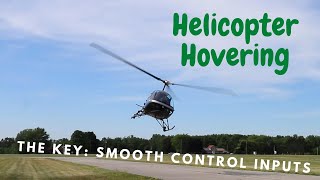
Kenny Keller teaches helicopter hovering by starting with pedals, then collective, then cyclic control. The key is making inputs so small they're barely visible, and practicing turns and directional hovers until your hands stop fighting the aircraft.
Chapters
Hey, it's Kenny with Helicopter Line Ground School. We're getting ready to go out in the helicopter, do some hovering, and just talk about the essence of what it takes to hover a helicopter. It's really about smooth control inputs. So do us a favor, subscribe this channel and click the bell when you do to be notified of our videos that we put out weekly. All types of different subjects. I am the creator of Helicopter Line Ground School. If you'd like to learn more about Helicopter Line Ground School, there's a link right down below this video with hovering. The essence of flying a small helicopter really doesn't matter which one you're flying. You might have some buttons and switches in different places, and startup and shutdown can be a little bit different. But the essence of what we do in the aircraft to make it hover is the same again in the small utility helicopters. So what we're going to do is we're going to go do a video just showing you the basic hovering maneuvers. Turns hovering left and right, forwards, backwards. We have inside Helicopter Land Ground School in the private pilot section, we have specific videos where we really dive into all the controls. But we needed a fresh video of actually kind of how you put it all together. So I'm going to climb in the aircraft, talk you through how when we first get started teaching you, we give you the pedals for a little bit and then we give you the collective, and then we give you the cyclical. Everybody always says, well, boy, if you could put a camera on each, you know, piece inside there. The thing about it is, if you're doing this correctly, you don't even see those movements. So a camera on the control really doesn't do you any good because if you can see it moving, you're probably moving it too much. I do have a GoPro in there with a downward shot so you can kind of see some of the movements. When you first kind of get your hovering started, you'll see some of the control inputs. But what I'm getting at is once you get a smooth hover going on, you're really not going to see many of those control changes. The cyclic changes are small. You're going to be moving it in this form and fashion collective up and down and then working pedals left and right. So let's go climb an aircraft fired up. And we're just going to show you the basic hover stuff. This video we wanted to gear towards our members that have been saying, well, I'm really having trouble with over controlling. Well, everybody does everybody that learns to fly a helicopter and learns to hover helicopter has trouble in the beginning with over controlling. So no. Everybody deals with it, with time, with practice, practice with your instructor, it's going to get better. And then all of a sudden one day the light bulb pops on and you go, wow, I'm hovering and I'm talking, I'm talking on a radio and chewing gum all at the same time. It will come to you. The key is you have to remember smooth control inputs. So let's go jump in the aircraft and do a little bit of a.
Alright, so we got a hover going, going on here. So let's say you were in here with me and I was giving you your first lesson on hovering. I would give you the pedals a little bit. So basically what we do when we get you started is we have you, we're following you along the pedals, but you're having, we're having you look at, look outside 50 to 75ft or so and we just tell you just to try to keep the nose pointed at that obstacle straight out ahead. So let's say all of a sudden the nose starts drifting a little bit to the left. We have you push a little bit of right pedal. If the nose starts drifting to the right opposite, you just push left pedal to bring the nose back. And the normal person of course is going to put great big inputs in there in the beginning. That's totally normal. So there's a little more exaggerated where you can actually see what's going on too much left and right. So the first thing is to understand its pressure changes a little bit on each pedal to get the aircraft to do what you want to do. So we get you focused on outside first and then we start changing other things to make you work a little bit harder once you start getting kind of decent at it. But ultimately that's what you do. And I'll go ahead and show you. Like the hovering turns, once we have you working the pedals, we'll do 90, 180 and 360 degree turns. So we'll do something like I'd have you clear the tail to the right and then start adding left pedal pressure, turn 90 degrees and stop. Then apply right pedal and bring the nose back to where we started. So we're going to do those, we're going to do 90s, we'll do 180s. Tell clear left. I'm sorry, clear right. And then right now I have the wind behind me. So we're teaching you to understand the One, the wind's behind you. You have to work these pedals a little bit harder. It's a light wind today, so it's not too bad. So you can see in the camera a little bit what's going on there. Tail clear left, gonna go back to the right. And then we'll also do 360 turns and we'll do those in both directions. So we do the 90s, 180s and 360s in both directions. Gives you a little idea what we do there with the puddles. Now the collective, the collective just controls up and down movement, basically. So as we're sitting here, if the helicopter, if I want to go up, I just start raising up a little collective. Then I take the pressure off to make it stop. If I want to go down, I push a little bit of down collective. Alright? Now what a typical person is, or a typical person does, is they do this and then they do this and then they do this and they'll start cranking it up and down like they're working on, you know, hydraulic jack. And you don't want to do that. It just takes these small collective changes up and down. If you want the helicopter to go up, you start raising the collective. If you want the helicopter to go down, you start lowering the collective. That's simply with my left hand, I'm moving that collective up and down. That's all I'm doing now. Then we'll start working with the cyclic and again we give you one of these at a time before we have you put them all together. So right here is the cyclic in my right hand. Basically if I want to hover to the left, I start pushing a little bit of pressure on the left side or to the left, makes the helicopter go to the left. If I want to go to the right, I'm looking clearing to the right. I put pressure on that cyclic to the right. Helicopter moves to the right. Now I'm gonna do one of those 90 degree turns to check behind me, make sure nobody's behind me. Tilt clear right? Yep, clear behind me. I'll get back to my starting point. Now if I want to hover backwards, I'm just gonna pull aft cyclic. To go forward. You go forward on the cyclic. Again, these are very small minute changes. And you can go caddy corner too. Of course. You can go any direction that you and you're just pushing that cyclic towards the direction you want to move. Okay, that sounds easy enough, right? But now I'll kind of demonstrate for you what happens when somebody starts Learning to hover when you over exaggerate, which again, this is the problem they're telling us that they have. And it's very common, everybody goes through it. We get you using this cyclic and it's going to look like this. And this is not an exaggeration when we first get you doing this and you can see what I'm doing with the collective, I got the two cameras. I'll give you a view from both outside the helicopter and inside the helicopter. And trust me, this can get even worse. It just all depends on how confident the instructor is. But look how much I'm still not really moving that cyclic a lot, as you can see in the camera. So that's the typical thing a person has a problem with is that cyclic control inputs, as you can imagine, they're just, they're over controlling and they're moving that cyclic everywhere. Now I think this cyclic is the most difficult to learn. I really do. And here's the trick. If this will make sense to you at all, let's say you start drifting to the left. So you gotta counteract that and go, okay, I want to stop that. So I'm going to push to the right. Well, then you start going this way. All right. Pretty soon you get a pendulum axe. You're going right. Okay, I'm going to push left. So you do this. Well, you're going to do that all day long. What we call pendular actions, pendular effect. You almost have to like go back to a neutral. Hopefully that makes sense to you. That's like the best way I can explain it. If you start moving to the left and you want to stop that, you push a little bit to the right and then you got to kind of go back to the left again. Just to hear it. Almost like going to a neutral is still the best way I can think to explain that. So this to me is the most difficult one to teach. So then once you get those some experience on those three different areas, then we start putting it together. We give you multitudes of things. Like we'll say, okay, we're going to have you work the pedals and you're going to work the cyclic. And then we'll say, okay, you got the cyclic and the collective. And then we'll say you got the collective and the pedals and we give you different versions of that. So you start learning how the controls interact with each other. So one more time, when you first starting out, here's what it's going to look like. And depending on the Experience level of your instructor, how far he's gonna let you go. You know, it just depends now. As time goes by, it'll get better, don't worry. And that's like right now, I'm out in a nice big area, right? Nothing around me. Those hangers are a safe distance behind me in the hangar. Nose trucks. I'm checking behind me again. Of course, you always gotta be looking out for people behind you. Trucks, equipment, aircraft, whatever. But this is how we start out, is taking you out in the nice big open area where you get an opportunity to work on these controls. So now let's look at. Let's try to make it smooth, and let's watch the controls and see how much I'm moving it. So I'm going to do my best here and I'm going to explain to you what I'm doing and see how much of it you can see in the. In the camera. So right now I'm moving a little. You can probably see that I'm moving left and right pedal a little bit. I'm going to. I just keep changing the pressure. You're never going to just sit there and hold the pedal still. And people are surprised when we say, well, hovering is the hardest part. They go hovering. Well, you're just holding it in one place. Well, right now with those pedals, I'm just making tiny movements left and right. You can probably see them if you really look. A little bit of left pedal, a little bit of right, a little left, little left, little right. And I just keep making pressure changes left and right, left and right. Collective. Let's talk about that for a minute. Right now, the collective. I'm doing nothing. I'm starting to sink. I'm going to go a little upward pressure. I can have a camera on that and you're not even going to see that. The camera could be right beside it. Now I feel like I'm going up. I'm giving a little downward pressure. I'm constantly making pressure changes with that collective. Up, down, up, down. Now if I actually move it where you can see it moves, then the movement is going to be aggressive. Okay? If I had a camera on there, you could see that action, but that's not what you want. So again, smooth control inputs, learning all these and putting them together.
All right, All right, we just finished up. Hope you enjoyed that. It's some good stuff. Hopefully those tips help you out. Again, subscribe to the channel. Click the bell when you do to be notified of our other videos and go to helicopterground.com the link is below this video where you can learn more about our helicopter online Ground School membership. So click that bell after you subscribe and we'll see you in the next video. It. It.










