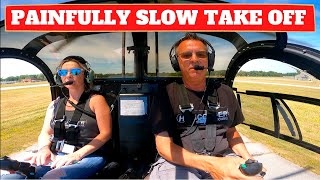
Kenny Keller and Heather Height demonstrate the painfully slow takeoff, a helicopter technique where you keep collective at hover power and use cyclic to inch forward until you can climb. It's safer in emergencies and works in hot, high-density conditions where normal takeoffs are risky.
Questions this video answers
50% off any course or membership.
Called a July 4th sale; "we have been running it for 10 days" and "it's going to go till July 8th."
JULY50 (also links below the video that require no code).
All right. I'm Kenny Keller, creator of Helicopter highway and Ground school. Sitting next to me is your member concierge Hogs member concierge Heather Height. We're getting ready to show you. We're gonna talk about the painfully slow takeoff, which is what I teach and I use and have since I started. That's the way I was trained and that's the way I use it now as a cfi. Painfully slow takeoff. So we're heading into the. We're gonna actually use the taxi, I think, for this one. But on our way in to get to the taxiway, we're going to tell you about the sale.
Yep.
Did we tell them already?
I don't think so. Not today. We have a 50% off any course July 4th sale. We have been running it for 10 days. It's going to go till July 8th, 50% off. You can use the code July 50 from our website, helicopterground.com or if you go below this video, there's links there where it'll take you directly to checkout. No code needed. What else did you know about that? It's huge.
Sounds like you got it. So the painfully slow takeoff, the idea is you keep the aircraft as low to the ground as possible. Two or three skid, two or three inches of skid height clearance, or more if you're not comfortable being that close. But the idea is to stay as close to the ground as possible so that you can have the most benefit of ground effect. And the painfully slow takeoff is taking off without adding power. You're just using the cyclic to keep moving yourself forward inch by inch by inch. And we call it painfully slow takeoff because nobody wants to do it. Everybody wants to just pull power and go. But we've learned that a lot of times if you're gonna have an engine failure, it may very possibly happen when you're adding power. So if you're doing your takeoff keeping your collective set at hover power, you can most of the time do the entire takeo and never add power. Okay. It will normally get you through etl and it'll get your climb and you can get all the way up to your cruise flight. So we're going to demonstrate it here in just a second. I get down the taxiway, I'll do a good hover pre takeoff check, and then we're going to show you the painfully slow takeoff. Now, I do this all year round because. When the weather is cooler in the winter, you have a lot more available power. But if you train this way all year round, you'll be ready for those super hot summer days. And I can tell you I was glad to learn this method because I got out into the working world, and when I got my opportunity to fly a jet Ranger, I flew News reporting at 135 charter. And we go out one night on a super hot evening to go up for the news. We took extra people. Camera operator took a student with us and took on extra fuel so we could stay up for evening news. Super hot. So to get that jet Ranger off the ground with excess fuel and passengers, I had to pull clear to the limit. I couldn't add any power. So we've got a camera down there for a skid view. Sorry, excuse me. And we're going to do painfully slow takeoff. So warning caution lights are out, gauges in the green. Everything looks good. We've got fuel. I just had the gentleman fuel before we took off. So we're all good now. I'm not going to add any power. And this is why we call it painfully slow. So I'm going to go forward, forward, forward, very gently. And on a hot day, I might even touch my skids. But if you just keep moving it, keep your nose straight, it won't be a problem on a smooth surface. I'm just going to keep going forward, keep going forward. Start to get a little bit of etl, so I got to push through it. Still not adding any power. Still not adding any power. Now we're increasing our speed. I still have not moved the collective, so I have not made a power change. Here we go. There's about 30. There's 34, 35, 40. Boom. We can start our. Start our climb out. Augusta wind there. And there you go. That is the painfully slow takeoff. A lot of people want to jump in and they want to pull a whole ton of power and they want to have that nose low. Well, the problem is, what if you have an engine failure? I'm gonna go back down here to the taxiway. Clear for me, right? Look for any airplanes, Heather. I'm gonna look over there for airplanes. I don't see any clear. I'm gonna head down to the taxiway. So we'll switch to the skid view. If you think about it, if you're down near the taxiway or the Runway or any smooth surface and you're taking off and the engine quits, what are you gonna do? You could just lower. You can just slide right onto the Runway, keep your nose straight and slide on. But I'm gonna go a little more power, a Little more nose low. What if I'm pulling a bunch of power and I'm doing this where I'm nose down? If the engine quits, then I'm gonna dive right into that taxiway or that Runway. So the painfully slow takeoff has a lot of benefits. It is learning how to take off without adding power. You know, you're learning how to take off on hot days with heavy loads. You're learning how to be prepared if the engine did quit for some reason during that takeoff. If you're nice and level and the nose is straight, you could just ease the thing onto the ground versus going, oh, man, the engine is going. I gotta go half cyclic and bang your tail boom. Or whatever the case may be. So painfully slow takeoff. Hopefully that's what you're being taught. If you haven't, you should experience it. And that's a great method. And it's. That's what we do. All right, so that takes care of that one for today. So reiterating, July 4th, special sale ends July 8th. 50 off. Any membership, anything on the home page. But because you're watching this video, just go below. Yeah, you don't even need the code. All the links are below. Private pilot, advanced pilot, private pilot, one year. Pro pilots. There's several pro pilot options, all 50% off. And again, code JULY50. Or go below and just use the links below and below the video. Yep. And tell them one more time while they get a hold of you.
Heather 574-767-1797. Call or text, or you can email me heatherelicopterground.com and we'll help you get signed up. If you need time to upgrade, take advantage of those professional pilot memberships and everything, 50% off.