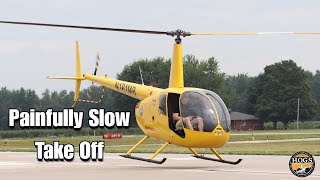
Kenny Keller presents an instructional YouTube video demonstrating the "painfully slow takeoff" technique for commercial helicopter pilots. Starting from a hover (~21–21.5 inches manifold pressure), he slowly taxis the helicopter forward without adding collective power, then transitions into a standard climb (approximately 60 KIAS and 500 ft/min) while explaining the method's efficiency and safety benefits, especially in hot/humid or heavy-load conditions.
Chapters
Welcome back to 30 Days of Videos. Just little tips and things we've seen from the last 30 check rides we've done over the last 30 months. And this one we pry, we preach in videos a lot, but it's about the painfully slow takeoff. But I want to gear this towards commercial applicants because a lot of the ratings we do, of course, are advanced ratings. Warsaw traffic helicopter 181, my Bravo departing 18 for right traffic, Warsaw. And a lot of them have never been shown the painfully slow takeoff. And the idea is at the commercial level, you're going to be flying on hotter days, more humid, heavier, loads more passengers. So we're just going to start here from a hover. We're about 21 inches, 21 and a half. And I'm going to have Heather kind of point the camera down there towards the manifold pressure just so you can kind of see. And we want to do this whole takeoff without adding any power, just hover power only. So we're about 21 and a half. I'm keeping my hand neglected, but I'm not going to raise it. So I'm going to start moving forward. And we do have a full load on about 60 degrees.
So, Warsaw traffic for my kilo, turning Left crosswind, Runway 18. Warsaw.
We're just going to keep easing forward, easing forward. If the skids touch, they touch. As long as we keep the nose straight on a flat surface, nothing bad is going to happen. So we're going to keep moving forward, just keep painfully slow. Now we're down to about 20 and a half inches because it's becoming more.
Efficient turning left down one Runway 184.
So there we got 20. We're going to keep it down, lower the ground closer to 50. Okay, still a 20 and a half. Now I'm gonna let it start climbing and I can get our standard climb. I can get 60 and 500 on the airspeed, which you're gonna see here in a second. And Heather can point it out right here, that hover power. We're down now to 20. I haven't raised it. Everything's become more efficient. So the power requirements went down. There's 60. We're almost to our 500ft per minute. If I go a hair half cyclic, right, there it is. There's your standard climb. 60 and 500 with actually now less than hover power. I did not move that collective. And another reason we do that is they tell us if the engine's kind of on its way out and if we're going to have a engine failure, it's most likely going to happen during a power change. Of course, a lot of people have been taught that. A lot of people have been taught that from day one. I teach private pilots that way from day one. That's how I take off every time. That's how I want them to do it. There is a more aggressive style of doing it. You can pull more power, a lot of people do it. But making use of that, there's no problem on that day when you're going to find yourself somewhere, you took on more fuel than you probably should have and you're going to be. It's going to be hot, it's going to be humid and you're going to find that you're. You pull up the hover and you're at max power, you can't pull anymore. And if you're flying more sophisticated aircraft.
And you over pull the traffic for my kilo turning left base. Runway 18 Warsaw.
In a example of a turbine aircraft, that aircraft's going to tell on you. And then you got to go back and explain to the company why you over pulled the power. So super, super important to learn that painfully slow takeoff. So do us a favor, subscribe the channel, click that little bell, you'll be notified of the other flying videos we got coming out. Nothing earth shattering, just things that we're seeing and that can hopefully help you in your training moving forward.
So we'll see you in the next.
Video.
When you feel the pressure to fly, but know the right decision is to stay on the ground, hit the hogs no go and live to fly another day. Day Helicopterground. Com.