Tips for getting First Certified Flight Instructor Pilot Job
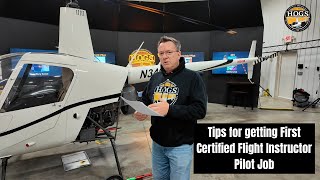
Kenny Keller shares how to land your first CFI job: build a detailed resume highlighting ratings and unique experiences, get night and instrument endorsements, log quality flight time like autorotations and confined landings, and be ready to relocate. Network widely and nail interviews by showing you can teach ground school and handle emergencies.
Questions this video answers
352 hours.
Private Pilot 101 a helicopter training blueprint.
heather@helicopterground.com (spoken as 'Email heatherelicopterground.com').
Enter 'Santa40' for 40% off any membership (promotion valid through January 1st period announced).
askhogs.com (available 24 hours a day, 7 days a week).
Chapters
Alright, real quick, in between our tips that we're giving you about getting your first job, type a question in chat right now because I'm watching in chat Christmas day ask us a specific helicopter training question that we could use in tomorrow's video. The first one that shows up on my chat on my phone on Christmas day will get a signed copy of helicopter 101 Private Pilot Training Blue Blueprint. Email heatherelcopterground.com with your name and your address and she'll ship you the book back to the tips laid that conversation on Christmas Day. Merry Christmas. Hey, what we're going to do today is we're going to talk about people getting their first job and I'm going to give you some tips because we recently had a viewer said hey, do you have anything inside your site for tips on getting your first job? And we don't. So I thought we would do this in a video share with you on Christmas Day. And we have a gentleman, Oscar, who kind of inspired this conversation who's been in our live events and I told him I would share his resume. So Oscar is a new CFI. Total flight time of 352 hours. Pic 266R22 35146 as a CFI so far 161 cross country 86 hood and weather 24 nights. So if you're looking for a new CFI, just reach out to me@kennyelicopterground.com and I'll send you his resume. I didn't know if he wanted me to put his email and name over the Internet but so here's a gentleman just getting started, low time, looking for a start. So for the others, for your first job, I first gotta say, you know, any job you could be going for could be tough to get right. So don't give up. If you don't get hired the first time, don't worry about it. You may have to apply and apply and apply over again. Just get started and don't give up. So number one, build a strong resume. What I want to say on that is everybody nowadays says oh, one page resume is that's all you should do. And I get that. But you see so many of those and I feel like if somebody sends me something, a one page resume is really hard for somebody to really highlight what their experiences are and why they would be a good hire. So personally, if you're sending me a resume I think it should be longer than a page because what's going to set you apart amongst Other people that are applying for that job. You know, do your standard resume stuff, but I personally wouldn't be afraid to go a little farther and we're going to hit some of these tips, things that you might want to add to the resume. Highlight your helicopter ratings and training achievements. Of course, include any unique flying experiences or accomplishments. Accomplishments such as time building, cross country flights or challenging weather scenarios. Use action oriented language and keep the resume concise and professional. Polish your interview skills. Practice answering common interview questions such as such as how you'd handle difficult students or emergency situations. That's huge, right? Because you have to be ready for if someone locks up on the controls while you're flying and then emergencies is probably one of the most important things that we're going to study and be sharp on, right? Be ready to discuss fire, aim and practical helicopter operations. Convey passion for teaching and aviation safety during the interview. You know, one of the things that I talk about frequently in the video is coming from our examiners and coming from one of the key helicopter manufacturers. There's a lot of bad destruction going on out there and there's a lot of things that are happening that shouldn't be sticking to the basics of what we learned as private pilots. Being as knowledgeable as you can is going to help you, you know, in your journey on this first job Next network within the aviation community. Attend aviation events, expos or seminars to meet potential employers. Stay in touch with your instructors, examiner and flight school connections. Join helicopter related forums and social media groups to discover job openings. I can tell you that pretty much every job that I've got since 2001 has been because I know somebody or because of the people that I've met along the way. The first job was at the flight school that I trained at and then the next job that really pushed my career over that one I got from really going out there and reaching out to the state I was in and the surrounding states. Anywhere that I could easily drive an interview. I hit every single flight school I could with an email reaching out to stating who I was, was ready to get my career started. So other than that, every other job I've got because I knew somebody so I can't or I totally agree with, you know, network within the community. Stay in touch with everybody and get out there and just talk to people. That is how it works. That is definitely one of the best ways. Stepped over here beside our hogs wall of fame for our TV that's highlighting the CFIs that have used hogs to get their their Training, gain extra endorsements, and this is really good. Obtain additional certificates or endorsements such as night flying or instrument proficiency. Absolutely. Employers value instructors who are versatile and can teach in various conditions. Employers value instructors who are versatile and can teach. Oh, I repeating the same one there. Yes. And we'll mention, for example, we have a mountain course that we're doing in Vegas currently. But if you're interested, you got to get in soon because we're getting ready to bring our 44 back soon as we move towards spring. But anything on your resume that could be different than the average is good. For me, for example, prior to private, I flew Enstrom, I flew Schweitzer, I flew Robinson, and that made the training drag out a little bit longer. But then once I became a cfi, I had places that went, oh, wow, you got instrument time. Oh, wow, you got Schweitzer time. We all know that Robinson's the most popular civil aircraft, so most of us go after that. Robinson training and Robinson experience. But don't overlook the fact that if you have Schweitzer time or Enstrom time, that can help you with those jobs where people are applying and they don't have Schweitzer Instrom. They're applying for a job with a bunch of R22 time and nothing in an instrument. Schweitzer. So any kind of extra endorsement or extra training, mountain training, anything that you can get varied. Different aircraft, different structures, different places in the country. Really, really good for that resume. I actually have a question before we move on. What's that? Does it matter in the job field? Like, let's say you're you. You have a commercial license and you just want to work, but you don't want to do CFI work. Is it harder to get work as a commercial than as a rated cfi? It's actually a really good question, and I think the mic will actually pick up your audio so that this actually might work out good. This could be a bonus at the end or a completely different video. There are a few people I know that got their commercial and started flying. But the problem with that, with your question, is most places won't hire you even especially for like giving rides, tours and things until you have maybe 250 hours or 400 hours or 500 hours. So a lot of the time the only jobs that are open are for instructors. And the system is backwards. Our industry is backwards. Why does it work that way? I can't even tell you. You would think instructors would be older guys that have been doing it teaching, but getting started. About the only thing you can do with zero or little time is become an instructor. So you can try just do commercial, but you gotta get lucky to find somebody who's gonna hire you for a job with really low time to get one of those commercial jobs. Yeah, that's actually a good question. Showcase your teaching skills, offer to assist fellow students and teach ground sessions to gain confidence and experience. Highlight your ability to break down complex topics for beginners in your job applications. This is pretty important because everybody wants to fly, fly, fly. And if you're the instructor who's willing to sit down with students and help them get through the ground knowledge, that's pretty big because the nature of the beast, new instructor, they want to build time, they don't want to do ground. So someone who is hiring you, for example, me, if I was hiring you and all you want to do is fly, fly, fly, you're not gonna get the job because I'm gonna want you to be able to sit down with us and help do ground with instructors. I'm gonna want you to help you or have you jump in front of a camera and help teach. Because the flyin's the easy part, the ground part is the hard part. And people, instructors in general aren't willing to do ground school. So I would highlight that in your resume. When you talk to these people, put a big emphasis on the ground training and how willing you are to help people with that ground and help them get past those struggles. Because a lot of people do have a stumbling block along the way, a learning plateau. And you have to be willing to help those people figure out what you have to do to get them past that hurdle. So that is another one that I'd say is pretty big. Log quality flight time. Focus on logging flight hours that demonstrate your proficiency, especially in scenarios relevant to instruction like hovering auto rotations and confined area landings. And if you've participated in unique experiences like HOGS vinyl approach courses, highlight those. You did a mountain course with us, highlight that. If you've used hogs, highlight it. We are now known in the industry. We've been around 14 years, and you can. There are examiners around the country that say their best applicants have used hogs, Right? So we've been in the business a long time. Our training's out there and been out there for a long time. So mentioning that you've been through a HOGS course, you've been here and you've flown with us, is actually good for your resume in my opinion. Next one Be willing to relocate. I call this be a road dog. Many job opportunities are location dependent. Being flexible with your location can increase your chances of landing a job quickly. Research areas with high demand for CFIs and express your willingness to move during interviews. This is big, and that's why I say be ready to be a road dog. You're going to spend a ton of money to get through the ratings, you're going to do a ton of ground study, you're going to spend a lot of money. This is a big effort. Then you're going to get that rating, you're going to get that cfi and you have to be ready to travel. And if travel is not an option for you, it's going to, it's going to be a little harder for you to get the dream started because you're only going to have those local schools and depending on where you're at in the country, there might not be a helicopter school for, you know, less than a two hour drive away from where you're at. So depending on where you are, it can make it very difficult with this career if you're not willing to travel. So that's just part of it and it's not necessarily a good thing, I can tell you. I was working at a school four and a half hours away from home when my daughter was born. And I would drive home every weekend. Friday night I'd drive four and a half hours home. Monday morning I'd drive four and a half hours back to work and I'd stay there all week. And as she was growing up, that was tough. That was tough. And I missed, you know, there's certain things I missed during that time. So that's a sacrifice that I made to move my career. And another job I had in the beginning was two and a half hours that direction. So, you know, two and a half hours that way to get to a job, four and a half hours that way. But I did what I had to do to get the time under my belt to move on with my career. And eventually, once I had the time, I got a job offer at a place 20 minutes from my house. But that's after I had the experience under my belt and the time in my logbook before I could come back and work at home. So being willing to relocate is one of the biggest, biggest things that's going to help you move on with a career practice. Professionalism and enthusiasm, which goes for any job that you're going for. Dress professionally for interviews and meetings with potential employers. I think it's pretty big. I'm not saying you have to wear a three piece suit, but as with a checkride, we always tell people, you know, a nice pair of dress pants, a decent polo, at least show up and look decent. And some people go argue, well, that's not right. You should be able to wear whatever you want. Well, wear whatever. Wear whatever you want. Your T shirt and your, you know, shorts and your flippy floppies and see how far that gets you. Here's what I like show genuine enthusiasm for helping students achieve their goals as this is a crucial quality in a cfi. I mentioned it in one of the last tips and I'm bringing it up again because I just think showing to the employer that you were really motivated to help students and do the ground is so important. Next, learn about a helicopter employer's fleet, which I think is super important. Familiarize yourself with a specific aircraft the flight school uses, such as Robinson R22 or R44. So yeah, you want to be have at least some time in your logbook for the job that you're going for for the aircraft you're going to be flying. Because you got to have five hours minimum by the regs to even teach in one before you go to that job. If maybe you don't have a lot of time in one, at least do a little bit of research and learn about that aircraft as much as you can before you ever get there. And now for one year membership Private Pilot with hogs. We're going to give that away right now and here's what you got to do. Use proper spelling and type the entire entire title in the chat. The live chat that is Private Pilot 101 a helicopter training blueprint. Lindsay's giving me a funny look. What'd I do? Stop showing the book. Oh well, there they had their tip. So type that in. Private Pilot 101 a helicopter training blueprint. Proper spaling, spelling, proper spaces. The first one that shows on my chat on my phone will win one year membership email. When I declare the winner, that is in chat email heatherelicopter ground.com Back to the video and my last one, we kind of already mentioned Leverage HOGS and Kenny Keller's resources. Mention your affiliation with HOGS and how the courses helped you excel in your training. We have proof back there on the HOGS Wall of Fame. You know, people come here now to do training. They go, hey, there I am on your HOGS wall. Or there's my instructor, there's my flight school, there's the aircraft they did my checkride in. Right. Use HOG networking events, videos and resources to stay informed about job leads because we do occasionally announce jobs that are available when somebody will say, hey Kenny, we're looking for a cfi. I'll put those messages out. You know, occasionally we look for extra help here. And I always want to hire from our HOGS members. Hands down, I want to hire somebody who has used the HOGS courses, has been active in our live events, active with us through email or text or phone calls. Because then I know you're going along with our methods. And we, you know, have a lot of, I don't know, a good base of quality training here that we hold ourselves to and expect of our students and expect of our instructors. And again, with a lot of shady flight instruction going on out there in the world, you're not going to hurt yourself by being affiliated with HOGS and using the HOGS products. I'm partial, but why wouldn't I be? Believe it or not, there are companies out there that won't hire somebody if they haven't had an accident. And I heard that when I was first told that, I thought, that's pretty intriguing. I went through an accident in 2005 and I was worried that my career was ended. The only thing it did was it held me up a little bit while I recovered from my injuries. And the first EMS job I applied for was shortly after. And one of my close resources said, you're probably not going to get hired this time around because you're fresh out of an accident. But don't give up, Keep instructing, keep flying, and put a little bit of time under your belt and then reapply. And about probably six months after that first time, I got turned down. I reapplied with that same company and I got hired. So my resource was right. Just give yourself a little bit of time between that accident, keep teaching, keep proving you're going to be out there doing, doing your thing. So personally, I'm not scared because somebody had an accident. I've had one. Was not my fault. This was a. It was a malfunction. And that accident also changed, changed my whole entire life. It changed my life. It changed the way I approach maintenance. It changed the way I look at pre flight. It changed a lot of things for me. And I know through, for example, you know, one of my instructors that I use has had a couple accidents actually. And after his first one, I asked the insurance company about it. Like, hey, is this going to be a problem? Adding, you know, this pilot and the insurance company's like, why would it be a problem, Kenny? Helicopters get wrecked all the time. That's why you pay for insurance. And that's why, you know, that's what we do is help take care of you through those times. And he said, we, if you believe in a pilot, it's not a problem because they had an accident. We don't just go, oh my God, the guy had an accident. We're not hiring him or you can't put him on. He said, absolutely not. It's not a problem. Just because somebody's had an accident does not immediately disqualify them. So, you know, again, you got to use some common sense with that. If you were out flying and doing something reckless and dumb, that could hold you up. But accidents do happen. People make mistakes. And again, like in my accident, it's clear in the report, malfunction, mechanical malfunction, it's in the NTSB report. So I had no worry about being blamed and moved on with my career. Congratulations to the winners. Merry Christmas. So Remember up until January 1st, 14 days of 40% off book giveaway each day. So keep coming back for the videos for the rest of the month. 40% off any membership with Santa 40, you go to helicopterground.com that link is below the video. Enter Santa 40 in the coupon box for 40% off any membership. Remember, you can go down below for private pilot Blue blue blueprint free PDF that's down below. Ask hogs.com yes I do want to plug ask hogs.com we have this cool tool that you can ask helicopter training related questions, ground or flight, 24 hours a day, 7 days a week at ask hogs.com totally free. 7 days, 375 weeks, 365 days a year, 52 weeks a year, 24 hours a day. Askaux.com and subscribe to this damn channel, would you? 14 years of making videos. Give me a Christmas parent present and subscribe to the damn channel. Would you? Click a like comment below? See you in the video and peace out when you feel the pressure to fly, but know the right decision is to stay on the ground. Hit the hogs. No go and live live to fly another day. HelicopterGround.com we'll get a copy of Helicopter Training 101. What do you say to the people out there in the world who said vaping is bad for you? So is crossing the street, which she'll have when she when you email her.










