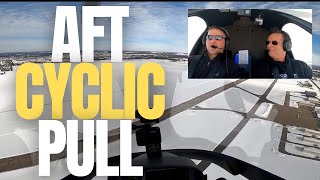
A short video discussion (Kenny Keller and another speaker) about helicopter autorotation technique focusing on the critical need to apply a small aft cyclic pull when entering an autorotation. The speakers explain how failure to use aft cyclic causes the nose to drop, rotor RPM to decay, and can lead to a fatal outcome — citing a real EMS helicopter accident as an example. The talk emphasizes practicing autorotation entries at cruise speeds and maintaining airspeed/RPM with a brief aft input.
Chapters
Here we go.
In 3, 2, 1.
Aha. It so does. Look at that. Yeah, maybe that's what it is, part of it. So it did. That nose dropped and you see the rotor RPM came down.
Oh, that was immediate. Yeah, I mean, it was immediate. That nose went.
Yeah, that nose kind of came down, didn't it? We just kind of got to see that rpm. I was surprised by that RPM too, right away.
We got the low horn right away. It's fun to talk about this stuff and then go out and test it and see how it directly affects one particular aircraft. When you enter an auto rotation, you need an aft cyclic pull. If you don't, the nose drops, RPM drops, and then you start chasing the thing all the way down. If you don't enter it nice and get a nice entry and one thing's off, then you chase it all the way down. You're up and down with the collective or you're back and forth with a cyclic during the auto rotation entry. A nice small aft pull. I call it set the speed. Because what I do, if I'm using 70 for a glide, I like to enter about 72, 73, 75, a little faster than my glide speed. So when I go down collective and a small aft cyclic pull that brings me back to 70, it sets the speed, keeps the RPM nice, nose doesn't drop, and it makes for a nice auto rotation. And then I mentioned yesterday that there is an accident, an EMS accident, where the guy's traveling along at 120 knots or whatever, has engine failure at cruise speed, and they determined that he didn't apply aft cyclic, lost rotor rpm, and I believe everybody died. It's more than just a training aspect. If you have it in the real world, especially going faster than your normal training speed, you need a small amount of aft cyclic to keep the nose from dropping and keep the RPM where it's at.
You know that I like to do real world stuff. I like to teach real world. So I know once you get your rating, you're going to basically be going from point A to point B, and you're going to go from point A to point B at cruise airspeed. So why not practice your auto rotations or your entry into your autos at cruise airspeed?
Sure, if, let's say 60 is the number you're using for your training aircraft. They want to enter the auto, it's 60.
Yeah.
And they want to glide at 60.
Right.
And then when you give that little bit of half pull that you need to keep the nose from lowering. Then you, you're pulled. You pulled back. So let's say you just went from 60 to 55. So then you go, oh, well, I'm a little slow. I need 60. Pulling it back forward. And then they hit 65. And then they go, oh, not too fast. Then they pull it back. And that's why I'm saying how they'll seesaw with the speed. If you don't have the nice entry, you don't pull the aft, the nose goes down. Then you start monkeying with that cyclic. And then you still might start monkeying with the collective too.
And it's RPM goes.
So then they pull up. They pull up too much. So what they do, they go down too much. And as a student, that's normal. Yeah.