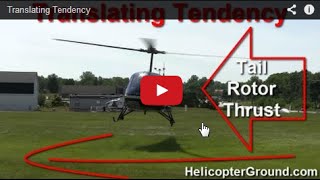
Kenny Keller explains translating tendency, the lateral drift that happens when hovering a single-rotor helicopter. It's one of the three T's in helicopter handling, alongside effective translational lift and transverse flow effect. Some aircraft are rigged to compensate for it, others need pilot input.
Chapters
What is translating tendency Your textbook definition right out of the Helicopter Flying Handbook. The tendency of a single rotor helicopter to move laterally during hovering flight. Also called tail rotor drift. It's one of the three T's that everybody screws up. Effective translational lift, transverse flow effect and translating tendency. And in this helicopter, this is an instrument, they rig the mast slightly to the left to compensate for transiting tendency. Depends on what aircraft you're flying. Some aircraft have a change in their rigging to compensate for it. There are some aircraft that they don't compensate at all. You just hold the cyclic to keep the aircraft centered. So if you've struggled with this, don't feel bad. Everybody messes up the three T's. I'm Kenny Keller, the creator of Helicopter Online Ground School. Hope this video has helped clarify that for you. Please give us a Like Please subscribe to our channel. Please leave us comments down below. And if you'd like to check out our 24 hour test drive, take a look at our training. There's a link for that just below this video and there's also another link for membership sign up. So please like share and comment and go to one of those links below if you'd like to find out more about our training. Thanks for stopping by and we'll see you in the next.