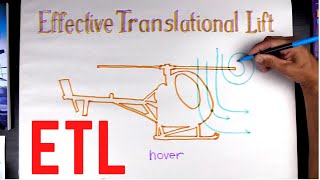
A Kenny Keller YouTube lecture describing helicopter aerodynamics during the transition from stable hover to forward flight. The speaker walks through: hover airflow and ground-effect vortices; effects of any horizontal airflow (even a few knots) reducing induced flow and increasing lift; the transverse flow effect (about 10–20 kt) producing rotor shudder, a right roll (via gyroscopic precession), and left yaw (tail rotor becomes more efficient); and Effective Translational Lift (ETL, about 16–24 kt) where clean airflow increases lift and reduces power required. Practical pilot advice is given to slow the transition, anticipate control changes, and back off collective once in ETL.
Chapters
So now we're going to do a video on a helicopter going from stable hover flight all the way through etl. And what happens aerodynamically and what happens to the ship. So for these scenarios, we're going to pretend like there's no wind. So dead calm. And we're going to start off in a hover. So step one, we are just in a hover. Hover. Everything is pretty uniform. Air is coming down like this. Got our vortice or in ground effect. There you go. So that's kind of our starting point. Now with. And the term you want to say is with any horizontal movement, which means if you get 2 knots of wind, that will cause things to change, or if you just start going at a walking pace, things will start changing. So step two is any horizontal movement, I should say horizontal airflow. Now we're starting again. This can be just a walking pace. So we're starting to move forward in the back half of the helicopter. Really nothing has changed. Still coming down. Going out more to see. Front half mostly the same. Probably right here is the same. But then the air isn't quite coming straight down. Now it's starting to shift and come in a little bit more like this. And your vortice is being reduced a little bit and being blown away just a little bit. Now when you change your airflow from coming straight down to a little more horizontal, you have reduced your induced flow. You can watch one of my other videos where I explain why reducing induced flow increases angle of attack. But when you reduce induced flow, you get more lift. So the helicopter wants to kind of pick up a little bit. Also with a smaller vortice, it will produce a little bit more lift as well. And the helicopter. And you'll feel this if you do a nice slow takeoff, you'll feel the helicopter kind of at the beginning, just kind of want to pop up a little bit. And that's getting any beneficial lift from any horizontal movement. Now we're going to start accelerating and going a little bit faster and a little bit faster, and we're going to get into a transverse flow effect. This happens between 10 and 20 knots. So what happens is you can kind of almost think of it as the front half of the blade is in clean air. The back half is still in dirty, recirculated air. So we're starting to go a little bit faster. Front half is more kind of horizontal like this and coming through nice and pretty clean. The vortices have been blown away. The back half is still coming down like this because it hasn't fully been blown away. And you have a vorticee, so you can think of it as front half clean. Back half is still kind of dirty. Three things happen here. One, we get a shutter, and you'll recognize this as you start flying, you start taking off, you get a little vibration, a little shutter. What this is, and the way I picture it is you have a blade, and it's going back and forth between, oh, clean air, my vortices blown away. I got good horizontal flow, not as much induced flow. Oh, bad air in the back. I got a lot of induced flow. I got a vorticee not producing much lift. So clean, dirty, clean, dirty, clean, dirty. It's just the vibration of the rotor system going through that. The second thing is a right roll. Now, we talked about gyroscopic precession in another video, so you may want to review that. But if I look top down at the helicopter, so here's the body of the helicopter and the tail, and I have the blade. You're getting more lift at the front of the blade, but because of gyroscopic precession, that has a maximum effect 90 degrees later over here. So you have that increase in lift affecting you on the left side, which will cause the helicopter to roll to the right a little bit. Third thing, we have a left yaw. This tail rotor back here, remember, it's doing the same thing as the main rotor as far as pushing air, creating lift, all that kind of stuff. It has vortices, it has induced flow, and just like the main rotor. So as you start moving forward into clean air, those vortices will get blown away. The airflow will be more horizontal, not going straight in like this. So your tail rotor will become more effective, which means it's going to push harder, which means all that left pedal you have in for hover. Now that tail rotor is going to become more efficient. So it's going to yaw you to the left. So as you're pushing through this, you need to be backing off that tail rotor and pushing some right pedal to keep your nose straight ahead. Now, this is a really a funky transition that takes a while for students to get through because they're not anticipating it. The nose will kind of dip up and they weren't anticipating. So they'll nose over. Then it'll roll to the right. So they'll push left and then the tail rotor swinging to the left. So then you're too late pushing right pedal, and you get this kind of fishtailing, weird thing. Until you've blown through it. The key to learning this is to slow it way down. All students who are just going too fast and they can't anticipate if you slow it way down and you just start creeping forward like a grandma would, start learning how to fly, and you'll start to feel the shutters, and then you can work your way through these things a lot easier. And then that will build the anticipation to where you can be like, oh, this is going to happen. Next, we get to etl, which is just effective translational lift. So this is effective translational lift. This is now happens between 16 and 24. Now we have clean air going through the rotor system. Our vortices, we always have little vortices, but they're all but blown away. And now we have. Our induced flow has been greatly decreased. Remember, induced flow is bad. So we get rid of that, we get more lift. Our vortices are gone. Again, those are bad. We get rid of those, we get more lift. And this is where it requires a lot less power because the rotor system is more efficient. You can back off the collective and you can cruise along. This is why hovering takes a lot more power than it does to actually fly forward. Now, notice these two. The airspeeds overlap, but these will never overlap. Basically, if you hit transverse flow at 10, you're, you're probably going to hit ETL at 16. If you hit transverse flow at 20, you're probably going to hit etl. Then at 24, you're not going to have both. It's always going to be this, then this. And this is why we like to get through the ETL to get into that clean air. It.