Vortex Ring State Vuichard Recovery Technique Settling With Power
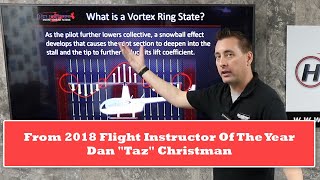
Dan Chrisman explains vortex ring state, a dangerous aerodynamic condition where helicopters sink into their own downwash. The standard recovery requires lowering collective and pushing forward; the Vuichard technique uses power and lateral movement to escape with less altitude loss. Pilots need to recognize the symptoms and practice both methods.
Questions this video answers
Eurocopter accident: August 23, 2013; Robinson R44 rooftop accident: March 4, 2003.
Airspeed less than effective translational lift (ETL) — typically cited 10–24 kt (rule-of-thumb often <10 kt); rotor producing engine power (>~20%); vertical or nearly vertical descent ≥300 ft/min.
Build airspeed to ETL/Vy — commonly cited between about 30–45 knots in guidance to ensure escape from VRS.
Minimal—typically reported around 20–50 ft.
Chapters
Whenever you're ready, man.
All right, all right. Hello everybody. I am Dan Taz Chrisman. And today we're going to be talking about vortex ring state, or how I settled with power. It's often considered as the equivalent of the fixed wing stall. The vortex ring state is an aerodynamic condition of powered flight where the helicopter settles into its own downwash. Alright, so here's a little bit about what we're going to talk about. So we're going to start with some aircraft mishaps, a little bit of history about the vortex ring state. Then we're going to go into us versus the world, the rotor working states. Then we're going to talk about what is vortex ring state, conditions necessary for the vortex ring state, flight conditions leading to the vortex ring state, symptoms of the vortex ring state, and then we're going to talk about the recoveries and then settling with power, and then I'll give you the takeaways. So what you actually need to know from this whole discussion today. On August 23, 2013, a Eurocopter with 18 persons on board was on the final stages of an instrument approach into an airport. As the aircraft neared the minimum descent altitude of 300ft AGL, the nose pitched up 12 degrees. Airspeed was 43 knots, and at about 240ft the pitch had reached another 20 degrees. Nose high airspeed was at 32 knots and descent rate was approaching 1000ft per minute. As the Super Puma descended through 100ft, the airspeed had dropped below the flight data recorder's lower limit of 30 knots. The engine torque had been increased to 115% and the rate of descent was about 1,800ft per minute. The aircraft hit the water 1.5 nautical miles short of the Runway, killing four passengers and seriously injuring three others as well as the pilot. More than 10 years earlier, on March 4, 2003, a Robinson R44 was the subject of a TV commercial filming in Indonesia. While the aircraft was making a steep approach with a 12 to 15 knot tailwind to a hotel's rooftop helipad, it developed a very high descent rate which the pilot appeared never to arrest. The helicopter struck the helipad, bounced into the air and then rolled off the edge of the building fell 15 stories onto a third story swimming pool. Two passengers on board were killed, as was the pilot. So why are we talking about these? Well, it goes into the vortex ring state. So. So the insidious nature of vortex ring state makes it vital that pilots understand and avoid the conditions that lead to Its development. George D. Both Essat first recognized the vortex ring state in 1922 with his Flying Octopus. This machine was a massive six bladed rotor similar to what many of the quadcopters of today look like. Since then, numerous flight tests, wind tunnel experiments and mathematical modeling efforts have refined our understanding of the vortex ring state. It is understood that the number of rotor blades, rotor RPM and rotor diameter have little effect on the vortex ring formation. The helicopters with higher disc loading and increased blade twist are more susceptible to it. Alright, so I'm going to address the elephant in the room here. So, in the US there's a lot of confusion on whether vortex ring state should be properly or improperly called settling with power. Controversy stems from a condition completely different from vortex ring state in which engine power required exceeds the engine power available. Why is there this confusion? Well, over the years, aviation organizations have used conflicting terms in discussing these different conditions. In the 1950s, the US Navy referred to the vortex ring state as power settling and used the term settling with power for the power available versus power required situation. In the 1960s, US army pilots in Vietnam used the term settling with power to refer to the vortex ring state and power settling when they were trying to get out of a landing zone while being overloaded with troops. The FAA uses settling with power and vortex ring state interchangeably in the Helicopter Flying Handbook as well as practical test standards. Several other authors do as well. Most of the rest of the world's aviation agencies differentiate between vortex ring state and settling with power and treat them as two separate issues. Along with those, I'll highlight this Robinson has also started to come out with their safety notice SN22, which basically says vortex ring state is different. That being said, though, when it comes to the written test, most of these countries still use the terms interchangeably. So even though some of the other countries talk specifically about separating them when it comes to taking the written tests, they actually still follow that they're both the same. Alright, here's your disclaimer. So, since the general consensus in the helicopter industry is leaning to the separation of the two terms, I'm going to do the same here. For now, I'm going to discuss Vortec ring state as is currently understood in the industry. And at the end of the presentation, I'll go into a little bit more about the difference between vortex ring state as well as settling with power. Engineers analyze vertical flight dynamics using basic aerodynamic states of flow at the rotors during vertical flight. I'm going to look at three of these, those being the Propeller state, the vortex ring state and the windmilling brake state. The vortex ring state is only one of the three distinct working conditions for a helicopter's rotors. In propeller working state, or the normal working state as it's sometimes called, airflow is directed downward through the rotor and the rotor disc moves in the direction of the rotor thrust. As in vertical climb, hovering is a static thrust conditions of this state. So as you can see here, all the thrust is producing down, which is going to take the helicopter up or keep it in the hover holding it right there. So this is the propeller working state. The second state is if the helicopter descends at greater than 300 foot per minute, upward flowing air is drawn in and down through the rotor. This forms the large circulating pattern that we know as the vortex ring state. So on the second set here you can see the air starts circulating and gives us those rings that we're used to and we're going to go into more in depth about that. The third one is the windmilling brake state. It's encountered. If the descent is allowed to Continue Greater than 2,000 foot per minute, the flow of the air is pushed entirely upward through the rotor. The force generated by the rotor is equivalent to that produced by a parachute of the same diameter. So all the air is pushing up and we call this windmill break state. It's actually trying to slow itself down there. Interestingly enough, the boundary between the vortex ring state and the windmilling brake state is the ideal auto rotation condition. So when you're going into an auto, you're somewhere between these two, you're somewhere between these two states, between the vortex ring state and the windmilling brake state. Alright, so what exactly is a vortex? So a vortex ring is a region of rotating fluid moving through the same or different fluid where the flow pattern takes on the same shape of a donut. So as you can see here, got this little puff of air coming out, creates that donut shape as you're going out. So the helicopter produces the same similar type of thing when applied to helicopters. The vortex ring describes the recirculation of airflow around the tips of the rotor blades. So on the Comanche here you can see we got the circulating air going around showing a nice picture of that ring. The animation we got over here, we're actually seeing the rotating blades and it creates at the tips, you can kind of see the little circulations of the donuts as it's going. So it kind of creates that corkscrew all the way down with that ring. The relative airflow Onto each blade section is dependent upon the induced flow and the local rotational speed, both of which are greatest near the tips. So as we know here, we got the standard slides right out of the helicopter flying Handbook. We got the twist of the blade here. So we know that the center of the blade, as it's rotating near the mast, it is not rotating as fast as the tip. So therefore it needs to generate the same amount of lift as the tip does. So what do they do is they increase the angle of attack closer towards the root of the blade, whereas at the tip, it's a little bit flatter. Therefore, you're going to create the same amount of lift or pretty close to it. It's important to realize because of the higher blade angle at the root through the washout, the angle attack at the root is larger than at the tip. So we kind of talked about that. So as we're slowing down, as we're putting more pitch on that blade, you're not going to end up getting as much lift at the root tips once you start moving the air through it. If the pilot lowers the collective slightly, the aircraft begins a slow rate of descent, which produces a minor rate of descent flow up towards the disk. So as you're lowering that collective now, you're starting to get that air coming up through the center. As it does that, the angle of attack at the root blade starts to increase to the point where it's no longer going to be creating lift. It's going to be basically stalled at that point. Once in a descent, the upward flow opposes the induced flow from above, and the effect of the rate of descent flow is ceases to be equal over the disc. As the rate of descent increases, a stage is soon reached where it is equal and opposite to the small induced flow near the mast. Eventually, the blade root section stalls. That's why I was talking about earlier right here. You're going to start getting that stall. As you go further and further into the vortex, it's going to stall even more. As the pilot further lowers the collective, a snowball effect develops that causes the root section to deepen into the stall and the tips to further reduce its lift coefficient. So as you're descending, not only do you have the air pushing up through the middle, you've also got it on the sides. It's going to increase. You start getting these vortexes at the tips of the blades. Well, now that you've got enough air pushing up through the center, around the center of the mast, you start getting another second ring in between where you're actually producing the induced thrust or the induced flow as well as the upflow. We can kind of see that right here. So here's your second ring inside the rotor disc there. The upward flow above the stalled region tends to merge with the induced flow over the center area of each blade, so that a secondary vortex forms away from the center of the disk. So there you go. That's your second rotor or your second vortex that everybody talks about. The only section of the blade producing thrust is the relatively small area between the root and the tip, which is insufficient to support the weight of the helicopter. So as you're descending even faster, you get more of that upflow. The only induced flow you're getting is just from that small area of the tip right there. And usually it's not enough to sustain the weight of the helicopter, at least not in. Most of these are helicopters we're flying. If the rate of descent increases and if collective is reduced, further descents of more than 6,000ft per minute are likely. So there you go, you got the air coming up from below. Basically, it's counteracting everything that you've got from the induced flow and you're not having enough lift, and it's going to keep increasing until you either recover or you hit the ground. The main danger in vortex ring state is that the high rate of descent requires considerable height for recovery. If the helicopter enters vortex ring state too close to the ground, there is little that can be done before the aircraft impacts the surface. If the helicopter pilot chooses a flight path, airspeed and rate of descent combination that coincides with the aircraft's downwash, the helicopter could enter the vortex ring state. So the FAA Helicopter Flying Handbook gives you three states. These three states are pretty much universal. Some of the numbers are slightly changed depending on who you're talking to. But the three big things here are. Number one, you have a horizontal velocity that must be slower than effective translational lift. So you have to be lower or slower than effective translational lift. The Helicopter Flying Handbook says that that's 16 to 24 knots. Most people teach 10 knots. Anything less than 10 knots in any direction is usually the rule of thumb. The rotor system must be producing some of the available engine power, so somewhere between 20 and 100%. Most people say anything greater than 20%. A vertical or nearly vertical descent of at least 300 foot per minute. The actual critical rate depends on the gross weight of the aircraft, the RPM density, altitude, and a bunch of other factors. So here again, I call this the 1, 2, 3, rule I think Kenny has talked about that in some of his previous ones. So less than ETL. So I say less than 10 knots engine power, so greater than 20%. So that's your two and then vertical decent of 300ft per minute or more. So there's those three and we're going to recap that at the end just to make sure you guys got it alright. There's a definite combination of airspeed and rate of descent that's largely determined by the power in use that produces the vortex ring state conditions. So this graph here, this is pretty universal, but it basically shows you the areas where you're going to get light disturbances of vortex ring state or severe disturbances where you're actually getting thrust variations in it. So most of this that you're going to see here. So like it says here, a steep descent with little power produces a rate of descent so large that the vortex ring state is avoided. So if you're descending so much, remember you're back in that autorotative state. So the example they give you here, 1500 foot per minute. Yeah. If you're over here at 1500 foot per minute, even if you're at 90 degrees descent rate, you're basically in that auto rotating state. So you're not really in the vortex ring state. A decent angle shallower than 30 to 40 degrees. So somewhere over in this area. So if you're anything less than about 40, you're too shallow to actually get into that vortex ring state. So there again the general consensus, this is kind of universal. Now we know what the FAA says, but the general consensus is basically anything less than 500 foot per minute, you're okay. Anything greater than about 1100 to 1200, you're okay. So there's just got this one little, almost looks like an egg shaped looking thing right there. So stay out of that area. So it's very important to understand what your own helicopter is going to be doing. Beyond about 1200ft per minute, the rotor will be more or less in the autorotative state. Even though there is still enough induced flow to qualify as the vortex ring state. The real difference is what you're doing with that collective. So if you've got the collective pull, you're pulling power, pulling some pitch, then you're going to be in that vortex ring state. As soon as you lower that in that collective and put yourself in the auto rotation, then obviously you're no longer in that vortex ring state. Three combinations can be encountered under the following flight conditions, which can cause an unhealthy vertical descent rate and ingestion of the downwash. First one being downwind approaches to landings or quick stops. So we've always talked about you never want to take off with a tailwind, you never want to land with a tailwind. Obviously in one of our discussions earlier, that was one of the things that led to one of the fatal mishaps. Another one is pinnacle or mountaintop landings with considerable upslope wind. So that upslope wind can actually help generate the increased rate of descent or simulated rate of descent and get you in that vortex ring state. Excessively hot approaches with an aggressive flare and pitch pull at the bottom. So you're coming in kind of fast. You go to do that quick swap ends and get yourself into the vortex ring state. And then the last one, long line or vertical reference work with a lot of, with a lot of fore, aft, left, right, translating movements. So you get a lot of those translating movements in there when you're up high out of that out of ground effect hover. All these flight conditions require that an induced flow be present, some power be in use, and the interference to the induced flow by an airflow from below the aircraft. So let's talk about the downwind approach to quick stops. So if you're landing with a tailwind, the down wash will be blown under you as the rotor system instead of trailing behind you. So if you got that wind, it's pushing you this way. You can see in the animation it's pushing that vortex state underneath of you. And then you could be in that vortex ring state. Pinnacle Mountain slope landing. So here's the helicopter flying in. As you're trying to level off, you reach that upslope and it's basically generating more wind coming up underneath the helicopter. So even though out here you might not be in that, you know, greater than that 300 foot per minute, as you start getting closer to it, the effect of this wind coming up the upslope is going to generate that for you. Alright, long line or vertical reference work. So obviously if you're staying out here, you're hovering in that outer ground effect hover area and you're just kind of circulating, you're stirring up that air. Well, eventually what's going to happen is you could settle in, into it and get into that column of air and it's going to start settling you down. So obviously if you're hot, you're heavy, you know, those four high, hot, heavy, those types of situations is where you're going to really be an issue with that. One and then the excessively hot approaches. So I kind of alluded to it earlier. You're coming in nice and fast, you kind of go and throw on the brakes, you're swapping ends and you're kind of pushing that induced flow out in front of you. And you could end up settling into it and getting into that vortex ring state. Alright, so some of the symptoms of vortex ring state, the rotor is going to be pumping air into a large bubble underneath the aircraft. So that's kind of what I'm showing in this diagram here. It's kind of old, but it demonstrates what we're looking at. Very good. So as you're starting to get in that vortex ring state, you can see it's actually developing a bubble around you. What's going to happen is as it continues to push more and more air into it, it's like any other bubble, balloon or a bubble. Eventually if you get enough air into it, it's going to pop. So that's what we're showing here. As it increases in size, eventually it's going to pop. Does that every few seconds. And these disturbances causes the flow patterns around the disk to be highly erratic and confused. This results in large and sudden changes to the angle of attack of the individual blade sections, causing severe dissymmetry of lift. The helicopter will then pitch, roll and yaw, making aircraft difficult to control. So you can see on the animation here, as it starts to increase, you start getting the vortexes and eventually it's going to pop. And you can see it looks like a fire. Right. So it's kind of waving back and forth. That's that dissymmetry as the air bubble pops. So that's what you're getting all the pitch and yaw and roll from there. Alright. The key to avoiding vortex ring state is to recognize the symptoms. So we kind of talked a little bit about them. Here's the big picture of them. So you're going to get some harsh vibrations often felt through the controls because of the stalling of the blades at the root increases the control forces. But the vortices forming and breaking off the tip having an effect too. So you can get harsh vibrations just because of the dissymmetry there. Random yawing, pitching and rolling from the disc trying to compensate for the dissymmetry of lift. Yawing may also occur if the tail rotor is in the unstable tip vortex airflow. So not only is that airflow coming straight down, it can also be blown into that tail. So you can get a little bit of the yaw as well, fluctuating power. So the demands and torque fluctuations from large increases in rotor drag. So as that blade is rotating, it's going to be creating drag, right? So you, you're getting increases of angle of attack, decreases of angle of attack. You're increasing and decreasing the amount of lift and drag that's on the rotor itself. Therefore, it's going to cause fluctuations in power, reduced control responses caused by the reduced area of the rotor that is producing thrust and able to respond to inputs. So if you remember back to one of those animations I had earlier that had the rotor spinning and it showed the, the basically the descending air. Well, we always think of air coming straight down out of the rotor. Well, it's not exactly what it does. It actually kind of creates like a little corkscrew as it's coming down. So therefore when you get differences in that little corkscrew, you're going to be creating a little bit of differences in the controls as well. So it's not going to be as responsive. So like I said, some of the rotor is actually going to be stalled. You might not get as much responses out of it. And then obviously the big one there is the rapid increase in rate of descent. Like I said earlier, it could approach anywhere close to 6,000 foot per minute if it's allowed to develop fully. If vortex ring state has been allowed to develop, the pilot's main consideration should be to remove the helicopter from the airflow condition that is producing the problem. To recover, you must eliminate one of the ingredients that contributes to the vortex ring state. So one of those three factors you have to get rid of. So for us in the helicopter, the low speed is usually the only one that we really have a lot of effect over, but it does involve a significant height loss. However, this is not as easy as it sounds because the controls can be very inefficient, especially in a helicopter with low control power. So most of the helicopters that we fly in the training environment are very underpowered. So you might not have a lot of power or a lot of control efficiency to help get you out of that. So here we go. This is the normal or the standard technique. So if vortex ring state is inadvertently encountered, two recovery techniques are available. These are the two main ones that everybody talks about. The standard technique involves reducing the collective pitch. That's basically reducing the downwash. Then you're going to lower the nose to fly forward and then you're going to fly out of the downwash and then applying recovery power. So basically you're going to reduce the collective pitch, push your nose forward to fly out of that descending air, and then once you're outside of it, then you're going to bring the power back in and fly away. It should be noted though, that the down collective decreases the blade angle of attack and could aid in the recovery. But the associated increase in descent rate may not be acceptable if close to the ground. So this is the big problem with this one is if you're coming in at 500ft above the ground, 300ft above the ground, and you get into vortex ring state, you might not have the power to get or the altitude to get out of it by using this technique. So this is kind of what we're looking at for right here. So like we said, cyclic forward or slightly off to one side. So anything kind of getting that helicopter to move forward. There we go. It's great special effects.
Oh, gosh.
There we go. All right, so push that cyclic forward right or slightly off to one side to kind of get you a little bit more moving to one side to increase that airspeed. So typically we say somewhere above ETL is obviously what we're looking for. A lot of the books for the flight manual say to get to your VY airspeed. Typically what I've read is somewhere between 30 and 45 knots will be enough to get you out of that setting or out of the vortex ring state. So like I said, cyclic forward to increase airspeed, build up and then apply power once you're out of it. So there you go. You can see the graph here. As you're descending, you might end up losing a significant amount of altitude. This is basically from, if you're setting it up to practice it. So start out 2,000, 3,000ft above the ground. If you're practicing them, you might end up recovering around a thousand feet or so. So you can see it's going to be significant as far as the amount of altitude that you lose. So the more collective down that you use, the more that it's going to be. The newest technique is named for Claude Vachard, an inspector in the Federal Office of Civil Aviation in Switzerland. I think he's since retired, but he came up with this technique after doing a lot of long line work in the Alps. So a lot of steady state hovering with a big long line hanging out underneath of you, you don't really have a lot of altitude. So he came up with this technique. It involves applying recovery power while moving the helicopter sideways. The sideways motion is assisted by the tail rotor Thrust out of the downwash. When flown properly, the Vachard recovery produces minimal altitude loss. So somewhere in the neighborhood of 20 to 50ft. So that's really good. I've done this on the Robinsons and the Schweitzer that I fly. And it is a significant difference between the normal where you could lose three, four, maybe 500 foot to. Basically it's almost a non event. As soon as you start getting that a little bit of left pedal and right cyclic and you're out of it right away. So it works pretty good. What we'll do is we'll show you the video now that they produced over in Switzerland. And this is the Vachard recovery technique. Sam sa. Sa. Sam. Sa. Sam. Cool. Alright. So that is the Vachard technique. Highly recommend. If you've never had training in it, go find a CFI that has had training in it or go up and practice with a cfi. So it's definitely well worth the time. Alright. And then lastly there is a third recovery. I've kind of alluded to it. I call this the last resort. And the main reason why I say that is because if you enter the vortex ring state and you can't get out any other way, the last resort would be to go ahead and enter that auto rotation. So you're basically taking all the induced flow out of it and you're just turning it into an auto rotation. The big problem with this is usually when you get into this vortex ring state, you're probably close to the ground. So if you're doing an auto already trying to do your auto at 300ft, you might not have a lot of time. And then like I said earlier, you could reach those decent rates of up to 6,000 foot per minute. So you might not have time or altitude. But if all else fails, that's one of the other techniques that you can use. Alright, so the recovery. The key to recovery from vortex ring state is recognizing the condition and acting before it develops. So I took this right out of the Robinson safety notice here, SN22. It says pilots should always be aware of wind conditions and plan descents to avoid vortex ring state. Training should emphasize recognition and avoidance of vortex ring state and include instruction in both recovery techniques. So Robinson's even gone ahead even one step further and they're saying they want you to learn how to do the Vachard technique as part of their safety notes there. If you didn't notice, Tim Tucker is a very. He's the chief test pilot out at Robinson and him and Claude Vachard have been working very well together and that's one of the reasons why Robinson is bringing us on board so fully. All right, so. So that's vortex ring state. So what's the deal with settling with power? So I've been talking kind of around it, this whole lesson here, but the big difference here is one of the unusual characteristics of vortex ring state is the high power required to maintain constant rotor thrust. So in the past pilots have called this settling with power based on their observations that the helicopter keeps coming down even though full engine power is being used. So you know, that's one of those states that we talked about. You got 20 to 100% and the helicopter's still descending.
Right.
We're talking about pulling the power there. Well, that's after you've already been established in the vortex. So once you're in the vortex. Yeah, that's part of it. Right. So one can lead to the other one. That's what we're going to talk about here. So like I said, the confusion results when symptoms are related that do not describe the true vortex ring state, but describe settling with insufficient power. So that's straight out of the Canadians Helicopter flying Handbook, but it is true. Alright. So this may occur when a pilot attempts to arrest a rapid or low power descent only to find that he has insufficient power available to bring the helicopter to either to a hover or a no hover landing without exceeding the engine limits. However, this is not vortex ring state. So what we're talking about here is as the helicopter is descending, you're not really in that vortex. Maybe you're only doing 150 foot per minute or something like that. I'm going to show you an example here in a sec. But you start pulling and you're descending. Even though it's 150, you don't have enough power to actually pull yourself out. You're still descending even though you might not be in one of those three or you don't have all three of those variables that we talked about earlier, most of the helicopters we have nowadays, especially the turbines, have enough power and enough blade area that they can actually pull out of it. But for us that are flying stuff like the Schweitzer, the Robinsons or the instruments you may get in this area where you're settling with insufficient power. At best, settling with power can only be linked as a characteristic result or effect of the vortex ring state. At low altitude, where a rate of descent can not be arrested with available power in time to avoid the Mishap. So once you get down low, like we said, if you're below 500ft or even below 1,000ft and you start getting into either one of these. So either selling a power vortex ring state, to be honest, the recovery is still kind of about the same. You have to get out of that descending air. So if you don't have the power available, then you're kind of screwed. You're going to have to get forward airspeed to get that ETL to get back, some kind of a flying degenerate lift to get out of it. There is only one cause and effect relationship between the vortex ring state and settling with power. So you can have one without the other. Settling with power does not require that you be in a vortex ring state. I've kind of alluded to that. If you're not descending inside that 300 foot per minute, you could just be descending at 100 foot per minute. But if you don't have enough power to stop that descent, basically you're settling, you've got the 100% power and you're still sinking even though you're at 20 knots or 15 knots, but you have 100 foot per minute descent. That would be settling with power. Like it says there, settling with power is simply a rate of descent that cannot be arrested by the available power. The power required exceeds the power available. You just don't have the power there. So here's an example. So you're at 4,000ft hovering out of ground effect at 95% torque. You're max torque is 100%. You climb to 6,000ft and as you slow to an OGE hover, you Note that at 40 knots you are already 100% torque. You are on the back side of the curve and you know that you are not going to be able to hover OGE at 6,000ft. However, you try anyway and you find you cannot hold the hover and you settle into a decent rate of about 150 foot per minute, holding 100 foot torque. So there you are, you are at 150 foot decent as you're coming down and you're at full power. But note that you're not inside that 300 to 500 foot descent rate, right? So you're slower than ETL or you're getting closer to that, less than ETL. But you got that descent, you're pulling the power, you're at 100% and you're still descending. Here's another example. So you climb up to 4,000 foot, you level off and Then you start a descent. As your rate of descent increases, you start to zero out your airspeed. When your descent rate passes 500 foot per minute, you find yourself in the beginning stages of the vortex ring state. Like we said earlier, in the beginning stage, you may be able to arrest the descent with available power, but note you are technically in the vortex ring state. However, settling with power has not yet taken hold since the power available may still exceed the power required. So once you start that, we know we can hold 100% all the way up to 6,000ft. So you might be in that vortex ring state, but you know you still have enough power because we said you can get all the way up to 6,000ft there. As your descent continues and you start pulling in more and more power, you find yourself in the full vortex ring state with a descent rate of 1400 foot per minute. So now you're technically in that settling, or you're also technically now you're at 100% and at 1400 foot per minute, so you're technically in the vortex ring state. The power required to arrest such a high rate of descent this late in the game far exceeds the available power. So now that you're descending at 1400 foot per minute descent, you don't have the power, at least not in most of the helicopters most of us fly to get that, to get out of that vortex. More importantly, your rotor system is engulfed in turbulent vortex and has reduced overall rotor efficiency. So in the beginning stages, vortex ring state precedes the power settling. In the late stages, vortex ring state causes increasingly high rates of descent. So you can see how that vortex ring state can lead to a settling with power area. Settling with power means pulling full power and still going down where proper lift is still being produced, but is not enough. So that's right out of the professional helicopter pilot studies handbook. So like I said, they're saying you still got power, you're pulling full power and you still got enough lift, but you're not utilizing it. So sailing with power is not an aerodynamic condition, it's a power management condition. So the vortex ring state is slowly aerodynamics, and then this one's just power related. Alright, so another situation, we call it over pitching is often misinterpreted as vortex ring state. So this is where the pilot rapidly increases the collective considerably and the engine cannot produce enough power to overcome the large swift increase in drag on the rotor system. So I've had a guy coming in, we're doing a pinnacle landing in the Schweitzer and He gets down there, we're holding it really nice and then he gets close to the ground and he just yanks on the, on the collective. Now the blade, the engine RPM starts slowing or the blade starts slowing down because he pulled so much pitch on it that it's created enough drag and there's nothing else that we can do and it just starts settling. So that would be an over pitching situation there. Alright, so the result is that the rotor system quickly slows down, loses efficiency, causing the helicopter to instantly sink. And again, this is not vortex ring state, but it can be an engine issue there. Alright, here you go. These are the takeaways I was telling you about. So if you remember nothing else from the rest of this discussion, these are the four things that are the four areas that you need to know for your checkride or for the written. So first one being knowing the conditions that lead to vortex ring state. So an airspeed less than ETL, greater than 20% power applied and a rate of descent greater than 300 foot per minute. Know the flight conditions leading up to the vortex ring state. So those downwind approaches, the pinnacle landings and upslope winds, the hot approaches with the aggressive flare and pitch pull. So that swapping of the ends there, the vertical reference work with lots of translating movements that disturbs the air that you can get into that vortex state. Thirdly, know the symptoms of vortex ring state. So recognize the vibration, the yawing, pitching and rolling of the aircraft, the fluctuating power, reduced control responses and rapid increase in the rate of descent. And then finally knowing the recovery techniques for the vortex ring state. So that standard recovery where you're lowering the collective, pushing the nose forward with the cyclic flying out of the vortex ring state, getting above that ETL and then pulling the power, the Vachard recovery technique. So knowing applying that power with the collective via the power pedal and then the opposite cyclic to use that tail rotor to move you outside of that vortex ring state. And then lastly, obviously understanding the relationship to the vortex ring state in the auto rotation to where if all else fails, you can enter that vortex or you can enter the auto rotation and that would get you out of that vortex ring state. Alright, these are the things that we've talked about. If you guys have any questions, you can shoot me an email@danisher.net and I'll get back to you as quickly as I can. And then these are my resources, this is all the stuff, stuff where I got the information I just told you about. If you have any questions, like I said, Give me an email. Be happy to answer those questions for you. Or you can contact Kenny and he'll point them to me or answer them for you. Awesome.
Can I steal your mic for a second? Thank you for all the hard work. I love the animations that you saw there in Taz's presentation. You're going to see more of that in the future. I'm going to reach in front of Taz. I got to mention real fast before we go, we're going to hang around for about 20 minutes answering your questions. So type your questions in the box below the video. Taz and I authored top 10 checkride tips. That's Amazon number one best selling book. We ship those anywhere for $7. We bought the book for you, we'll ship you the book. We'll put a link of that nearby somewhere. And I can't thank Taz enough for the presentation on Selling with Power. I love the animations that you did. Selling with Power is a big one. You know, the examiner, I've been using it for 20 years, always tells students or the applicants, he always says in this world today, selling with power is the one that's probably going to bite you in the rear. So he, like many other examiners, you know, they want to make sure you understand this. So it's not only just for your checkride, of course, it's to be safe and keep yourself out of it and know what to do if you do get into it. So say something to Taz, thank him for today. Put your comments down below and we will see in the next video.
Thanks.
Works for me.










