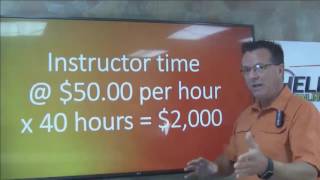
YouTube video (Kenny Keller) explaining typical costs to earn a helicopter private pilot rating. Presents ballpark overall figures ($10,000–$15,000 as a reasonable range; expect up to $20,000 or more), explains why costs vary (helicopter type, lesson frequency, study habits), provides an itemized example using $250/hr aircraft and 40 flight hours, and offers savings advice via Helicopter Online Ground School.
Questions this video answers
$10,000 to $15,000 (Keller calls $10k low and $15k more appropriate), with advice to expect up to $20,000 in some cases.
$250 per hour (example rate used to compute $10,000 for 40 hours).
40 hours of flight time (minimum cited in the example).
30 hours total (20 hours dual and 10 hours solo for the add-on example).
Instructor time could range from $25 to $100 per hour; Keller uses $50/hr as a ballpark average.
Chapters
What does it cost to become a helicopter private pilot? Get this question all the time, whether you're brand new or for add on pilots. I get asked all the time what's it going to cost me? I'm Kenny Keller, the creator of Helicopter Online Ground School and I'm going to answer that question for you right now. I'm going to break it down, going to cover the general cost of what it may or may not cost you. We're going to talk about why that cost varies. We'll then do a cost breakdown so you can see where some of these charges come from. Then I'm going to tell you how you may be able to save some money through this flight training. So I'm going to go with an average of 10,000 to 15,000. I think 10,000 is on the low side. Can you get it done for any less than that? Maybe, but I doubt it. I seriously doubt that you're going to get away for less than 10 grand. And I'm going to show you here in a minute why that is 15,000. I think that's more of an appropriate number. Could you spend more than 15,000? Absolutely. You could. Again, depending on some different factors. I tell people expect 20 and if you get done for less than that, then great, you know, be happy about it. But that's a general idea of more on the minimum side of what it could cost you. So as I mentioned, the cost can vary on many different factors and we'll go through a few of those. Number one, the type of helicopter used for training. The most popular helicopter out there you will see is the Robinson R22, by far the most popular training helicopter out there. There are others, it's not the only one. But the R22 is very, very common helicopter used for training. The R44 is a larger helicopter. That's a four place helicopter. These are available out there for training. This one's going to be a little more money than per hour than what the R22. And there's the instrument helicopter. You may find yourself flying an instrument. There's also Schweitzer and there's Brantley's. There's some other out there, but the Robinson really is the most popular. Schweitzer is another common helicopter that's used for training. Those are out there and they're all going to range somewhere in the area, somewhere between, let's say two to five hundred dollars. We're going to do an example here in a minute at $250. The 250 is a reasonable Number you can find a helicopter out there for 250an hour. Some maybe a little bit less. Not a whole lot less, some more or quite a bit more. The next big one is number of lessons per week. We tell people you want to fly at least three times a week. That really seems to be the best progress for people. If you only fly once a week, by the time you come back a week later, you're kind of catching up from where you were a week ago. It's just hard to make progress. And you can imagine over time you want to make progress. So going once a week isn't usually going to be the best. You can fly every day. But for a lot of people, that overwhelms you. And you don't necessarily make as much progress when you fly every single day. Not saying you can't do it, just saying that on average for your money, usually around three to four times a week is usually going to be best. Then I think the next one. Study habits and knowledge retention. You know, it depends on how well you're going to study and how well you're willing to study on your own. You can study on your own. You can work with your instructor. We have a helicopter ground school available. We're going to talk about it in a little bit. These are all the different ways that you can study and learn the information. Most people want to fly, fly, fly, fly. They don't really want to sit down and do the ground school. Instructors don't always want to sit down, do the ground school. So in turn, you end up taking more time to get the rating because you don't study. Happened to me. I failed my first checkride because I could fly pretty good. But the knowledge, the ground knowledge was just not there because I didn't want to study. My instructor didn't force me to study and he didn't want to teach me the ground school. He just wanted to fly. So now let's talk about the hours. I mentioned that $250 an hour, you're going to have to have a minimum of 40 hours of flight time. So if you use the example of $250 an hour to get that 40 hours of flight time, you're going to spend $10,000, no way around it. So if you get an aircraft a little bit cheaper than that, great. You're going to save a little. Could you be flying something that costs more than $250 an hour? This is absolutely. Yes. Now this is the 40 hours is for somebody brand new. If you're doing the add on, you still have to have 20 hours of dual and 10 hours of solo. So you still have to have 30 hours even if you're already a private pilot airplane. For example, if you're going to do the helicopter add on, you're still going to have 30 hours minimum. So, boom, there's 7,500 bucks in flight time on an average of 250 an hour. So let's talk next about instructor time. Instructor time could be as little as say 25 an hour, which is way on the cheap side. Some people charge as much as $100 an hour. So you could be anywhere in there from 25 to 100. As a general ballpark figure where you're going to be at. So if you figure instructor time at 50 an hour, taking kind of an average, and you did put that at 40 hours, there's 2,000. You're going to have to have the 20 hours of duel with your instructor. No matter which rating you're doing, you're going to have to have some ground time with that instructor to learn the knowledge. Even if you're learning on your own, he still has to check your knowledge and make sure you're getting through the information like you need to. So I put this at a round figure of 40 hours for the flight time and ground time that you're going to need to prepare for the test. So we're going to put that at 2000. Again, could be less, this one could be more. So next we'll move to the books. Materials, medical certificate checkride. I put those at about a thousand dollars. The books you're going to need, you're going to spend a hundred or two hundred dollars. Medical certificate is probably going to cost you around a hundred dollars to $200. The Checkride itself, pretty customary, they're around 500. There might be some guys that charge less than that. I've heard of checkrides as much as $800 for the private pilot rating. So again, 1000 is kind of an average. I'm figuring for books, materials, your medical certificate and your checkride. So boom, that puts us a total of $13,000. So again, what whether you're doing an add on or a private initial, the cost is going to vary a little, but it's still going to cost you a decent amount of money. And that's why I say 10 to 15,000 figure, kind of a minimum average. And again, I'm giving you kind of to the low side. The average person takes more like 60 to 70 hours to get their rating. Took me 88 hours because I was jumping around different helicopters, wasn't getting the ground that I needed. Part of that's my fault for jumping around and flying different aircraft and going different places. But the other part of it was never having somebody really sit down and go, look, we got to get through this ground school. So that's a lot of it too. So next you ask, how can you save some money? Well, you can save some time and money with our helicopter online ground school by learning the ground knowledge, we'll help you with the flight time. I kind of already showed you the numbers on the ground school. It all depends. An instructor can hand feed you if that's what you want to do. I had a student one time that I'm sure I spent over 100 hours of time on the ground with him. And this gentleman was a doctor and he was a sharp guy. But coming to the airport was his getaway time and he didn't really want to study that much on his own. He did, but he liked coming to the airport and he preferred just to be hand fed all the ground knowledge, which is fine. If you have the time and you want to spend that kind of money, you can. We also have people on the other end of the scale. One of our star students, Johan, did all the ground knowledge before he shows up at his flight school. And when he walks in to start flight training, they're blown away. When he comes in with pretty much all the knowledge that he needed, he blows instructors away, does his flying in three weeks and gets the rating. So the more ground knowledge that you learn on your own, that's going to help you in the aircraft and in turn help you save money with the flight time as well. So where do you go? You might be your next question. Helicopterground.com depending on where you're watching this video, the video link is probably down. Description box below might be above or beside the video if you're on Facebook. Depends on where you're at, but helicopterground.com is the place to go. That's where you can find our different membership levels. Private, commercial, CFI. And we also have special sections on the R22, the R44 and the instruments, so you can take a look at those as well. So if you're interested in help with Helicopter Outline ground School or with some helicopter ground school helicopterground.com Please give us a like and a share on this video. Any comments or questions, put them in the box below and we'll see you in the next video. It's.