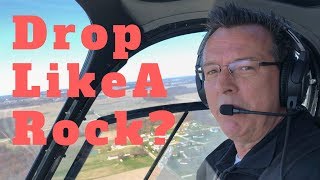
Kenny Keller and pilot Gary demonstrate how helicopters stay airborne during engine failure. When the engine quits, a freewheeling unit lets air flowing up through the rotor keep it spinning. They show the maneuver from entry through flare, landing safely near treetop level.
Questions this video answers
Lower collective, apply right pedal, and a little aft cyclic.
500 AGL.
About 70–75 knots (Gary: "about 70 on the airspeed" / later referenced as ~75).
Around treetop level, about 40–50 ft (per manufacturer guidance may vary).
Located in the upper sheave (disengages rotor from engine when RPM falls).
Chapters
Hey, It's Kenny with HelicopterGround.com. i'm the creator of helicopter line ground school. We're going to show you a presentation here on auto rotated descent that's going in our new private pilot section. So we'll get to that in just a minute. We just want to let you know that our ground school is being updated. We're putting lots of new videos inside the helicopter line ground school. So this is an example of a lot of stuff we're doing to spice things up and make our ground school that's really, really, really good. Even better. So let's get to the auto retain of descents. We're going out today. We're going to do a classroom presentation for you but we're going to do it from the helicopter. We've got that we're going to share with you up here on the screen. And this is compliments of our operations manager Brian Rutledge, who you probably know, or maybe not Neil, if you're new to helicopter land ground school. Brian Rutledge is our operations manager. He built a presentation for us on autorotative descents to add to the aerodynamics section. We're going to go out, talk about the presentation and then show you a.
Few things with the aircraft traffic. Helicopter 8626 Papa beyond right downwind for 28. Now extend until the airplane lands.
All right, auto rotating descents, autorotation descending and non powered flight with a little RPMs come from the upward flow of air. Right now we're flying along, getting ready to get set up for an auto. At the beginning of an entry to an auto rotation we're always going to do the same three things down collective right pedal and a little bit of aft cyclic. At the entry that airflow is going to change. When we go from forward flight to descending the airflow is going to change and start going up through the rotor system. Driving the rotor system, we've taken away the engine power, we start to descend. The upward airflow keeps the blade spinning, actually makes them speed up. So depending on what you're flying, you might be entering at 60 knots. 70 knots depends on the aircraft. What are you going to use today, Gary?
We're going to shoot for the Kenny.
Color method of 500 AGL and we're.
Going to shoot for about 70 on the airspeed.
All right, so Gary's going to enter around 74 minute traffic. Arrow 32622 is left base Runway 28, full stop. Plymouth. He'll enter the auto and we take the camera down to the RPM and show you how that usually will build just a little bit during the glide. In a straight in auto, in a 180 auto, during the turn, that RPM will always build and we'll show you that too before we're done. Somewhere around treetop level, 40ft, 50ft again, depending on what your aircraft manufacturer says, you're going to start a flare. That flare is to slow the aircraft down, to get ready to level it out and race the collective either to go to a full touchdown landing or to a hover. So as Gary's getting set up with this auto rotation, we're going to show you, we want to explain direction of air. During powered flight, the air is drawn from above and accelerated down through the rotor system. The engine is generating the rotor RPMs. During autorotated flight, the rotor system disengages from the drive system via the freewheeling unit and the unpowered ship begins to descend. The airflow changes direction and begins to move upwards through the rotor system, causing them to spin. Rotor RPM is now supplied by the upward flow of air. Okay, so we had to give way for an airplane. So we're going to cover another slide here as Gary's getting set up for the auto rotation. So you're going to have some type of a freewheeling unit no matter what aircraft you're flying. Different models have maybe different names or a different setup, but basically I think it was like a clutch in a car. Right. If you're driving a manual shift, you push the clutch in, the engine and transmission are no longer married. So in a helicopter, same thing. When we enter a lot of rotation, it's like pushing the clutch. The main road transmission is then no longer driving the rotor system. The rotor system is going to keep spinning from that upward flow of air.
Plymouth Traffic Helicopter 8626 Papa will be on final for 28 Plymouth.
The freewheeling unit located in the upper sheave. When the engine fails or when the throttle is closed in flight, the freewheeling unit disengages the rotor from the engine. Happens as soon as the RPM gets lower than the rotor rpm. Think of it like the rear hub of a bicycle. You can stop pedaling, but the bicycle keeps moving. Alright, so we're getting ready to do an auto rot rotation here. Then we'll come back and talk about the three regions of the rotor disc. We're flying along. Gary's getting ready. We have 500 AGL. He has about 75 on his airspeed, which is good. We can enter a Little bit higher than the glide speed that we want. So he's getting prepared. And when he enters, he is going to, he's going to lower the collective a little bit of throttle. He's going to pull just a little bit of aft cyclic and he's going to add some right pedal. We do this every time. All right, we're going to let Gary enter the auto rotation when he's ready. And our focal point is going to be airspeed and rpm.
One, two, three.
All the way down. Right pedal. Okay, now that RPM is going to build because we're no longer flying with the engine. We're flying with the upward flare air flow coming up through the rotor system. So he's actually raising collective a little bit because the rotor system wants to speed up. He's flaring now. He's going to level it out. Now he's bringing the engine back in and we're back into a hover. So there's kind of the elements of the auto rotative descent. And that's where we change from powered flight to non powered flight in that upward flow of air now going up through the rotor system.
Traffic helicopter eight six two six papa on the go.
28.
Try left traffic.
All right, so that was an excerpt from our helicopter airline ground school, the private pilot section. If you're enjoying our content, please go below and subscribe to our channel. Click that bell right beside the subscribe button so you'll be notified when we put out new videos. Please click the like button. If you don't like the video, click the like button twice. So go to the comments below and also let us know what your questions are. What are the things that you're wondering about? Autorotative descents. Put those questions in below and we'll answer those in upcoming videos again, like subscribe. We'll see you in the next video. 1, 2, 3. Sam.