Why This Helicopter Pilot Chooses The H269 / Schweizer Helicopter
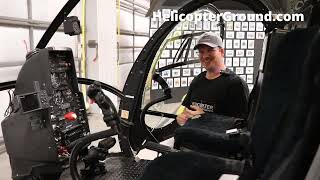
A pilot explains why the Schweizer 269 helicopter works for training and personal flying. The 51-inch cabin fits three people, the rotor is quieter and smoother than older designs, and the manual throttle teaches you to manage RPM yourself. It's been used by the military for decades and handles rough terrain well.
Chapters
All right, so first we're going to start with useful load. So in the 269, we've got a placard here that says that our max cabin weight is 600 pounds. So that's quite a bit, actually. But that's just the cabin weight. The max useful load, depending on the serial number of your aircraft and how it's outfitted, approaches about £950. So that's actually a significant amount of weight, and it gives you a lot of options as an owner or operator on how you can utilize the aircraft. So the second point we want to make on the Benefits of the 269 is longer flight times. So if you look at this, this is a pretty sizable tank. This is actually 30 gallons, and we've got one installed on the aircraft. But there's also a spot on the other side of the aircraft for an auxiliary tank to be installed, giving you potentially 60 gallons of usable fuel. And what that translates to is longer fly times. If you've got 60 gallons on tap, you can fly a significantly longer distance. And that's really helpful for personal use or during flight training. When you're doing your cross countries, during something like IFR training, where you've got longer cross countries, it gives you the opportunity to make longer flights without having to stop for refueling brakes. That saves you time for startup, shutdown, doing all your pre takeoff and landing checks, everything like that, and it saves you time at the pump. So longer flight times translates to save time in flight training, more efficient flight training, you get more done in a shorter period of time. One of the other benefits of the 269 is its cabin size. So aside from how much weight it can actually carry in the cabin, the physical size of the cabin itself is wider than most other training options on the market. Now, the 269, according to the PoH, has a cabin that's 51 inches wide. What that means is that depending on the aircraft, some of them allow you to remove the collective stick in the center here and and replace it with a seat, meaning you can carry upwards of three people. It's probably more realistically two adults and a small child, but it does present smaller operators the opportunity to perform tours or photo flights in the 269, which they can also use for flight training. That can lead to savings, as you don't have to have quite a large fleet of aircraft, but it also means that you can seat larger people. So that opens the door to people who are taller, that don't fit as well. In something like a Robinson, that is a very small cabin. Another benefit I want to point out as well, in conjunction with this, is that the pedals are adjustable in the 269. In the Robinson, they're fixed, and that works for most people. But this gives you a little more adjustability with those pedals to give you a little extra leg room for those of us who are longer in the legs. The fourth benefit of the 269 is the fully articulated rotor system. So if you look up at the rotor system here, we've got three rotor blades. One of the benefits to that is that it's a quieter aircraft. So in today's day and age, a lot of people make noise complaints. You hear people moving next to airports that have been there for decades and then complain about the noise. Well, fully articulated rotor systems, because we have three rotors, they're less susceptible to blade slap. That doesn't mean it can't happen, but it means that it's less likely to occur. And it's often less quiet or less. It's often not as loud, so it's quieter. Another benefit is the smoothness of the ride. So because we have more rotor blades in force generating lift, that translates to fewer vibration, and that means that the ride is more enjoyable for private owners and there's less fatigue on students when they're actually training the aircraft. So that can translate to longer training sessions if required. Another benefit of the fully articulated rotor system and of the 269, is that it is less susceptible to mast bumping. Now, mast bumping, we know, is something that is inherent with a semi rigid rotor system, and it's where the main rotor hinge itself can contact the main rotor mast and cause the rotor had to actually shear off of the helicopter. Since we have a fully articulated rotor system and all the movements of the blades within the rotor system take place with various hinges, that means that we're not going to encounter that particular flight hazard in the 269. Another benefit of the Schweitzer 300 or the 269 is that it uses a manual throttle. So a lot of other helicopters now in the training market use a governor which manages most of the throttle control for you. You as the pilot are still responsible to make sure that you're actually keeping the RPMs in your aircraft within limits, but the aircraft does a majority of the work. Now, on the 269, we don't have a governor. What that means for us is that we as pilots are directly responsible for maintaining where that throttle is set and managing our rotor rpm. The reason that's a benefit, even though it sounds like more work up front, is that it allows you, especially when you're learning, to manage those RPM and feel how main rotor RPM is directly correlated to tail rotor authority. And that's something that's often overlooked when you're flying something like a Robinson, which is still a great aircraft. But because it does so much of that work for you, you're less in tune with how closely those are connected. The 269, on the other hand, because you're responsible for controlling main rotor RPM allows you to learn very early on how to manage those RPMs and and how it directly affects your tail rotor authority. Another benefit of the 269 is its extensive military training history and military use in General. So the 269 was adopted in 1964 as the primary military trainer, often referred to as the TH55. It saw continuous use through 1988. So it trained literally thousands of Vietnam era pilots. And believe it or not, a derivative or variant of the 269 is still in use today in what's known as the MQ8B Fire Scout, which is a UAV that the Navy employs for off ship operations. So even though it's no longer the primary trainer for the military, it's still in use today despite its age. So it's a great aircraft, has a very long history of safe operation and turning out fantastic pilots. An additional benefit of the 269 is its high ground clearance. Between the cab and the ground itself. This is a benefit for things like off airport operations. Many POH's state a caution to be mindful of landing in tall grass because it poses a fire hazard if that grass contacts your exhaust. Now, because the 269 sits a little higher, it gives you a little bit extra clearance to help avoid that hazard. In addition, if you're landing riverbeds or streams or anything else that poses uneven ground or the need to clear higher obstacles, the higher ground clearance of the 269 gives you additional options for off airport landing areas. Another benefit of the 269 is that its cockpit layout is more along the lines of a traditional helicopter. So nothing wrong with the Robinson. We love the Robinson. It's a great helicopter. It's trained thousands and thousands of pilots. But some people don't like the T bar as much. In the 269 we have a traditional cyclic layout, so each side has a dedicated cyclic stick and that avoids the T bar in the middle. And it kind of gives you the feeling that you're in a bigger helicopter. It connects you more to the real helicopter experience that some people have. So this may be more of a perceived benefit, depending on what your preferences are, but it is actually a nicer layout. It gives you really that large helicopter feel, so that when you transition to a larger aircraft, you feel more at home. There's not as much adjustment that needs to be made when you make that transition. The last benefit of the 269 we want to cover today is that it's a basic trainer for the MD500. Now, although McDonnell Douglas or MD Helicopters doesn't make the 269 anymore, when it was designed, it was made by Hughes, who also designed the initial type certificate of the MD 500. What that means is that if you train in the 269, moving from this aircraft into an MD500, you'll feel right at home. It's the exact same cockpit layout. You'll sit on the same side of the cockpit. And this is one of the unique things about the. Or somewhat unique things about the 269, is that the pilot in command actually sits on the left side of the aircraft as opposed to the right, like you would on a Robinson. Same thing goes for the MD500, depending on how it's equipped. So that means you'll slide right in, everything will feel right at home. No differences or major adjustments you have to make. So for those of you looking to either move into an MD500 as a career move or that want to own an MD500 as a personal purchase, this is a fantastic aircraft to get your training in. It's been a while where he does the. Did you install that clapper? And, God, Morgan Freeman's like, no, but. Catchy jingle, isn't it? Clap on, clap off, Clap on, clap off the clapper. There's our blooper for the end of the video. Oh, man. All right, whenever you're ready. Clap away.










