Would You Accept Downwind Landing Instruction From Tower?
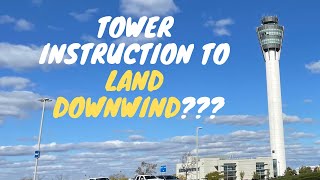
Kenny Keller walks through a real tower radio transcript where a pilot is instructed to land downwind, then explains why you shouldn't accept that clearance and how to request an alternative instead.
Chapters
Helicopter1 Romeo Alpha, do you want to do a touch and go on the Runway or on the taxiway of beam Atlantic?
Tell him taxiway, Beam Atlantic would be.
Fine, taxiway would be fine. Helicopter 11 Romeo Alpha.
Helicopter 1 Romeo Alpha, roger that. Taxiway Alpha Abeam Atlantic cleared touch and go.
I don't know where he's having us land. I tell you, I gotta be honest.
Yeah, I got it, you know. Yeah, Atlantic is where we had our mid flight base.
He's telling us to land on a taxiway. For what Runway?
Well, taxiway by Atlantic, that's, that's just the taxiway right by the fbo.
So we're just gonna pick a spot that's in the taxiway and land?
Yeah, okay, pretty much. Apparently they don't have a lot going on.
Okay, if they were.
Helicopter 1 Romeo Alpha, after your touch and go, are you gonna be staying in the pattern or departing somewhere else?
We'll be departing back to the south towards Plymouth. Helicopter one, one Romeo Alpha.
Helicopter one Romeo, roger.
There you go. Okay, just remember, I know it's intimidating when you get, when you, I mean you have virtually no experience with this and I'm over here going, ain't no big deal, okay? You sound confident on the radio and that's all you got to do. If you sound confident, they have no idea you're going, what, what, what? So just try to repeat the best that you can.
Is it etiquette to talk fast and mumble back to them?
It doesn't sound that bad. Okay, so, you know, the old timer taught me a long time ago, sound confident on the radio even when you're not. And it gets you a long ways. And that's true. So what we're going to do is, you know, he's just allowed us to touch and go because obviously there's nothing going on. Now if something changes and an aircraft comes in, he might give us a different direction. So right now we're cleared for the touch and go, right? Because he said it, he's not worried about us now we're helicopter, we're going slow. So something could change between here and there. So just keep on doing what you're doing. For right now. We're gonna go right past him when we're doing our approach down to the taxiway so he can see us, he.
Knows what we're doing.
And you'll see the tower when we're down there, if you don't see it already. And so it's all good, you know, I know it's new to You. And you're kind of going. But all you gotta do is talk to him and just basically tell them what you. What you want to do. And, well, you know how to do that.
You're a cop.
You've been talking on radio for 20 years. You know, it's. It's short, sweet, to the point, and get your point across in the least amount of words you can use and try to repeat the most important things that they say. You don't have to repeat every word. But a squat code, of course, is very important. You know, cleared to land, cleared for touch and go. You know, anything that's real pertinent, that in the interest of safety, if you forgot that they. Okay, so just be. Listen in case he gives us some other. Some other instruction. Do you see the tower yet?
Yes. That's not a very big tower.
No, it'll look bigger when we get down there. Atlantic is just past that, where there's a. Oh, okay. There's a couple planes sitting on a ramp. Yes, that's Atlantic. Okay, so that's where he's expecting us. That general vicinity is where he's expecting us to shoot an approach to. So if you even want to shoot it, just kind of beam the tower. That way he can see exactly where we're at.
And where's the. Like if we came up here and we just wanted to get out, Is there a pilot's club or.
Well, yeah, you can go into Atlantic. That.
He.
He said Atlantic. That's the fbo. That's where.
Okay.
Med flight's at. That's where they sell fuel.
Look after one Romeo Alpha. After completion of your touch and go, fly heading 090. Maintain VFR at or below 3000.
Clear. Touch and go.
Main 090 helicopter 11 Romeo Alpha.
Very good.
All right, Just a little bit of tower traffic there to warm you up for today. That question the title of today. What if you get an instruction from the tower to land downwind? I wouldn't do it. I've never had to do it. You can always request for something else and simply explain to them, hey, that's a downwind landing. Can we. Can I use a different approach? And we'll go more into that in a minute. I am Kenny Keller, creator of helicopter of helicopter online ground school. Heather is typing in chat right now. Heather's our member concierge. Her information is down below this video. You can text or call Heather. And we've got some special deals going on right now. Holiday. There's always some kind of special going on. You can get a hold of Heather, you can chat with her right now in chat. Her phone number is down below for the Hogs business line. Links down there to our site. Again, we got specials going on. So we had another great session with our one on one member today. And the last two of these or three of these, we went on for almost an hour. I'm going to make this kind of quick. I know holidays come up tomorrow, people want to get off and doing some other things. So we had another really good session. This was number five out of six and he started right off with study habits. He goes, you got kind of a theme going here. And he said, I want to tell you that, you know, the helicopter went down for maintenance and last week he thought it'd be up by now. Helicopter still down for maintenance. So he said, you know what, I did my Monday, Wednesday, Friday flight times since the helicopter was down. I made that my study time at home. So what time I would normally be traveling to the airport, I used that time Monday, Wednesday, Friday to sit down and study. And I said, great, right? And these are small, easy tips, but these are the things that make a difference. And the other recurring theme that keeps coming up is it's going back to basics, right? Making good use of your time. Helicopters down for maintenance. Go in and do ground one on one with your instructor or sit home and read a book, read the helicopter flying handbook, go through the poh or we're going to talk about that here in a minute. So study habits, having good study habits. And it's really about getting through the ground knowledge. That's what we do at hogs. Links down below for memberships. So number two, this came up, he did get to fly, but he flew in a different aircraft because his first aircraft was still out of service. So he got an opportunity to fly something else. And he said, wow. My instructor said, hey, if you can fly an R22, you can jump in about anything. And I, I was shaking my head going, yes, absolutely. And we went into deep discussion about what he flew and what he did. And, and I said, it's absolutely right. You know, people love to bash the R22. But all that aside, if you can fly the R22 and you train in the R22, it makes transitioning to other aircraft so easy. And that's something you hear in the industry, and it's the truth. So one benefit to flying in the R22 is it really trains you to where you can fly damn near anything. So number three, studying pays off. And I Could tell today from his, what he was telling me. His instructor noticed it. He's like, man, I don't know what you've been doing, but as soon as we get our aircraft back up, you're soloing. And the amount of things that he's been able to accomplish just in a few weeks time just by going back to basics, right? And all the stuff that we've talked about. And again, I haven't taught him anything earth shattering. It's been going back to basics and talking about the ground knowledge and hammering home. And I will argue this to my grave. It's 75% of the work of getting your license is the ground school. 25% is actually flying in the helicopter. That can be a struggle, but it's not as big as a struggle as learning all the ground knowledge. So he wanted me to mention that, you know, the studying pays off and you'll see it, your flights will go better, you'll make more progress when you are flying and in turn saves you money, impresses your instructor, makes you feel better. We harp on this all the time because we have to harp on all the time. People want to fly, right? We all want to fly. The flying's the fun part. There's so much more to flying than just flying the helicopter. And even once you get in a professional environment, many times, example ems, you spend a lot more time preparing pre flight and talking, you know, briefings. Spend so much more time talking about it than you actually do actually flying. He got his copy of the study guide. So we haven't had a whole. We've had some feedback, some great feedback, but this is the first member I've really spent some time talking with. And he got it and Heather had just walked in as he was talking about it and showing it to us. And he said, I have been through this cover to cover. I'm like, wow, you've only had it a short amount of time. And he said, I'm gonna go through this two or three more times. And he agreed. He said, man, the amount of stuff in here, amazing. And there's a link down below, I believe. If not after this video is done, after we get it going live, I'll make sure it's down there. But I'm pretty sure it is. It's been in all the live events. Events. So our member totally thrilled over his copy of the study guide. Again, it's over 400 questions and, you know, loves the study guide. That's what he said. He's like, dude. And I'm like, well, Brian did spend four months on this. Our operations manager, Brian. Brian Rutledge spent four months writing this. And then we had a bunch more time, you know, putting it together and getting the COVID and finding the distributor and all the, you know, things that went on in the beginning. So the private pilot study guide that is down below. And this member absolutely loved it. And he said, you know, all the things we've talked about, like one of the big ones, he said, don't let go of the collective during the hover. If you want to go to that one, Heather, I think that's number five. And I discussed this with Brian since. And he said, you know, in law enforcement, aviation, we don't do that. And it's so important for the slowing down, taking the time in the cockpit, and if you need to change a frequency or something, take the time, set the helicopter down on the ground and secure everything. Whatever you're flying, you're going to have different ways of securing the controls. They maybe you go to idle, whatever you do, make your frequency changes, get ready to go and pick back up. He was talking about that, and along with the next one is slow, smooth and methodical. If you want to flip to that, Heather, he said, you know what? I've taken the slow, smooth, methodical. And yes, I'm repeating what we've been talking about the last couple weeks. But he wanted to talk about how much it's made him progress in the aircraft, but by taking the time, slowing down everything, slowing down the startup, find a smooth flow with the checklist, practicing things where things are, finding them without touching or without looking down, you know, finding where stuff is. And he kept reiterating how much he's like, dude, the slow, smooth, methodical. And he just kept bringing it up, and it just made me grin because this is what we do in a helicopter. Nothing you ever do has to be an abrupt, you know, decisive maneuver, other than only I can think of is yes, in an R22, if the engine fails, you got to have that collective down in less than two seconds. We get that. But everything else you do, even emergency stuff, is nice, smooth movements. So let's go to seven and we'll go a little more into detail on this. And he started telling me a story, and this is why this one is one of them that jumped off the page, you know, in my notes and jumped off today. Our one on one session was going great. And when he started talking about this and, you know, for him just explaining to me what was going on, he gave me a Scenario of the tower gave him a instruction where he was going to have to land downwind and there were some different things that he could do. And him and his instructor talked about it and they somehow did something when they kind of hooked around into the wind and everything was fine. And so I jotted that down real quick. I'm like, I know I brought this up because this is one of the things that we hadn't discussed yet. And I know we have this in our free radio course that we have. I should put a link down below for that. I'll put that down below after we get done. Today we have a free radio course you can go through. And one of them that I like to talk about is sometimes a tower. If they're not real familiar with helicopters because some, some airports, helicopters are coming and going all day long and they're more up to speed on how helicopters operate. Sometimes you go to a tower or maybe they don't work with helicopters all that often. And our member is a fixed wing pilot, first has his private airplane he's doing his helicopter out on. So again, anytime you're a fixed wing pilot, I don't know how to say this other than airplanes are more forgiving if you're going to attempt a landing downwind, from what I understand, if it's just a few knots, you know, in an airplane, not a big deal. Moving over to helicopters, I don't teach downwind landings. Some people like to argue the point, say, oh, you should practice them. I don't. And I have found throughout my training and then in my professional career and all the different environments and things I've done, I've never been forced to down. I've never been forced to land downwind. Have I landed downwind? I have because I misjudged the wind and I noticed the aircraft acting kind of goofy on the approach and things a little shaking and things going on. And either I, you know, was able to just finish that approach or I went, oh, wow, the wind's behind me. I goofed and then do a go around, make change and come back into the wind. I personally don't teach downwind landings. I don't think they're necessary. I think there's almost always a way that you can manipulate that landing so that you're not landing with a direct tailwind. So when we were talking about this, I said, this is one I like to talk about. And if this isn't something that's in your toolbox yet, there is nothing wrong if a tower gives you. Let's say a simple direction like, yeah, enter a right base and shoot your final approach to the numbers two, eight, maybe. Doing that puts the wind directly behind you. And they're not doing that because they're trying to cause you problems. They're doing that because this is the flow of traffic and they're not thinking. And if it's a helicopter and you have a tailwind, it is acceptable. And there's nothing wrong with replying to the tower. You know, tower such and such, helicopter such and such. I understand your direction. That will be a downwind landing for us. Can we come up with something else? You know, however, you can simply get out to the tower that hey, that's a downwind landing. Can, Is there another approach we can do? Is there something else we can do so that we don't have to land downwind? I have done this and I have never had a tower get snarly with me or get, you know, get mad about it or there have always been really good when you just come out and just get to the right, to the point, say, hey, you know what, that's a downwind for us. I really don't want to land downwind. If I could do something crosswind or approach into the wind, what else can we come up here with? There's usually a ramp or a taxiway or a large, large grass area somewhere. That's why we fly helicopters, right? We fly them because of their ability to land anywhere. So let's say nine times out of ten if they give you a downwind landing instruction, it's probably going to be pretty easy to change that and just ask for something else. Of course, don't be rude about it. And might there be an instance where you just have to do that? I suppose there could be. We could go on and on. You know, there's millions of scenarios on what, you know, could happen in any style of a landing. But when they're, they just might not be thinking about it again. I had a. I'll throw another one in there. When you're talking about tower. I flew tower Tower Airport once where I thought they understood the difference between air taxi and hover taxi. And I had a controller kind of get snarly with me because I think he said clear to hover taxi across the Runway over to the fbo. So he was confused and he thought, I thought, hover taxi, we know what that is. Three to five feet above the ground, speed of a brisk walk, you go across, right? And guys, I'm trying to remember now how we got confused but it was like he was like, I told you to hover taxi. Well, I am hover taxiing. But he, in his mind, he thought a hover taxi was an air taxi where you're flying a little faster and a little more airspeed. So there are times where if a towered environment isn't real up on the helicopter environment, sometimes it can kind of get you into trouble. So you just always have to be ready to ask for something different. And don't be afraid. You're a pilot in command. You know what the aircraft can and can't do. Don't be afraid to politely ask for something else to do. And we're going to cover one more thing. The last one is lte. And this came up in the conversation just through our, our nature of talking about things. And so I wanted to hit LTE today. A lot of times I wonder, sometimes I wonder if we hit LTE enough. You know, we hit selling the power vortex ring state really hard and we hit low G and auto rotations, losing your engine. Do we always hit lte? You know, as much as what we need to. So, you know, if you haven't reviewed LTE lately, I highly recommend that you review it whatever shape or form or fashion Helicopter Flying Handbook or one of the HOGS videos or whatever you want to do. But the main thing that we discussed, and again, him as a student pilot, I just asked him some questions. Like I said, what would you do? Let's say you're out with your instructor and you're doing some training and you ended up on the other end of the airport because you thought you were going to take off into the wind and you guys decide to end the flight for whatever reason, and if, when you turn and you're going to taxi back to the ramp at your hangar, but it's like half a mile, 3/4 mile down the other end of the airport, are you going to. When you've got a pretty heavy hefty tailwind, what are you going to do? And he started to give me an answer which was appropriate. I go, but just think, this is where you want to think about sometimes not putting yourself in that position. Why fight going all the way back to the hangar with a tailwind behind you and the whole time and you're fighting that tail and you're wearing yourself on the pedals and it's going left and going right and you're working the heck out of the pedals. What comes to my mind is if you keep above 30, you won't get into LTE why not do like, if it's appropriate to, let's say it's a class G airport, do an air taxi, take off into the wind, get your 50, 40 or 50 on your airspeed and your, you know, say 60, 70, 80ft of altitude and do a circle, come around and land back into the wind. So with the lte, it really is about avoiding lte. You know, he understood the three winds. When I asked him, I'm like, what are the three winds? He knew that. He knew the directions. He was giving me the numbers and giving me the names of what they were. And I said, you know what, that's awesome. That's great that you've memorized the numbers and you know what each one is called. But it's a thought process of if the wind is quartering off the front, the wind's going directly into the tail rotor, the wind's behind me. This needs to have me thinking, you know, I'm in a position here where I could suffer lte. If I'm going to be at a real slow airspeed, maybe you can do something different. Like I just mentioned, if you keep 30 on your airspeed, you're not going to get into it. And I asked him, I said, what do you think is really the kind of key? Let's say you're in one of those environments where you just have to get the aircraft from right here and you have to get it over to there and it's a short distance away and, you know, you're going to be fighting that tailwind to get over there. And through the discussion, he got to what I was looking for, which is staying on top of those pedals. If you go, okay, I know I've got this wind, that could be a danger of lte. I'm going to have the wind behind me, it's gusting, you know, and it's, it's a pretty heavy duty wind. I have to get over there using good control inputs and staying on top of those pedals and managing that. Going low and staying slow is going to help you get to that spot without getting into lte. The problem is a lot of people want to hurry up, right? It's like, you know, you got to get from here over to there. You don't really have any other choices. And that wind's kicking your ass from the behind, right? And you're working hell as pedals and you're, oh, my God. So what they do is they start going faster and they start going faster, and they start going faster with more Wind behind them, that's not a good idea. You're making the workload higher and keeping yourself in that danger area. So by using good pilot technique, staying on top of those pedals, making sure you're using really good control inputs and not letting the thing get too far away from you, staying ahead of the aircraft and using good technique is absolute key. So I promised Heather we were gonna make us a little bit shorter today because I know I'm getting tired. Been a big week. We got specials going on. Contact Heather at 574-767-1767. She can work you up some deals. We have the one on ones. This is going really, really well. We have a professional pilot package that's unlimited, where I'll do six one on ones with you. Though it's a limited time offer. Daniel can set you with those, his links down below. He can talk to you and kind of pre qualify you ahead of time because depends on where you're at, it might not be absolutely right for you at this moment in time. So that's going really well. I want to do some more of that and we promised to give away a study guide today. I do want to answer a question. What's the question?
But Johnston said, kenny, I'm a rusty helicopter pilot for about eight years, restarting my career in Prescott, Arizona, relearning at higher LA. What can I expect at the age of 63?
Get in there and do it. At 63 you've already, you're already helicopter pilot. So it's been six or eight years. Very quickly, in my mind, I go back to when I was flying ems. I flew with a retired Navy pilot and he hadn't flown in a lot of years and I can't tell you how many it was. But I know that when he went to work at our EMS base, they had changed the airspace classification since he'd flown last, right? And this was like 10 years ago. So that means he hadn't flown in quite some time. And the flying came back to him very quickly. He went out for an air interview flight and he did well enough that he got hired and his struggle was legitimately the knowledge. So I wouldn't worry so much about the helicopter. I think the helicopters are going to come back. I think getting in the aircraft with a dual or with a dual, with a CFI and start bringing that memory back, bringing those, you know, inputs back and that muscle memory, I think it will come back. I think you should probably use whatever form that you would like. We would of course encourage you to join helicopter Land ground School and go through a refresher. I'd go through and refresh everything. Why not? We have a simple monthly option that's pretty darn reasonable and is really reasonable right at the moment. It's like 30 bucks off between now and then. A Black Friday, I think it's 67 bucks a month. And any of our current members could switch to that if they want to do it real quick. You don't have a lot of time. The knowledge man. I think if you haven't been in eight or six or eight or 10 years, start with the knowledge. Start refreshing your knowledge. Get yourself a helicopter flying handbook. If you don't have the latest version, you maybe you've got a rotorcraft flying handbook or well, the older versions. Get the new helicopter flying Handbook. A new one came out in 2019 with some updates. You get that free from the faa.gov I'd start with the helicopter flying Handbook. Start freshening up that knowledge. Use an online course, you know, preferably helicopter on ground school links down below. That would be my advice. Get back in it if you want to get after it. We have people getting their ratings, ratings in their 60s and their 70s and we absolutely love it. And we have. I don't know if you're new to our channel or new to our story. We've been putting highlighting members on the wall. We just had a member at 67 get us private. We had another one at 62 get us private. And I think there's a third one in there on the last couple months of guys that have got their ratings in their 60s. So there's guys going out and doing it, getting their initial rating at 60 some years old. And our oldest we've had I think is 72. Gentleman bought a jet Ranger and got his private and his jet ranger at 72 years of age. So I wouldn't sweat the, you know, being in your 60s, sure it might be a little bit harder for us to learn things now. But you know what? If you want to do it and you put the time and your effort into it, I think it'll come back to you pretty quick and especially by just brushing your knowledge up first then jumping in with a cfi, going out and getting flying. Hopefully that's a good answer for you. So let's see. Let's pick a. What should we pick? Let's see if we can do a weather. What's a weather question? We can do. What's a good one? Let's see. Oh, let's do an easy one. Let's do an easy one. Okay. This question is to give away the new private pilot study guide. Heather will ship this to you direct. So after you win today, you will need to email heatherelecopterground.com heatherelopter ground.com she'll go online, get one of these, order for you and we'll ship it direct from the publisher. So this is an easy one and you're going to type your answer in the chat. Now, we always have to say this. Depending on how your feed's coming up, we pick our winner. By the way our chat shows and we know for a fact now people's devices will look different from one to another. Joe will say, hey, I was ahead of Tom, but on his chat we, we have to go. By the way our chat shows up. We know for a fact depending on your device and where you're at in the world, it could show differently on your chat. So the first person to answer this very simple weather question is number one in the weather section. We have them all tabbed, by the way, we have airworthiness requirements, certificates and documents, weather information, airspace performance limitations, operational systems, cross countries. General Aerodynamics operations manager Brian Rutledge spent four months putting this together with over 400 sample questions that you could be asked. So this one's easy. Get ready, start typing. Every physical process of weather is accompanied by or is the result of what I'm looking for. Two words. If you get the first word, we'll call that good enough. And I'm going to show Heather what the book says so she knows. Yep. All right, so while we're wait, we know that YouTube lags by about 30 seconds for us from the time I say something before it shows. So I'll just rattle here for another minute while we figure out who the who the winner is. So remember helicopterground.com we have a 24 hour test flight on all of our monthly memberships. You can go in, take a look, it's not for you. Unsubscribe and you're build nothing. We part as friends. We have 24 month ProPilot specials. On HelicopterGround.com we have an unlimited pro pilot special that's pretty darn cheap right now it's on the website helicopterground.com we've got one that's just propilot. You can keep the training, it never expires. So if you're going the professional pilot route and you want to have the training for two, three to four years, took me four years to get off the street to see if I and then we have the big one that you have to talk to Daniel about and see if you qualify that one. I'll do six one on one sessions with you. Right now I'm offering a flight in the H269 helicopter. If you want to travel to Indiana and go for a flight with me, do some checkride prep or just come experience the used helicopter. Do we have a winner? I'll accept either. Whoever's first. That works. So it's Roger, Roger C. You are the winner of the private pilot study guide. Heather will jump online and order it. We will be shipping that by the post office so it might take a little bit time to get there. The last one I gave away one last week. One last week that I ordered just because I wanted to see make sure that they were still shipping and showing up in nice boxes and nice packaging. It took me what probably two weeks to get took a little bit. So it's coming by the post office and we know right now with the world being short on help, particularly the post office because believe me, I've had some nightmares on shipping this past six or eight months. So be patient. She'll get it shipped out to you. Email heatherhelocopterground.com and she can take your. You can text or call Heather seven days a week at 574-767-1797. She's our member concierge, can answer pretty much all of your banks questions. She can help you switch with a membership ask questions. She's been doing it almost four years now. So she's pretty much. She's got the lingo down. When I listen to her communicating with people I'm like dang, you've caught on to this in the last four years, haven't you? She knows the what it takes for people to get ratings and understands add on ratings and moving from fixed wing to helicopter and so on so forth. So all right we're wrap it up because it's going to be holiday tomorrow. Thanks everybody for tuning in. Any other questions, Anything to say before we go?
Well, Captain Carter asks if you have any tips on technique for pedals in R44s.
We discussed that today with me and my one on one guy. Relax. And I say that because I can remember the last time I had an R44. I was using a little while for a lease and because I wasn't flying it all the time I jumped it on a real windy day and I remember over controlling the pedals and even though I Was a cfi, been flying a long time. You jump on a different aircraft and you let that overwhelm you and you get a little nervous and you're not breathing and then you start over controlling. And I can remember a specific day jumping in the R44 with my daughter, kind of a high wind day. And I'm like, ah, you know, no big deal, I'll be able to handle this. But I can remember picking it up and getting out on the taxiway and going, whoa, like, wake up here. Get back on top of those pedals. Good advice. Anytime you're having trouble with pedals, I go back to what I had in the beginning. I remember struggling with the pedals and when you put too much thought into it and you're looking down, maybe looking at your feet and you're thinking about torque and this and that, and you're going getting crazy with pedals and you're over controlling again. The simple tips are the best. Adrian, thanks for this tip. Twenty some years ago, I remember Adrian going, you're over controlling on the pedals. I'm like, I know. And I like, you know, making a big deal of it. And he goes, here's the thing, just do whatever it takes. Just push the damn pedal, you know, and it sounds simple. Just push the damn pedal. But. And it made sense. He's like, you're overthinking it. You're getting overwhelmed. You know where the nose needs to be. Push whatever pedal you need to get the nose where you want it. So quick, couple simple tips. Normally when people are struggling with pedals, it's over controlling. And tell me this, are you finding yourself where you've got that kind of. It's not a death grip, but you got your legs all tense on those pedals and you're doing this. I know exactly what you're talking about it. I haven't flown an R44 in a while, and I'm going to plan to go to California this winter. And Dave Faulkner, one of our Hogs fans, going to get me current R22 and R44 just for fun, in case I get a chance to fly one. And I'm sure when I pick up that R44 for the first time, I'm going to struggle with those pedals until I go take a big deep breath. You're not a student. Push the pedal, relax the legs, breathe in and out and do what it takes. That's my best advice on pedals. Anything else? No. One last thing. Weather's changing in our area of the world. Making weather good weather decisions is key. Being able to say no. Understanding, you know, doing a good pre flight and doing your weather check and we've all done it and we all do it and you want to go, you want to go, you want to go. But something inside of you is telling you shouldn't you need to stay on the ground and fly when the weather gets better. Put off to another day, wait till later in the day, whatever the case is, when you know the weather not good or they're forecasting ice or whatever these bad things that get us into trouble. Remember to stay on the ground. Hogs no Go button. We send these to their member to the members when they pass their checkride. If you're new to us, there's a great big wall behind me called the Hogs Wall of Fame. You can't see it right now because we've got some stuff moved around due to helicopters coming in. We were going to go Friday got delayed. Looks like we're going now next week. So anyway, the Hogs Wall of Fame is back there and you'll see it again soon. Our members are up there and we send out the no go button when you pass your check ride and send.
Us your picture live to fly another day.
Helicopterground.com all right, thanks everybody for tuning in. Have a Happy Thanksgiving and we'll see you in the next video. Peace.










