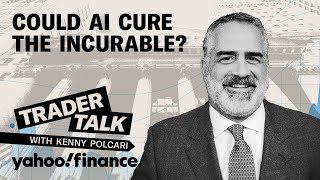
This is a Trader Talk (YouTube/podcast) interview (host Kenny Polcari) with Amir Heshmatpour (Executive Chairman & President of NEON Technologies, ticker NTHI) about NEON's business and the broader market context (index inclusion). Key points from the content: NEON Technologies is a NASDAQ-listed, USC-affiliated brain cancer/CNS platform with ~176 patents and four clinical trials underway. The company went public via direct listing on March 26, 2025, and completed/syndicated approximately $70 million (equity, debt, and equity line). NEON was added to the Russell Microcap index, which the hosts discuss as a liquidity/visibility catalyst. NEON announced a planned $50M partnership/deal with a UAE family-office-backed vehicle (Neuromina / Neurocure): the counterparty will buy $35M of NTHI stock at $25/share and operate a clinical-trial arm in the GCC/North Africa region. Lead asset Neo100 targets adult GBM (grade 3/4) with intranasal delivery that bypasses the blood–brain barrier; the FDA-required Phase 2A enrollment is 25 patients (NEON enrolling 30 to allow for attrition), with ~12 U.S. sites and parallel enrollment planned in the Middle East; Cleveland Clinic is involved as a major site and CRO support is mentioned. Management expects full enrollment of the lead asset by September and a near-term readout; they emphasize safety, quality-of-life benefits, and nasal inhalation dosing. NEON positions AI and quantum computing as strategic tools (via USC partnership) to de-risk and accelerate biotech work. The transcript includes repeated lines and a non-financial-advice disclaimer.
Questions this video answers
March 26, 2025.
About $70 million (equity, debt, and equity line of credit).
Over 176 patents worldwide.
Four clinical trials.
Russell Microcap index.
Chapters
Foreign.
Welcome to Trader Talk, where we dish out the latest Wall street buzz to keep your portfolio sizzling. I'm Kenny Pulcari coming to you live from the Yahoo Finance headquarters in the heart of New York City, a global hub where deals are made, fortunes are built, and the next market move is always just around the corner. Next, I'm going to share my big take on the index inclusion this week and sit down with Neon Executive Chairman and President Amir Hashma Patour and share my grilled ribeye with Arugula and Grana Padano. Hold on now here we're going to jump into the big take. Everyone gets excited when a small or mid cap company announces its inclusion in a major index, but most investors miss what's happening under the surface. Index inclusion is more than a gold star or a line in a press release. It's a seismic shift that can change everything for a company's future and anyone holding the stock. Why? Because when a stock is added to a significant benchmark like the Russell S and P or NASDAQ Index, it's not just analysts and retail traders taking notice. Suddenly, passive index funds and ETFs and pension plans and institutional giants are required to buy in billions in new money start flowing no matter what the company's latest earnings said or whether Wall Street's talking about it yet or not. The result? Volume spikes, trading spreads tighten and volatility often drops. What used to be an obscure, thinly traded can now become toe to toe with the market's heavyweights. For the companies, that means access to more and cheaper capital, better visibility and sometimes a permanent upgrade in valuation. For investors, you're playing on a bigger field with more players and liquidity. That's a massive edge if you know.
How to use it.
But here's the catch. Index inclusion can become a hype cycle with the crowd piling in to front run the fund flows. If you're chasing the move without understanding the company's fundament, you're gambling, not investing. The real winners are those who recognize the shift but stick to their process. Liquidity and attention can turbocharge a company, but execution keeps it in the index for good. Bottom line index inclusion isn't just a feel good moment for the management. It's the most potent catalyst companies will ever experience. If you're serious about finding the next breakout story, follow the money, watch the inclusions and respect the flows. But never forget, the fundamentals will keep you in the winner's circle even after the party ends. Joining us today is Amir Heshmatpour executive chairman and president of Neom Technologies, a Nasdaq listed company symbol NTHI. He's got more than 25 years of leadership experience across business, development, finance and mergers and acquisitions. He is the founder of AFH holdings, an advisory and consulting firm where he has led over $1 billion in IPOs and more than 5 billion in private funding and merger and acquisition deals. Amir previously founded and built Metrophone telecommunications into a $100 million company through 17 acquisitions. He's a founding partner of H and H Funding and has served on the UCLA Anderson School Management Board for over a decade. Please welcome Amir and joining me on today's podcast, Amir, it's a pleasure to have you. I appreciate you joining us today. I want to learn a little bit about NEON Technologies. Before we even talk about the questions I have, let's tell the audience about NE Technologies and who they are and why they should be paying attention.
Thank you, Kenny, for the intro. So NEON Technologies is a NASDAQ listed company under NTHI. We're the largest brain cancer CNS platform out of USC KEG medical school. We have over 176 patents worldwide with four clinical trials going on currently throughout US and we're expanding our footprint throughout Middle east and soon to be in India.
And now you guys went public in March of this year, correct?
Correct. March 26th. We went public on a very tough day and we did a direct listing. We circled about syndicated about 70 million between equity debt and equity line of credit.
And it was a tough day because as the listeners and viewers might remember, that was just about the time we were entering a liberation period. Markets revolving, volatile, they were under pressure. Yet you brought, you came public late March.
Yes, we came public March 26th. The market was down 600 points plus.
Not pretty.
Yeah. We are hoping that the 18 traded up to 25 and trade it down before the bell closed. But it's been quite the ride since the ipo.
It's been an exciting time, but certainly quite the ride. And the market gets smashed in the weeks after. Which didn't help, right? I mean is all that nervousness kind of got exacerbated. Exacerbated exaggerated with Liberation Day. Right. But anyway, that's all, that's all behind us. But what I'm fascinated about is in that short period of time, I mean this is only, this is basically August 1st, you've now been added to the microcap, the Russell Microcap index. Am I right?
Yes.
All right, so to you, what does that mean as this company now joining the index and the visibility, especially for.
The investor base, incredible visibility, credibility. A lot of institutional investors will be looking at us and they should be really paying attention to us. So like you indicated in the beginning, visibility, credibility, liquidity and index is holding us. If you look at performance of companies that have been added to the index 12 to 24 months out, they end up doing significantly better than when they entered. When they entered. Right. As long as all they're executing, gotta execute end of the day. Like it's not an automatic right. You know, with us, it's a pre revenue biotech company in clinical stage. So we have to enroll and we have to have positive FDA readouts. So that's the business we're in.
That's really the game for you, right? As a biotech company, that is actually the game you're in, Right. You're doing all these trials and you're waiting, awaiting for FDA approval.
Yes.
But now, you know, recently you made an announcement about a partnership with Neuromina, which is out of the Mideast. I believe we can talk about that, but how does it. It's a $50 million deal that you're using to expand your kind of your global footprint and accelerate your clinical trial program. So talk about that and where you see that going.
My background is corporate finance and structuring deals. I structured the deal with a very large family office out of UAE that manages approximately $3.3 billion. The deal's at $50 million. They're buying out of the 50 million, they're buying 35 million in stock of NTHI at $25 a share. We're going to sublicense our technology there. Once we close on that $50 million, they will own the majority of Neuromina, which is the investment arm. Right. And Neuromina is doing a operational company called Neurocure, which will be the clinical trial arm. They will run parallel path with our enrollment throughout our US sites, which we have about 12 sites and they're indicating that they will enroll about 10 to 15 people with brain cancer throughout GCC and North Africa.
Right. And does this, I'm curious just for myself, are these the people that enroll are children or adults or does it make a difference?
So we have four clinical trials. Our lead asset, the 100, is for adults that are suffering GBM. Brain cancer.
Brain cancer. Right. So let's talk about that, because the Neo100, what should investors expect from the results of these Neo100 clinical trials?
So I expect our readout to be positive. This is not a double blind test, unfortunately. Everybody that is on our medication, Neo 100, our grade four and grade three patients. Right. They are doing very well. Our Gantt chart, which shows progress, is showing about 21.5 months. We're extending life additional months, additional additional months. And it's very safe. Side effects are very minimal, if any, and quality of life is very good. They're not going into a hospital, getting chemo every day and so on. They're inhaling the drug at the comfort of their home.
Right. So I was just going to make that point. The drug is delivered intranasal delivery, which means they're inhaling it through their nose because then it bypasses the blood brain barrier, right?
That's correct. So it is a inner nasal delivery, non invasive intranasal delivery that bypasses the blood brain barrier.
Right.
So precision medicine directly to the tumor. They do it three times a day. Our cycle is six months. So we have to enroll in phase 2A. We have to enroll about. FDA required us to enroll 25 patients. We're enrolling 30 patients because some people unfortunately do fall off and pass away. Unfortunately.
Hold the line there. We'll be right back. Okay, so let's just pick that up from where we left off. You talk about, just so the audience understands, you mentioned grade two, grade three, grade four patients. That's just the level of sickness apparently, right? Grade four being. Being very sick.
Yeah. Grade four is basically, unfortunately, nothing has worked. Standard of care medicine hasn't worked.
Right.
And you've been basically sent home or sent to a hospice to pass away, unfortunately.
Okay, so let's talk about something else that I think is very important, and I think for investors it should be important, is that a lot of these early stage biotech companies are turning to AI and technology to help them, to help them manage, create trials, create, you know, help define the medicines. Explain to us how AI is impacting Nionic.
So I think AI is going to have the greatest impact on biotech sector. It is going to be a game changer for biotech. You're going to be able to cure a lot of uncurable diseases. You're seeing Jensen Huang from Nvidia every time he talks about, he talks about the impact on the biotech sector. There's a lot of biotech companies that are trying to de risk their clinical trials through AI. But it's not just the AI, it's also the quantum computing that you need, that power. It's not just the AI.
Right.
And we're kind of blessed to be partners with usc, KEG Medical School. This getting into these AI and quantum computing services is extremely expensive. We've been talking and negotiating with some big providers. It's enormous amount of capital that you need to throw at it.
Right.
And a small biotech company, we don't have the resources to push the clinical trials forward and implement that.
Right.
So we have to think wisely and for us to do that, like I said, we're very lucky to be a partners at the KEG Medical School. We're going to be able to do things at that school that most of these biotech that are outside of these university environments aren't going to be able to do. Right.
So then, so then let me ask a question. What's your vision for Neonic for Brain, this brain cancer platform over the say the next 12, 18, 24 months?
Our vision is what we've been doing. You know, Kenny, we went public on the 26th of March of March. We did it through a direct listing. My background, my experience. I've been involved in many public companies, from private to public. We made it into Russell. We're going to finish our enrollment like we announced to the investors. We will be fully enrolled in our lead asset by September. Right. And we're going to have a readout. Our binary effect is right around the corner. And like I indicated, this is not a double blind test. We're seeing the data. We're going to read out. I think the stock will move between the Middle east transaction at $25 a share.
When does that finalize that transaction?
We have four contingencies left. Board approved the deal last week. We have the definitive deal should be hopefully signed within the next week or the transfer of the license. We're negotiating with USC Medical School and USC Steven center for Innovation the license to be transferred to that entity. The biggest time that's going to take is putting these two entities together. It's not like us putting entities together. And since this is a entity that's doing human clinical trials and UAE is the first mover in that space in that part of the world, they're really thinking out of the box. You weren't able to do clinical trials till recently that are not approved in US or the European Union. So we're the first company to do trials in UAE for brain cancer.
Right.
That entities will take some time. Norton Rose is Norton Rose, Fulbright Stern are entities. They do a lot of due diligence on the people and KYCs and so on and so forth.
But be clear so the audience understands that while these trials are taking place in the UAE. They're operating under FDA U.S. standards. Am I correct?
They're operating under U.S. fDA standards. They've been very smart the way that they're doing it. They brought in Cleveland Clinic to run the clinical trials for them. They have a CRO called M42 which is a part of Mobadila Companies, one of their sovereign wealth funds. And they're very smart about the way that they're doing it. And so Cleveland Clinic happens to be one of our largest sites. One of the neurosurgeons out of Cleveland Clinic sits on our board of our scientific committee, Dr. David Pierboom. So the stars lined up for us. We've been trying to do this for some time, end up part of the world. And yes, stars lined up for us, for us to do this.
I think it's fantastic. It's been a great story and it's a new story. Right. You're only six months old so far as a publicly traded company, but there's a lot going on there. And there's a lot going on clearly in the space. And like you said, biotech is at a point now where it's really starting to once again take center stage. And companies like this, with visions like yours I think are leading that pack.
Yeah, you're absolutely right. We're less than six months old and I think investors should take a really hard look at us. I think we will be a great debt for them. It's a long term.
It's a long term because currently you're in the Russell microcap index, is that correct?
Correct.
Right. So it's a long term, but there is an opportunity there.
There's long term, there's an opera, but we're implementing everything as we are going to be moving up Restream as far as market cap, we've hired the firms to implement the Sox 404. We're putting all the checks and balances in place, all the weaknesses that you saw in our S1. All that will be out of the way before the year end.
Right.
So we're implementing everything to grow. Right. If you look at my previous track record, everything I've touched.
Your previous track record is amazing. Everything you touch turns to gold. I mean, it's really unbelievable.
That's. I, I dedicate all my time to these businesses and, and this has a special place for me. My, I've lost a family member for brain cancer, so.
Right. Yeah, yeah. And listen, cancer touches so many lives and brain cancer touches as many. And so it's work well done. And so I applaud your efforts here and I look forward to watching as this company grows. And I look forward to staying involved and having you come back again to bring us up to date six months from now and tell us what's going on and how it's all working.
I would love to come back to the show. You're a class actor.
Thank you. All right, so now it's time for dinner. So we're going to feature the grilled Ribeye with Arugul and Grana Padano cheese. The dish is inspired by the tagliata di manzo, a rustic Tuscan Mexican preparation where a grilled steak is sliced and then served over peppery greens, often with parmigiano or grana padano. It's all about the balance rich marbled beef contrasted by the bitterness of the arugula, sharp red onion and the bright acidity of lemon juice. The standout ingredient here is the grana padano. It traces its roots back to the 12th century, when Cistercian monks in the Po Valley developed a technique to preserve the milk. It's a a cooked, slowly aged cheese like Parmigiano, Reggiano's cousin. But grana padano is slightly milder, less salty and more affordable. It's beloved for its crystalline texture and nutty finish. It's perfect for shaving over warm steak or salad. You can scan the QR code on the screen for the full recipe and you can thank me later. In the meantime, that's a wrap for today's Trader Talk, but the conversation continues. Subscribe on Apple, Apple Podcasts, Spotify, Amazon Music or wherever you get your podcast. You got questions or topics you want covered? Email us@tradertalkahoo inc.com because I'm always listening. Until the next time. Stay sharp, disciplined and stay in touch. Take good care.
This content was not intended to be financial advice and should not be used as a substitute for professional financial services. It.