CoreWeave leads AI infrastructure stocks poised to surge
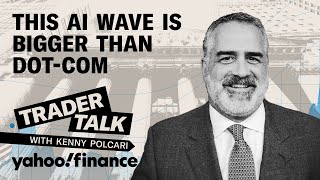
A YouTube episode of Trader Talk (host Kenny Polcari with guest Michael Lee) discussing AI infrastructure investment themes—particularly CoreWeave and Nvidia-driven GPU demand—valuation frameworks (PE ratio limitations), macro positioning (growth vs value, Fed outlook), and risks (energy grid, geopolitics, regulation). The hosts give bullish views on AI infrastructure growth and specific forecasts for CoreWeave's revenue and stock trajectory while advising diversified positioning. Also includes a brief culinary segment (Giambotta recipe).
Chapters
Foreign. Welcome to Trader Talk, where we dish out the latest Wall street buzz to keep your portfolio sizzling. I'm Kenny Polkari coming to you live from the Yahoo Finance headquarters in the heart of New York City, a global hub where deals are made, fortunes are built, and the next move is always just around the corner. Coming up, I'm gonna share my big tape on the hype around the PE ratios. I'm gonna sit down with my very good friend Michael Lee and and I'm gonna share my Giambatta recipe. Now let's jump into the big take. If you've spent more than five minutes around the stock market, you've heard of the PE ratio. It gets tossed around on tv, in the headlines and on every stock research site like it's gospel. The stock is cheap, its PE is only 10. Or it's overvalued. Look at the sky high PE. But here's the truth. The price to earnings ratio is a helpful starting point, not the whole picture. So what is the pe? It's simple. You divide the price of a company's stock by its earnings per share. If a Stock trades at $100 and it earned $5 per share, its P E ratio is 20. On paper, that tells you how much investors are willing to pay for a dollar of the company's profits. A lower pe, the market thinks it's a bargain. Or maybe it's a value trap. A higher pe. Maybe investors believe in massive future growth. Or maybe it's a bubble. The catch is that the PE doesn't tell you why. Sometimes a low PE means a business is in trouble or it's shrinking. Sometimes a high PE implies the company is a proven growth machine and investors are happy to pay for it. The PE ignores debt and future risks. Sometimes accounting tricks or one time events can distort. The pe. Pros know that a PE is just the tip of the iceberg. They compare it to a company's history. They compare it to industry peers and broader market conditions. They dig into the E as much as the P, asking if those earnings are sustainable, repeatable and real. To fill the story, they look at growth rates, margins, debt and cash flow. The bottom line? Don't let a single number make up your mind. The P E ratio is a helpful snapshot, but it's only one lens. You use it as part of the total story, not the whole story. A clue, not a conclusion. Savvy investors realize they need to do the work behind the headline. Okay. Joining me today is my good friend Michael Lee, founder of Michael Lee Strategy and one of the most recognizable voices in financial media regarding markets, policy and portfolio positioning. Michael brings a wealth of experience to the table having served as a vice president at Morgan Stanley where he advised high net worth individ individuals and institutions during some of the most volatile periods in recent market history. Today, through his independent advisory firm, he delivers a sharp, actionable insights tailored for long term investors. Focusing on navigating the intersection of macroeconomic trends, political developments and market dynamics. Michael's commentary is consistently direct, informed and grounded in real world application. Whether breaking down inflation data, commenting on Fed policy or flagging risks before they hit the tape. He's a frequent contributor on Fox Business and Newsmax and other national outlets where his no nonsense perspective on investing and the economy continues to resonate with a growing audience. It is my absolute pleasure to have him join us today. Please join me in welcoming Michael Lee. Michael, it is a pleasure to have you. Thank you for coming in from Connecticut. I know though you live in Florida, but your vacation in Connecticut. Thank you for coming in to spend the day.
Kenny, it's my honor to be here, buddy.
No, no, no, it's mine totally. Listen, I wanna get right into it because there's so much to talk about and you have a lot to say. So let's talk tech. We're talking all tech today with you. Number one. Let's talk about first. Is it overvalued? Is it still a buy? Sort out kind of the hype and the fundamentals for us considering, you know, it is, appears to be a little bit ahead of itself.
Yeah. So there is this view on the street that the infrastructure needed for artificial intelligence is gonna sort of, or the growth is going to massively decelerate at some point in the next 15, 18 months. I think that's total and utter nonsense. So if you look at what AI is, it's taking big pieces of data, organizing it and doing various tasks with it. So the biggest versions of AI, I think everybody's touched now are like your chatgpt, anthropic grok. These are your large language models. Okay, so a large language model used the unit of data for that as a token. A token is 3/4 of a page of language, not token in cryptocurrency. Just like same thing like a pocket would be for the Internet for data. So the amount of tokens we're going to need as models get more complex is going to skyrocket on an exponential basis. And the next thing to come with AI are agents. So you take a document or legal document, throw in ChatGPT and it says, hey, you need to make these changes in your organization. The agent will go and make those changes and implement it for you. The number of tokens an agent's going to use versus a large language model is exponentially higher. So the demand for compute, the demand for infrastructure is far beyond what the street is predicting right now. So I would say none of these stocks are overextended. They're far cheaper than they appear because like Microsoft last night the street was expecting their cloud, their Azure unit to grow at 35% year over year. It's an $80 billion mature business growing at 35%. They grew at 39%, up from 31% in the first quarter. So this is a business that's getting bigger that the, the growth is accelerating. And so you're, you're getting a higher, increasing growth rate on much larger numbers. It's mind blowing. And I think this continues on for many years.
Well, listen, I am at camp with you, I, and it's amazing to see when you, when you, when you hear from these companies, they're reporting the amount of money that they're spending quarterly, quarterly in the billions of dollars on AI and infrastructure. And you know, whatever it is that they're building, they are just spending massive amounts across the board, all of them. Right. I mean, look what happened with Microsoft and Microsoft and Meta yesterday when they reported. Crushed it. Absolutely crushed it.
So, so it's, that's a great, that's a, that's just a great way or examples to bring up because the expectations for Microsoft were sky high.
Right?
The expectations for Metta were sky high. They crushed them. Meta is your use case for AI and it's quite possibly the best use case in that all they've done is collect every piece of data on you maybe in some of the most non scrupulous ways over the last two decades. Well, that's what you're using to put into these large language models and then the agents to make it work for them. And so for you, you probably noticed over the last six months your Facebook feed is a lot better, at least minus.
Right.
I was not a big Facebook user and now I'm getting all these random suggested posts and then the ads are gonna get better. So if you're using these platforms more and the ads are better targeted, they can charge more for the ads. It's not right.
So listen, it's funny, I don't use Facebook, I never did. But I have Instagram, I have Twitter, I have LinkedIn. And to your point, yes, I think the ads are getting more targeted. Right. The things you read, the things you see. Now, some of it clearly also depends on stuff you look at the algorithm then sees what you're looking at and then sends you more of that.
Or listens to what I'm talking to other people about.
Or listen. Which I think is also fascinating how it listening to in fact, what we're talking about. But listen, there's a stock that you are just really hot on that I think that I need to learn more about, but I think that the audience would like to hear. And it's coreweave. So just tell us really quickly what Core Weave does and where it stands kind of in this whole model.
So the growth engine for Microsoft, it's Azure. Right. That's their cloud computing platform.
Right.
But so you're kind of buying the whole company. And yes, Office360 and their, you know, the coordination with ChatGPT. Yeah, there's some value to that. But you're really laser focused on the cloud growth. Well, why not just buy a pure cloud play? And coreweave is one of the first public pure cloud plays.
Okay.
All they do is buy Nvidia. Nvidia GPUs. And they rent them. Right? They rent them to Microsoft, they rent them to Google, they rent them to anybody who wants to rent them.
Okay? So this question, why doesn't Microsoft just buy them? Why is Microsoft going to Core Weave to rent them?
Well, they're not necessarily for sale. Coreweave. Right. It's not, you know, that would be a good idea. But you know, what Nvidia has done is they can't sell all their gpu. If they wanted to, they could sell every GPU they make to Meta or to Google or to Amazon or Microsoft. Because from a Nvidia standpoint, for every GPU produce, there's demand for 15. So Coreweave. So they need to diversify their customer base. And it's, you know, I think Meta and Microsoft may be number one and number two, Google and Amazon maybe number three and number four. And then you have Oracle and Core Weave, maybe number six or number seven. Nvidia also has a stake in them. And the amount of allocation, you know, it's like when we used to work at the banks, you get an allocation and a hot ipo. Yeah, you remember, hey, there's a hot IPO today out there. I think it just opened up at 100, it came at 30. But that's what these Nvidia GPUs are.
Like, which is the one that came at the New York Stock Exchange today. Right? Is that what you're talking about?
I don't know much about the company. I just saw that it was priced.
At 30 and it opened at 100. Yeah, yeah, that's a nice trade if you were able to get in.
But the thing with Core Weave is they make 30% a year on these GPUs. The cost of capital is somewhere between 10 and 12%. And it's run by ex hedge fund guys, not tax guys. So what do you do with the trade where if I can make 30 and I can borrow at 12, I'm just going to lever it up to the hill so it looks like they make no money where in reality they have 65% gross margins.
Right.
Okay. They're going to do between 5 and 6 billion in revenue this year. I think potentially more. Okay, let's take a step back. In 2023 they did 225 million in revenue. Okay. Last year they did 1.9 billion. This year they're going to do between 5 and 6 next year, somewhere between 11 and 15 and then well north of 20 in 2027 at a 65% gross Mar. That type of growth margin with that gross rate or with that growth rate, what kind of multiple are you going to put to it? So to me, I think it's going to be a $400 stock by the end of next year.
And it's trading where?
So right now it's about 117.
And it came at what price?
It came public, I believe at 49.
Only a couple of months ago.
Yes, but you know, it had quite possibly the worst timing to go public. The tariffs were announced Wednesday after the close. Stock went public that Friday.
April. In April. Right. Right before the. Right before. Right after Liberation Day. Yes, yes.
And so there's confusion about the business model when you look at the numbers. And it goes back to the first thing we talked about in this token.
Demand. Right.
So that's the demand for AI and for AI computing. And Microsoft's numbers for their cloud computing would have been higher had they built data centers quicker. So all of these companies that are competing in the space, they're capacity constrained. Right. It's a lot. It's easier to solve, in my opinion, for capacity than it is for demand. And when you have and running wild the way it is now, and it's really in kind of the infancy, like it's just going to accelerate again, not in a linear fashion, in exponential fashion. Here we Go right.
Hold that thoughtful moment. We're going to take a break. We're going to come right back. All right, so I want to finish that thought because when you talk about the exponential growth of names like coreweave and to your point, you don't see it slowing down. I don't see it slowing down either. But at some point, you know, you look at the Nasdaq, you look at the Mag 7, they're getting into overbought territory on the, on the RSI scale. Now, I know the RSI scale doesn't tell you everything, but it does give you a sense of when it's gotten a little bit too hot and that it should. It could pull back a little bit and take off again.
You're just teeing up my next one, man.
So let's go.
Let me know. Are we ready now?
Yeah, you're ready.
I just saw how my collar was a little. Okay, so yes, they may look a little bit overbought on the RSI scale. But what I follow closely is the Goldman Sachs prime brokerage data. And if you look at the net long or how long these hedge funds are not gross notional, but long notional positioning from these hedge funds, you're still near five year lows. And a lot of that has to do with, with the way long short equity is run and that if you move outside, when you have movements in markets that are multiple standard deviations and you have risk controls kind of blow up in your face, everybody gets a margin call. Even profitable price at these hedge funds. So the amount of like these hedge funds aren't long. These stocks. Okay. The exposure to the long side of the market is as low as it's been in the last five years. Maybe a month ago is a little bit lower. So we could get overbought.
You can get way overbought because they're so underinvested, is your point.
Yes. And these are the investors that move the market. If you and I were sitting at XYZ hedge fund and we had a $200 million of capital, we're leveraging that up to a billion dollars a day. Right. That moves the market.
Right.
That takes a lot of Jimmy and Joey in their mom's basement with the $50,000 Robinhood account to add up to that. And it's not that retail doesn't move the markets the same way. It's just that these guys have missed this from a structural standpoint and now. And there's also by and large by the banks, if you look at the estimates For a Marvell, for an amd, for a Nvidia, that there needs to be a deceleration in this capital capex investment. And so you were, you were doing a lot more the 90s than I was.
Yeah.
And part of the reason why the Internet bubble blew up is because everyone thought that infrastructure build out would just go on forever.
Right.
And 98, 99.
Right.
It was already there.
Right.
So I think we're five to ten years away in the AI. At some point you're gonna.
Right.
But the way to think about the way that it was explained to me is that with AI is you have a pyramid. And right now that pyramid is just a normal pyramid where the skinny parts at the top and the fat parts at the bottom. With the fat part at the bottom is where all the money's being made and that's the infrastructure and at the top is the software. So like my other favorite name, Palantir, which is.
Right.
Which is super duper expensive, that's like 80 times sales. But in a year or two, maybe three years from now, that pyramid's gonna get flipped upside down and the fat part's gonna be the software.
Right.
And so as that happens, I think the market's a little bit ahead of that. I think we have way more in these infrastructure names.
So do you think that when Liberation Day hit and the market started selling off and everyone panicked, all this stuff, do you think that a lot of the smart money, the hedge fund money, actually went short some of these names and now had to turn around to cover?
Yeah, well, I think most of these guys that run in the long short equity world are they're long two names and they're short five or they're short three and long two. And it's all about price dispersion. But like when everything moves so wildly so fast, our 200 million that we lever up to a billion is now 100. We can lever up to 3. And so they just got out of the market and the snapback was so.
Fast that they missed it.
So I don't like that's a problem.
For them and it's a problem for them. But what it does is it talks about future demand. Right. Especially as we go into the end of the year.
Yes, to me the trade is in these infrastructure names because the estimates need to go through an entire RE rating. So when you talk about price to earnings multiples and how this market is being rich, I think that what you're looking at on a forward multiple basis is not the case. Right. That we're looking at 24, 25 times earnings. In reality it's probably 19.
Okay.
Which is not cheap. But the realization that it's 1924 is going to push stocks way push stocks away.
So let's talk about as we move into the end of the year because we're now we're moving into August, we are clearly in the second half of the year. So let's talk about growth versus value right into the end of the year. Where do you really think is it? Tell me where you think we're going to be.
So like this growth versus value debate and I don't know that value's dead forever. But like I'm not wasting my time outside of this AI trade because it's just like you'll have pockets where there'll be good names that start to take off but that's a very select stock pickers market. Whereas we have a once in a lifetime growth trend right now in absolute dollar terms. Right. If you take 1990s numbers, this AI infrastructure build out is 5 to 10 times the size.
100%. No, I think it's very much still in its infancy stages so it's got room to run. But again you have to be smart as an investor. You can't put all your eggs in one basket either. No.
So like look, I think you can.
Be overweight, but you can't be 100% in one basket. I mean you can, but. Yeah.
So for me in my positioning right Now I'm like 35% tech and like 32% in communications and that tech. I may be underweight in tech at this point after Microsoft last night.
Right.
And I'm way overweight in communications and I have been that way because you know, Google was super cheap. So Google's moved from a buck 50 to almost 200 in the blink of an eye. Obviously I'm looking very smart after the meta move last night, which make up the bulk of that sector. So what are the other sectors you're looking at? I think there's all this drama with Powell and he certainly didn't cut interest rates yesterday. But let's look out a year, there's going to be a new Fed governor. If you look at where inflation is trending, which is 2% or sub 2%, that the next Fed chair is probably going to get to neutral pretty quickly. So a year from now you could see the front end at two and a quarter.
Okay, so let's, because I tossed this out, I talked to Adam Johnson last week. So let's Just toss this out. Do you have an opinion on who you think the next Fed chair is going to be?
No, that's a tough question because there's, you know, obviously Kevin Warsh, Kevin Hassett.
Bessant, the two Kevins. Yeah.
Like I think they're going to all be on board that like we're going to get to neutral or like slightly restrictive very quickly because right now the Fed is more restrictive than they've been this entire Fed Fed cycle. And inflation's trending down. So a year from now, it's not outlandish to think the front end is going to be at 2% or 2 and a half percent. And so bringing that back to stocks, you just had the big beautiful bill passed. So we got fiscal stimulus, we're going to get monetary stimulus. You have the largest investing trend in history.
So if you're saying 2 to 2.5%, that's a 200 basis point cut in rates. It's over some period of time.
Within a year.
Within a year. Okay, okay. I think that's a tad bit aggressive. But look, that's what makes the market. Right. Buyers and sellers. Let's just talk about risks on the radar. What could derail what we're talking about, this current bull market.
So like I think extrajunous events are what's going to stand in our way. Right. So something going off with Russia and Ukraine.
Geopolitical. Yes, geopolitical. Yeah.
And like the, the bear case for AI is not that it', hyper, it's a bubble. It's that the energy grid can't support these data centers.
Right. And that is also an issue. But if you look at what's happening in utility sector, utility sector I think is up 11, almost 12%, I think this year. I think that's all in anticipation of the demand that's coming that's going to be needed from these utility companies. Right.
So what I could see happening is like a core weave, a Google, a Microsoft at this six, nine months from now, two to three quarters away, having a disappointing number because they're just, and meta because they're just up against it. They can't build the data centers because they can't get the energy grid available.
Available. Right. Let me ask you one other question before we, before we bring this one in. Talk about AI regulation. Where do you think that that is going to potentially either help or hurt Kenny?
I'm like too stupid for that.
I hear you. Right?
Yeah, yeah. That's like beyond like, that's like I'm just looking at right, I've got this little trade where the market's expectations are way off from reality. And so in that pocket, there's a lot of money to be made as to how we need to regulate the fourth turning of technology. I play rugby, man.
No, I hear you. Because I think that's going to be clearly part of the time bombs along the way is how are they going to regulate it, who's going to have control of it, who's not going to have control of it, and what that's ultimately going to mean and ultimately. Cause I mean, look, we all know that AI can clearly spin out of control if it's properly regular. We've already seen it, right? You've seen some of these deep fake things that end up being created by AI.
I'll leave that to the deep thinkers and the smart people like Kenny Poulcari. So the other one, I don't know how you feel about it, is gold. Gold has these trends where it went.
From.
200 to 400, 400 to 800, 800 to 2000. And then now I think we're in our 2000 to 5000 type move.
I think, you know, gold's trading, I think at 33, 50 or so today. Right. It's been jumping around. I think it's between this 3350, 3450 trading range at the moment until it kind of figures out where the Fed is going to be, where rate's going to be, where a tariff's going to be. And so I think gold is going to continue to kind of just churn.
In there because there's debt and this deficit. So even if Bassett and Trump are right and we get this deficit sub a trillion dollars, right? Yeah. Like you're still going to have 38, $39 trillion out there. That's how we get there. So I think gold's on its way to 5,000. I own gold, I own utilities, I own financials, because I think going back to the rates, so the banks, I will really benefit from that steeping the yield curve because just because the front end drops, that doesn't mean the 10 year is going to move very much.
Agree. Listen, we've run out of time for this one. I want you to come back three, four months from maybe towards the end of the year and we're going to talk about kind of where all this went. In the meantime, I want to introduce you to my recipe of the day, which is Giamborta. Right now, Giamborta is a rustic, homestyle Italian stew, really rooted in southern Italy, particularly in regions like Campania, Calabria, Basilicata and Sicily. The name likely comes from the Neapolitan dialect, where giambatta loosely means like a mixture, a mishmash of stuff, which is fitting because the dish was designed to use whatever vegetables were in season or on hand. Traditionally made in late summer, when the gardens are overflowing with eggplant, zucchini and peppers and tomatoes, giambatta truly celebrates the abundance and simplicity. It reflects the frugality and ingenuity of Italian home cooks, especially in working class and rural communities where nothing was wasted and every ingredient had its place. Over time, families began personalizing the dish, adding potatoes for more substance or meat like sausage or chicken, to turn it more into a hearty main course. Today, giambatta symbolizes Southern Italian soul food warm, nourishing, endlessly adaptable and consistently comfortable. Look. You can scan the QR code on the screen for the full recipe and you can thank me later. In the meantime, that's a wrap for today's Trader Talk, but the conversation continues. Subscribe on Apple Podcasts, Spotify, Amazon Music or wherever you get your podcast. You got a question or topics you want covered? Email us at TraderTalkahoo Inc. Because we're always listening. Until the next time. Stay sharp, stay disciplined and stay in touch. Take good care. This content was not intended to be financial advice and should not be used as a substitute for professional financial services.
More from Kenny


Wall Street Is Celebrating| But Kenny Polcari Sees A Warning Sign | Kenny Polcari


Stocks Crashed After The Fed Move But Here’s What Investors Missed | Kenny Polcari
9/11 25 Years Later: Bond Market Warning, Oil Above $100 & Fed Rate Hike Fears | Kenny Polcari

Oil Hits $97, Bond Yields Surge & PPI Inflation | Markets Brace for Fed Decision | Kenny Polcari
The Fed Has a New Problem | Oil | Inflation | and Rising Yields | Kenny Polcari

The Fed Never Promised a Rate Hike | But Markets Panicked Anyway | Kenny Polcari

Nvidia Crushed Earnings | but the Biggest AI Opportunity Is Still Ahead | Kenny Polcari