Has the S&P 500 peaked or is the next bull run just beginning
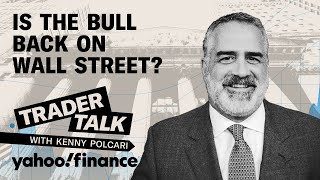
Trader Talk episode (host Kenny Polcari) interviewing Mark Newton (Fundstrat) about whether the S&P 500 has peaked or the bull run continues. Kenny argues the market is largely ignoring a government shutdown because fundamentals (stable GDP, low unemployment, manageable inflation) and Fed policy drive markets; Mark emphasizes technicals—seasonality, breadth, momentum, and leadership—saying breadth divergence and sentiment matter. They note equal-weight S&P breakout, sector rotation (financials, healthcare, industrials, transports), AI-driven leadership (MAG7/tech dominance), and watch windows for a choppy period mid-October to mid-November with a possible 3–5% pullback. Kenny also shares a short personal anecdote and the Lutata di Verdure soup recipe (QR code on screen).
Chapters
Foreign. Welcome to Trader Talk, where we dish out the latest Wall street buzz to keep your portfolio sizzling. I'm Kenny Polkari and I'm coming to you live from the Yahoo Finance headquarters in the heart of New York City, a global hub where deals are made, fortunes are built, and the next market move is always just around the corner. Coming up, I'm gonna share my thoughts on the government shutdown and I'm gonna chat with my very good friend Mark Newton. And. And then I'm gonna share my velutate di verdure recipe. Now let's jump into the big take. You'd think with Washington grinding to a halt, that the markets would be panicking. Headlines are screaming about furloughed workers, installed programs and political chaos. Yet the S and P keeps humming. Near record highs, volatility is asleep and traders are acting like there's absolutely nothing happening. So what gives the short answer? The market has seen this movie before and it never ends the way that the headlines predict. Historically, government shutdowns make great tv, but they barely dent corporate profits or consumer demand. Markets trade through them because investors know the political theater always ends the same way with a deal, a press conference and another round of finger pointing. In the meantime, liquidity stays high, early earnings stay on track, and the Fed, not Congress, remains the real driver of market direction. The deeper reason the market doesn't care. Investors have learned to tune out the noise and focus on the data that actually moves money. GDP growth is stable, unemployment is low, and inflation, while sticky, isn't spiraling out of control. At least not yet. For traders, that's what matters. The shutdown may rattle headlines, but it doesn't rewrite the balance sheets. Until it does, the the algos will keep buying. For investors, the takeaway is simple. Don't confuse the drama with danger. Political noise can shake the sentiment, but fundamentals drive returns. Use moments like this to stay level headed while others overreact. History shows that the best trades often come when someone else is distracted by the DC Chaos. The bottom line. The market doesn't care about the shutdown because it knows how the story's going to end. Politicians fight and cameras roll and the market, quiet, quietly keeps moving forward. The smart money knows better than to trade the noise. I would love to introduce you to my next guest, who happens to be a very dear friend of mine and was a former member of the New York Stock Exchange with me for, well, I won't tell you how many years anyway. Mark Newton is now managing director and global head of technical strategy At Fundstrac Global Advisors, Mark is one of the most respected technical analysts on Wall Street. Known for his very deep understanding of market structure, primary price action and investor sentiment. With decades of experience in chart analysis and market forecasting, he helps investors navigate short and long term trends across equities, commodities and the macro assets. His work at Fundstrat provides clients with the tactical edge that they need in fast moving markets. Please, ladies and gentlemen, join me in welcoming Mark to the discussion. Mark, it's a pleasure to have you.
Thanks, Ken.
I love you. You have no idea. I'm so glad that we have this chance to come back together.
You're a warm welcome. So I appreciate all that after all those years.
The floor. So listen, let's talk because there's a lot going on right now, right. So the government shut down all that stuff. But let's first talk about the seasonal patterns and kind of historical data and what that says about fourth quarter performance and market behavior.
Look, seasonally speaking, normally the period between August and October is down. When you have an incumbent president, somebody that's been reelected successfully, usually this period is a little bit better than normally. And that's one thing we have a new leadership. Important to study what happens in seasonality in post election years with a Democratic leadership that's, or really a new change of leadership. And in this case, you know, it's proven to be resilient. And also, let's not forget decennial pattern. You know, we are in the fifth year of a decade that's almost always very, very bullish and very positive.
Well, you know what I find interesting because I was one of those people that thought that, you know, as you move through the summer into August and September, that we were going to have, you know, some market weakness. Not a disaster, but a pullback maybe we had none of it. And I'm wondering if there were a lot of people that were kind of waiting for that opportunity that never came. Now we're into October, you know, you got, we're in the fourth quarter. You got the end of the year coming that you got all these people that were waiting maybe on the side that have all this money to have to put to work. Right, right. And so now. Cause that's what it feels like to me.
Yeah, look, we went from a period of extreme fear in April to now more. You know, I don't really want to be invested. I'll begrudgingly get long, but I don't really believe it. I think tariffs are going to be a big deal. There's going to be inflation. And look, none of that's materialized, none of that. The benefit of using technical analysis, we're always able to ignore all the noise. To your earlier point, you don't want to pay attention to exogenous events. You want to look for leadership. What's happening with cycles, trends, seasonality and most importantly, potentially, you know, sentiment. Are people really, really negative enough to enter to cause a bottom? They were in April. How are they now bullish enough to think that markets can peak out? And I would say the answer to that is, you know, there's still really not all that much evidence either on an institutional side or on a retail side to think that the people are all in and that's going to produce a market sell off.
If the sentiment goes too bullish, that actually could be a contrarian indicator.
Yeah, that's the one indicator you want to always pay attention to. And you know, we have seen some evidence in the last few weeks of sentiment getting a little bit more into like upper neutral territory. Equity put the call got to the mid-40s, that's not a great sign. We see two calls being bought for every put. Normally that can happen. We did see a three day pullback right after Rosh Hashanah. Of course it was short lived, not dissimilar to what we've seen every other month in the last five months. You look at September, you look at August, July, June, three to five day correction and then right back to the races. So is this month any different? I would say the one thing that's interesting to me is that all these people waiting, waiting, waiting, oh, it's going to pull back. It didn't. Now all of a sudden they think we're in Q4, now's the time we can go all in because the worst is behind us. We know the path of the Fed, we know what's going on. Earnings are great, the AI boom is with us. And clearly judging by amd, any of these companies are here in the last couple of weeks very much. Probably in the early innings. You look at what's happened to the quantum stocks, people are like, I can't stand out any longer, I gotta get in.
Right.
And so I am a little more concern that it's probably gonna be a choppier four to six weeks before we truly can make progress between probably November and January, honestly.
Yeah. So I'm still in the camp that look, we're in the second week of October, earnings are gonna start in earnest next week, but you're gonna get Pepsi and Delta Airlines at the end of this week, they're not down named, so it's not officially right. JP Morgan will kick it off. But I am in the camp that while I'm invested, right. I'm not saying to anybody, oh, you should sell your stocks. Not at all. I'm invested and I've been cautious, but I've been cautiously. I continue to invest because I'm looking for the other opportunities. I'm not chasing tech. We already own it. I already own it. I'm not chasing it up here. But there are other places in the market where you can find opportunity.
Yeah. Look to your point, after moving sideways for about two and a half months, the eco weighted S and P literally just moved back to new all time highs last week. So that is your financials, your healthcare, your industrials. We saw a breakout in transports last week. You're finally starting to get health care as an unusual sector. We think there's all this attack on drug pricing and it's gone straight down for about two and a half years in relative terms. But, you know, a healthy bounce at a time when, you know, people say, why is health care bouncing? If anything, it's been biotechnology and honestly that's led as small caps have come back to life. That's really fueled some parts of healthcare that people aren't paying attention to.
Well, I think you're right. But I also think, you know, the deal that Trump made last week with Pfizer, I think was obviously something that helped to light some of the health care names on fire, or at least a sector on fire. Right.
Health care remains in the crossfires of both parties and we honestly need to do something, I would say that's not wrong to think that we want to see drug prices be made more affordable to Americans. So. Sure.
Right. And I think that was, I think that was kind of that, that Pfizer story that came out last week, I think it was very positive and actually I think we saw the sector moved substantially that day or the day after or going into it. There was, you know, all that speculation.
Has taken a willingness to invest in companies that he thinks are viable, that he wants to see survive. And Pfizer along with of course intel, and it's unprecedented. But, you know, it certainly worked. It's helped to buoy our market at a time when everybody thinks we're rolling over.
So I want to do one thing just so the audience understands. Define for them, when you say the equal weight S and P, what the difference between that, what that and the S and P is Right.
Yeah. So let's take the S And P. So 8% is Nvidia.
Right.
6% is Apple. You have about 15% in two stocks alone.
Right. So of the total as a big.
S and P was going up daily. But if you're a portfolio manager investing in industrials, you're getting killed. You can't keep up with because you don't own any Nvidia.
Right.
Or Apple. So you have a small number of stocks that are weighted very heavily in the S and p. You know, 30% is technology, so you have to be able to keep up with the tech move. And it means there's a lot of underperformance, even though correlations are rock bottom. I mean, it's a great environment for stock picking. But if you're not owning technology, you have to really figure out how you're going to keep up if that's your benchmark. So equal weighted, the benefit is that everyone is equal weight across the S and P. So it gives you a much more clearer picture of what is the market doing, so to speak. So when you see the Dow all of a sudden move to new highs, E corded S and P all of a sudden move to new highs, you know, that's encouraging. We want to see the transports do the same thing. For those that are Dow theorists, it'd be great if every little piece of the puzzle was, was moving in the right direction. I think we're, we're getting there. That's a slow process. But, you know, I'm encouraged by what's happened in recent weeks.
But when we talk about the equal weight, what we're talking about is giving every stock in ESP the same weight. So Nvidia is not 8% of the, of the, of the, of the index. So. And that's right. And that's actually where you can see if, if, if traders or investors, if they're looking, you should be looking at what's happening in the equal weight, because that gives you a better view on kind of what's happening in the broader market.
That's right.
Right. All right, so let's talk about momentum indicators. That what that signals for stocks.
Look for those that are unaware. I mean, momentum can be simply defined as, let's say you're tossing a ball up in the air and initially it moves quickly, but then it slows and it starts to drop. And so, you know, stocks do this all the time, year after year. You want to capture stocks as they're starting to move and trending higher when momentum is very Strong when they get to be so called overbought, it's not necessarily a sell signal but you want to pay attention because as they get too overbought like we see now with gold that has an RSI, a relative strength index of about 90, then you know, the upside might not prove to be as promising I think in the months to come. So when they start to fall, you know, momentum goes in and out of favor. So common momentum caters are ones like RSI relative strength index which has a gauge between 0 to 100. Other ones like MACD moving average convergence divergence or more trend following, they don't judge overbought oversold, but they help you to stay on the right side of the trend. And so I encourage people that don't use technicals use a MACD on a weekly basis. When the MACD is positive and particularly on a daily and weekly, you want to stick with that stock when it starts to roll over, then you utilize risk management techniques or whatever, depending on what your timeframe is to make adjustments.
All right, hold that thought one minute because we're going to take a break. We're going to come right back. So let's now talk about breadth and leadership. Right? And are the markets, in your opinion or our investors too dependent on what's happening in the mag seven names?
Well, I think the world is too dependent. I mean these are companies that are dominating with regards to earnings growth. They're the ones that are making the money.
That's right.
People think they're overbought. But let's not forget we haven't seen an AI cycle ever before. So they could easily go to 100 PE right now they're you know what in the low 30s, mid 30s. Who's to say that that being overbought is a reason to sell when we're still in the very ear early innings of AI? Not based on my own thoughts, but based on what every CEO of all these companies continues to say time after time after time on conference calls. Demand is simply overwhelming. So we've had this over the last 100 years. It's happened a dozen times. You look at the generals back in the 30s, General Motors, General Electric, they all dominated the index indices, right? Exxon, Dupont. This is just 2025. It's not 1935 anymore. It doesn't mean necessarily anything is different. It means you have to understand what represents the S and P. And in this case, you know, you have neuter leadership that that's a good thing. These are all companies that are changing our Lives for the better. We shouldn't be upset about, oh, that means it's a bubble. It's more about what are trends, what are what the company's saying specifically. And use that to frame how you invest in the market.
But you know, you can have short term overbought, which all that means to your point is manage your risk, understand that. Don't necessarily go chasing it, give it a chance to digest. Maybe it backs off a little bit. Nothing says it's going to back off 50% but you have to be smart about how you know, how you, how you assess what the market's doing and what these individual names are doing.
Having watched markets for a long, long time, I'll just say that it's rare for overbought conditions to lead to immediate sell offs as quickly as what investors might think. You hear these phrases all over time in the media. Oh, it's overbought, it's over. And it might be overbought maybe on an hourly basis or on a daily basis, rarely on a weekly or a monthly. When they get truly overbought on a monthly, it's time to pay attention. But you know, that's not going to be your be all, end all time frame is important for any investor. Know your time frame, know your risk tolerance, right? Don't put all your eggs into one technology stock. Obviously you want to have some diversification. We're all different and so utilize that kind of risk management that works for you in your own timeframe.
Right? So talk about this. I don't know if you had a chance to even look at this latest announcement we heard this morning. OpenAI and AMD, right, because now AMD was up 35% or something on the back of that news, right, that OpenAI is now going to do what with AMD?
I think in general, anytime that a company opens their mouth and says they're doing significant with OpenAI or any type.
Of AI, you know, but to your point, OpenAI, they get in bed with AMD, they get in bed with Nvidia, they get in bed, but you know, they're in bed with everybody, right? It's kind of a, the thing that's kind of interesting is when you think about it, Nvidia, Jensen Wang, he's involved in almost every one of these deals, whether it's through OpenAI, whether it's through intel, whether it's right. Which makes it interesting on the one hand, but kind of for me raises a little bit of a flag saying, okay, it feels kind of circular to me, right?
We'll, we'll know that when the time comes. I mean, look, I am not one to say let's leave the party early unless I have the proper science. So if you want to stand by the punch bowl and near the exit, that's great. I'm willing to have a few more glasses of punch and hang out with all the AI leaders and talk how we're gonna make money.
Let's talk about what you think the next big signal is gonna be from a technical kind of perspective. Right. What are you looking for? What are the signs of, you know, another look, I was gonna say a potential breakup, but we've clearly broken out.
I think you have to differentiate between short term and intermediate term. I think short term we wanna see evidence when you start to see real breadth, divergence. And we've seen breadth. You know, the percentage of stocks above their 20 day moving average is down about almost half of where it was about three months ago. Okay, that's interesting. It's not a we're gonna sell everything. It just means that tech is working. The rest of the market really hasn't. Now that's starting to slowly change. If we don't see the rest of the market go up materially in October to join tech, that would be a little bit of a concern. If and when we see sentiment start to get more optimistic. My own cycles say mid October to mid November is going to be a choppy period. If we're going to get a correction and I do think we're going to get some sort of a back and fill, I think that's going to be our window is likely November. So short term that's what I'm looking at.
All right, so when you say, when you say a slight correction, 5 to.
8%, 3 to 5%, probably 3 to 5. Very, very difficult to know. All I know is if tech is still working really, really well, very difficult to expect too much, too much. And I want to see tech really start to roll over. That meaning the leaders, the nvidias of the world. I don't mean I want to see it because I'm bearish. I mean if you want to be bearish on the stock market, you need to see evidence of these main leadership stocks within the S and P starting to roll over, starting to fluctuate. We don't see that yet right now for the intermediate term it's more of a longer term where nothing is really working. And 9 out of 10 markets will peak because breadth really starts to roll over. How many stocks are within 20% of all time highs. When that starts to shift, the stock market doesn't peak at all time highs but many, many stocks peak and start to fall off beforehand. So when you start to watch other indicators like that, it will give you a clear warning signal that something is amiss and I really want to pay attention. The cycles that I look at have been bullish since 2022. They show a little bit of a choppy phase coming in 2026. That doesn't mean a bear market. It does mean that after two years of 20% and then potentially this year being up 20%. 20, 20, 20.
Right.
Midterm election years typically are a year when you have to consolidate. So I'm watching but I'm not really taking much action right now to try.
To prepare for that. So the missing jobs report in your mind, is it something to be concerned about? Are you worried about? Are you worried about what the job? The ADP was negative, right? The ADP last week was negative. It was negative 37,000. It was supposed to be plus 50, give me negative. So that was fairly negative. But the jobs report, we didn't get anything. But the jobs report was only supposed to also show 50,000 jobs. So are you concerned?
I try as a principle never to let economic data keep me up at.
Night get in the way.
But I think that, you know, they're all looking at past data. If there's any area that's ripe for regime change, it is taking humans out of the equation with regards to the Fed and replacing it with AI. That could be a non emotional way of managing the economy. And I think that, you know, GDP has been good to your earlier point. Unemployment's been low, the labor market definitely has slowed pretty materially. But people are not firing, they're just stopping hiring. A big difference. So you have, it's sort of a bifurcation within the labor market and it makes it tougher for the Fed to do its job. You have a number of people now within that are all jockeying for Powell spot and that puts the Fed clearly in the line of fire because you have a couple that oh, we definitely should be cutting and oh, it's fine for I don't know what any of us gain in our day to day routine by sitting and listening to these guys talk about. I just find that you have to watch what's priced into the market I think is very important. How many cuts are on the table for what's going to happen. So between now and next summer, let's say a year from now, like next October, we have about four cuts and we have at least one for sure. It's going to happen the end of October this month, another one that likely is going to happen by the end of year. And I think it probably will because the fact that there's no data now, so we don't know. So the Fed clearly wants to be err on the side, I think, of keeping rates easy. Scott Bessant is a genius. I think if he'll do anything in his power to likely juice the economy, keep things running faster, as long as you know, I think inflation doesn't get out of control. And with everything we've seen, crude oil is going to have a short path of $50. How does inflation rear its ugly head if crude goes down and we have the deflationary part of AI that's making everything less expensive as productivity goes up? So those are two important forces to why we shouldn't really care about inflation, even if it has a minor bump. I don't think it's a big deal. And I think we ought to really focus on the labor market. So I'm very much in favor of cutting rates and letting the economy run. So, yeah, that's all I'm going to say about the economics. I think that I'm not an expert in that field, but I certainly like to see what the spreads, what the Fed is talking about when you look at the one year, one year forwards and they're sort of at a higher level right now than the rate cuts have been priced in. So there's a little bit of a divergence there.
Right.
That means the Fed either eventually has to join what the market's saying or we got to strip all these rate cuts out and make them come back to even. And so I don't know what the right answer is there.
Right. I think if we get, I think if we get two more rate cuts, that'll be another 75 basis points that we will have cut on top of the hundred that we cut last year.
Right.
I think that puts us to a place where I think it should be okay. Unless of course, we see the economy go off the edge. Listen, I really appreciate this time. We had to talk. I could talk to you for another three hours, India, but we really can't do that. I gotta get into the recipe of the day that I want you to be part of this. Look, when I was a kid, on Sundays, it always smelled like simmering soups in the kitchen. Right. My mother believed that the secret to good soup wasn't the vegetables of the stock, that it was the slow patience that turned the humble ingredients into something velvety and rich. So the Lutata di Verdure is one of those soups. It's simple. It's just velvety vegetables, right? It's broth. It's a touch of cream, but it feels like a warm hug after a chilly day. Now I remember coming in from raking leaves with cold fingers and red cheeks, and there it was on the stove, bubbling quietly, right? The steam fogging up the kitchen windows. Now when I make it, I take the same unhurried approach. I sweat the shallots, letting the squash soften just enough and then folding in the cream so the whole thing comes together nice and silky and smooth. I like to serve it with toasted baguette rounds, just as my mother did, and always with grated cheese on the side. A bowl of elitate isn't just a meal, it's a way to slow down and remind yourself that good food doesn't have to be complicated, it just needs care. Now you can scan the QR code on the screen for the full recipe and you can thank me later. That's a wrap for today's Trader Talk, but the conversation continues. Subscribe on Apple Podcasts, Spotify, Amazon Music or wherever you get your podcast. You got questions or topics you want covered? Email us@tradertalkahoo inc.com because we're always listening. Until next time, stay sharp, stay disciplined and stay in touch. Take good care.
This content was not intended to be financial advice and should not be used as a substitute for professional financial services.
Sam.
More from Kenny


Wall Street Is Celebrating| But Kenny Polcari Sees A Warning Sign | Kenny Polcari


Stocks Crashed After The Fed Move But Here’s What Investors Missed | Kenny Polcari
9/11 25 Years Later: Bond Market Warning, Oil Above $100 & Fed Rate Hike Fears | Kenny Polcari

Oil Hits $97, Bond Yields Surge & PPI Inflation | Markets Brace for Fed Decision | Kenny Polcari
The Fed Has a New Problem | Oil | Inflation | and Rising Yields | Kenny Polcari

The Fed Never Promised a Rate Hike | But Markets Panicked Anyway | Kenny Polcari

Nvidia Crushed Earnings | but the Biggest AI Opportunity Is Still Ahead | Kenny Polcari